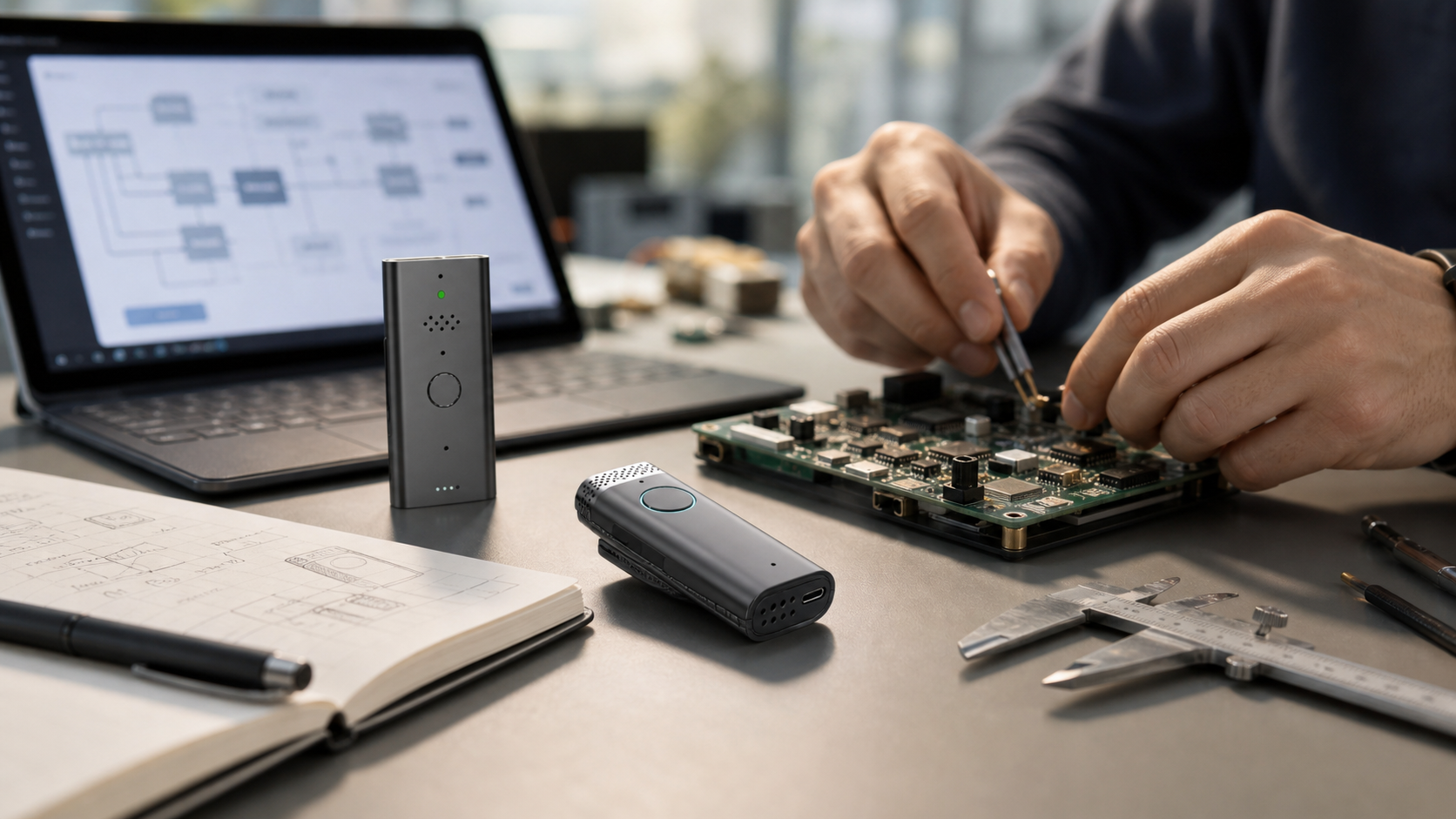
Physical AI is moving artificial intelligence beyond screens and software applications and into devices that can perceive, understand, and interact with the real world.
These systems may include robots, wearable AI devices, smart cameras, autonomous machines, sensor terminals, industrial equipment, and AI-enabled environments. What they share is a combination of physical sensors, AI models, edge computing, connectivity, software, and real-world action. Building a production-ready physical AI product requires effective AI hardware integration across sensors, embedded software, connectivity, and AI platforms.
NVIDIA describes physical AI as technology that enables autonomous systems such as robots, cameras, and vehicles to perceive, reason, and perform actions in the physical world.
However, for companies bringing physical AI hardware to the United States, the key challenge is no longer simply:
Can the device perform the task?
Customers, regulators, procurement teams, and security leaders increasingly want to know:
- Who controls the source code?
- Where is the product developed?
- Where is customer data processed?
- Who holds the firmware signing keys?
- Can an overseas team remotely access the device?
- Can every critical component be traced?
- Who is responsible for testing, updates, repairs, and security incidents?
- Does the U.S. company have real engineering and manufacturing capabilities?
The future of physical AI hardware in the United States will therefore depend on more than product performance. It will depend on trusted sensing, secure software control, auditable supply chains, edge AI, and accountable local operations.
The Key Takeaway
Building trusted physical AI hardware does not necessarily mean replacing every international component immediately.
It means creating a clear operating model in which the company serving the U.S. market controls:
- Product definition
- Core intellectual property
- Source code access
- Device identity
- Security credentials
- Firmware approval
- Remote access
- Customer data
- Final testing
- Product delivery
- Ongoing support
This is the difference between importing a connected device and building a U.S.-controlled physical AI product.
Why Physical AI Companies Need a New U.S. Operating Model
The U.S. regulatory environment does not currently apply one universal rule to every physical AI device. Requirements vary across consumer IoT, connected vehicles, healthcare, defense, telecommunications, critical infrastructure, drones, and other sectors.
However, the direction is increasingly clear.
The Department of Commerce has already adopted supply-chain restrictions for certain connected vehicle hardware and software linked to China and Russia. The FCC’s U.S. Cyber Trust Mark program is creating a voluntary cybersecurity labeling framework for consumer wireless IoT products. NIST guidance emphasizes device identity, access control, data protection, secure software updates, cybersecurity monitoring, and lifecycle management. CISA also encourages technology companies to make security a core product responsibility rather than an optional customer configuration.
These policies do not mean that every component in every physical AI product must be manufactured in the United States.
They do show that the market is moving from simple country-of-origin questions toward deeper questions about control, access, software, data, ownership, and accountability.
Is Final Assembly in the United States Enough?
No.
Final assembly in the United States can provide important operational benefits, including faster customization, local testing, shorter repair cycles, secure software loading, device provisioning, and better quality control.
But final assembly alone does not establish a complete U.S. physical AI capability.
A company may assemble a device locally while an overseas organization still controls:
- The product architecture
- Core source code
- Firmware signing keys
- Remote management servers
- Customer data
- Device credentials
- Software updates
- Critical supplier decisions
In that situation, the physical location of assembly has changed, but the product’s actual control structure has not.
Companies should also be careful when using terms such as “Made in USA” or “Assembled in USA.” The Federal Trade Commission states that an unqualified “Made in USA” claim generally requires a product to be “all or virtually all” made in the United States. An “Assembled in USA” claim also requires the principal assembly to occur in the United States and to be substantial; simple end-stage screwdriver assembly will not necessarily qualify.
For this reason, physical AI companies should distinguish among:
- U.S.-based product development
- U.S.-controlled intellectual property
- U.S. final assembly
- U.S. software provisioning
- U.S. testing and quality assurance
- U.S.-sourced components
- Legally supportable U.S.-origin marketing claims
These are related concepts, but they are not interchangeable.
Can Physical AI Companies Still Use Chinese Manufacturing?
In many commercial projects, yes—provided that the product is not subject to a specific sector, procurement, export-control, or customer restriction.
China remains one of the world’s strongest ecosystems for electronics engineering, component sourcing, tooling, prototyping, PCB assembly, enclosure manufacturing, and production optimization.
The goal should not be to discard that capability without a business reason.
The goal should be to redesign how the capability is used.
A practical operating model may allow an overseas engineering and manufacturing team to support:
- Non-sensitive hardware engineering
- Mechanical engineering
- Tooling and fixture development
- PCB and PCBA production
- Supply-chain sourcing
- Cost optimization
- Prototype manufacturing
- Non-core module development
- Manufacturing quality coordination
- Authorized functional testing
At the same time, access can be restricted around:
- Core application source code
- Production customer data
- Firmware signing keys
- Device root credentials
- Final firmware approval
- U.S. production environments
- Remote control of deployed devices
- Customer-specific security modules
This is not simply an outsourcing relationship. It is a structured division of responsibilities based on data sensitivity, intellectual property, security authority, customer requirements, and regulatory exposure.
The appropriate structure will vary by industry. Companies selling into government, healthcare, defense, critical infrastructure, or other regulated environments should evaluate project-specific requirements with qualified legal, cybersecurity, and compliance professionals.
Who Should Own the Product IP and Source Code?
For a physical AI product primarily developed for the U.S. market, the U.S. operating company should generally control the core product architecture and the intellectual property necessary to operate, maintain, secure, and improve the product.
That usually includes:
- Core system architecture
- Main application source code
- Device management software
- Security architecture
- Customer-specific integrations
- AI orchestration logic
- Production deployment configurations
- Firmware release authority
- Product documentation
- Device identity systems
An overseas team does not necessarily need access to the entire product repository to complete hardware or manufacturing tasks.
Instead, access can be divided by:
- Project
- Component
- Repository
- Interface
- Role
- Sensitivity level
- Development environment
- Time-limited authorization
For example, a hardware team may receive interface specifications, test tools, binary files, reference firmware, or a limited software module without receiving the complete production application.
The important question is not simply where an engineer is located. It is whether access is necessary, limited, documented, monitored, and revocable.
Where Should Physical AI Data Be Processed?
Physical AI devices may collect more sensitive information than traditional business software.
Depending on the product, the device may capture:
- Voice and conversations
- Images and video
- Location information
- Spatial maps
- Worker movement
- Biometric signals
- Equipment activity
- Customer interactions
- Environmental conditions
- Operational behavior
For that reason, physical AI products should be designed around data minimization and clear customer control.
A strong data architecture may include:
- Edge processing by defaultUse on-device AI to filter noise, detect events, classify information, identify wake words, or extract relevant signals before transmitting data.
- Configurable storage locationsAllow customers to select U.S.-based cloud infrastructure, a private cloud, an on-premises server, or another approved environment.
- Limited raw-data retentionAvoid storing continuous audio, video, or spatial information when the use case only requires events, metadata, summaries, or structured results.
- Documented access controlsEvery person or system accessing customer data should have an authorized role, a defined purpose, and an auditable access record.
- Customer-controlled deletion and retentionCustomers should be able to define how long data is retained and when it is deleted.
- Separation between development and production dataEngineers should not automatically receive access to real customer data simply because they contributed to the device or software.
Edge AI is especially valuable in physical AI because it can reduce latency, limit unnecessary data transfer, support offline operation, and create a clearer privacy boundary.
Who Should Control Firmware Updates?
Firmware control is one of the most important—and most frequently overlooked—questions in connected hardware.
NIST’s IoT cybersecurity guidance states that device software should be updateable only by authorized entities through a secure and configurable mechanism. NIST also identifies capabilities such as device identification, access restriction, cybersecurity-state awareness, and secure lifecycle management as important parts of connected-device security.
For U.S.-market physical AI hardware, a secure firmware process should define:
- Who owns the signing keys
- Where the keys are stored
- Who can approve a release
- Who can build production firmware
- Who can publish an update
- Which devices receive the update
- How the device verifies the signature
- How failed updates are handled
- Whether the customer must approve deployment
- How the release is logged and audited
A recommended model is to keep production signing keys and final release authority under the control of the U.S. company or the customer.
An overseas engineering team may help develop or test firmware, but it should not automatically have the ability to push software directly to deployed U.S. devices.
Physical AI systems should also support:
- Signed firmware packages
- Secure boot
- Version control
- Staged deployment
- Rollback or recovery
- Device-level identity
- Update audit logs
- Emergency isolation
- Customer-configurable remote access
Remote access should not be treated as an invisible default. It should be explicitly authorized, limited, logged, and revocable.
Does Every Physical AI Product Need a Complete Robot?
No.
One of the biggest misconceptions about physical AI is that companies must begin by building a humanoid robot, autonomous mobile robot, or complete robotic system.
Complete robots require substantial capital, specialized mechanical engineering, complex safety validation, long certification cycles, field maintenance, spare parts, and a mature service network.
A more practical starting point is often a trusted sensing, interaction, control, or edge-computing terminal that can connect people, AI software, equipment, and robotic systems.
Examples include:
- Wearable AI devices
- Multi-microphone sensing terminals
- First-person vision devices
- Edge AI cameras
- voice agent hardware
- Secure robot-control terminals
- Worker-assistance devices
- AI-enabled communication gateways
- Modular audio and vision sensing units
These products allow a company to enter physical AI without immediately assuming responsibility for an entire robot platform.
Why Wearable AI Devices Are a Strong Physical AI Entry Point
A wearable physical AI device is not primarily a clothing product.
It is a modular human-machine interface that allows an AI system to understand what is happening around a worker and provide assistance at the point of action.
A wearable AI terminal may combine:
- Multiple microphones
- Beamforming and noise reduction
- First-person cameras
- Motion and posture sensors
- Edge AI processors
- Push-to-talk controls
- Speakers or earphones
- Haptic feedback
- Wi-Fi, Bluetooth, LTE, or private-network connectivity
- Local storage
- Secure device identity
- API and SDK integration
The device may help workers:
- Capture instructions hands-free
- Document completed work
- Identify equipment or objects
- Receive step-by-step guidance
- Confirm tasks
- Communicate with an AI agent
- Control a nearby robot
- Escalate an abnormal situation
- Authenticate an action
- Create an auditable work record
Potential applications include logistics, warehouses, field maintenance, security, healthcare, retail, construction, inspection, and industrial service.
Wearable physical AI devices also offer practical manufacturing advantages:
- Relatively limited mechanical complexity
- Modular product architecture
- Lower initial tooling costs
- Small-batch production capability
- High software and system value
- Easier local customization
- A realistic path toward U.S. assembly, testing, provisioning, and repair
Instead of competing directly with complete robot manufacturers, a wearable terminal can become the trusted human sensing and control layer within a larger physical AI ecosystem.
Is 3D Printing Suitable for Physical AI Manufacturing?
3D printing is highly useful during product development and low-volume pilot production, but it is not the ideal long-term process for every component.
It works well for:
- Camera housings
- Microphone enclosures
- Sensor brackets
- Controller cases
- Magnetic mounting structures
- Cable-management parts
- Test fixtures
- Customized low-volume components
It may be less suitable for:
- High-stress clips
- Repeated-flexing structures
- Large skin-contact surfaces
- High-temperature components
- Flame-retardant applications
- High-volume parts requiring tight consistency
Early physical AI manufacturing may combine:
- 3D printing
- CNC machining
- Laser cutting
- Small-batch sewing
- Silicone casting
- Soft tooling
- MJF or SLS printing
- Off-the-shelf electronic modules
After the product design, demand, and unit economics are validated, the company can move selected parts into injection molding, dedicated tooling, automated testing, and higher-volume production.
The manufacturing process should follow the customer and product maturity—not the other way around.
How Should a Physical AI Product Move From Prototype to Production?
A practical path usually includes four stages.
Stage 1: Product and Security Architecture
Before building the enclosure, define:
- Target user
- Operating environment
- Required sensors
- Connectivity
- Edge versus cloud processing
- Data retention
- Software ownership
- Firmware authority
- Device identity
- Security requirements
- Expected pilot quantity
This prevents the team from building a technically impressive prototype that cannot pass customer security or deployment reviews.
Stage 2: Functional Prototype
The goal is to validate the highest-risk assumptions:
- Audio quality
- Camera position
- Sensor accuracy
- Battery life
- Thermal performance
- Connectivity
- Local AI processing
- Ergonomics
- API integration
- Environmental durability
At this stage, 3D printing and off-the-shelf modules are often appropriate.
Stage 3: Paid Pilot
The pilot should test more than whether the device turns on.
It should validate:
- A complete customer workflow
- Measurable operational value
- Data handling
- Firmware update procedures
- Device provisioning
- Serial-number tracking
- Repair requirements
- User adoption
- Support workload
- Willingness to pay
A paid pilot provides stronger evidence than general customer interest.
Stage 4: Controlled Small-Batch Manufacturing
Once the pilot succeeds, the company can introduce:
- Traceable BOM management
- Approved supplier lists
- Final assembly procedures
- Secure software loading
- Key injection
- Functional test stations
- Security testing
- Quality records
- Packaging
- Repair and rework processes
Only after order volume becomes predictable should the company make major investments in tooling, automation, facilities, or dedicated production lines.
What Does a U.S.-Ready Physical AI Manufacturing Partner Actually Provide?
A physical AI manufacturing partner should offer more than component sourcing or assembly labor.A qualified AI hardware OEM/ODM partner can support engineering, sourcing, prototyping, testing, and controlled production without requiring the customer to build a hardware team from scratch.
The partner should help connect product strategy, hardware engineering, software integration, manufacturing, security, and customer delivery.
Depending on the project, GMIC AI can support areas such as:
- Physical AI product architecture
- Wearable AI hardware
- Multi-microphone audio systems
- Voice-capture devices
- Edge sensing terminals
- PCB and PCBA engineering
- Firmware integration
- SDK and API support
- Prototype development
- EVT, DVT, and PVT coordination
- Supply-chain development
- BOM and component traceability
- Functional testing
- Device serialization
- Small-batch manufacturing
- U.S. delivery, repair, and after-sales support
Physical AI products require reliable embedded AI hardware development across PCB design, firmware, radios, sensors, power management, and software integration.
Our role is not to replace a customer’s AI software platform.
Our role is to help the software reach the physical world through reliable sensing, secure connectivity, manufacturable hardware, and a controlled device lifecycle.
For every project, ownership and authority should be defined clearly:
- Who owns the product design?
- Who owns newly developed IP?
- Who controls the source code?
- Who controls the signing keys?
- Who can access production data?
- Who approves firmware releases?
- Who is responsible for certification?
- Who handles customer support?
- Who carries final product liability?
These decisions should be made before mass production, not after a security review exposes gaps.
Frequently Asked Questions About Physical AI Hardware
What is physical AI?
Physical AI refers to AI systems that use sensors, software, computing, and physical devices to perceive, understand, and act in the real world. Examples include robots, autonomous machines, smart cameras, wearable AI devices, and intelligent industrial terminals.
Is physical AI the same as robotics?
Robotics is one major application of physical AI, but physical AI is broader. A device can support physical-world perception, interaction, or control without being a complete robot.
Does physical AI have to run entirely on the device?
No. A physical AI system may combine edge AI and cloud AI. Edge processing is useful for low latency, privacy, offline operation, and data reduction, while cloud systems may provide more advanced models, fleet management, storage, and analytics.
Is U.S. assembly enough to make a device trusted?
Not by itself. Customers also need to understand who controls the IP, source code, device credentials, firmware updates, customer data, remote access, testing, and supply chain.
Can a U.S. physical AI product use components made in China?
In many commercial products, yes, unless a specific law, government procurement rule, industry requirement, or customer policy restricts those components. The company should maintain supplier traceability and separate sensitive software, data, credentials, and release authority from general manufacturing access.
Where should signing keys be stored?
Production firmware signing keys should generally be stored in a controlled environment managed by the product owner or authorized customer. Access should be limited, logged, and separated from normal firmware development.
Why is edge AI important for wearable devices?
Edge AI hardware can process audio, video, sensor, and operational data locally. This can reduce latency, support offline use, lower bandwidth costs, and prevent unnecessary raw data from leaving the device.
What is the best first physical AI product?
For many companies, a modular sensing or interaction terminal is more practical than a complete robot. Wearable AI devices, audio-visual sensing modules, edge AI terminals, and secure control interfaces can reach pilot customers faster and require less capital.
When should a company invest in a U.S. factory?
A company should first validate the product, customer demand, paid pilots, manufacturing process, BOM, margins, security architecture, and expected volume. Manufacturing capacity should expand in response to repeatable demand.
How can GMIC AI help with a physical AI project?
GMIC AI helps AI and robotics companies turn software use cases into manufacturable hardware. We support audio and sensing devices, wearable terminals, firmware and API integration, prototype development, supply-chain engineering, small-batch manufacturing, testing, and ongoing product support.
The Future of Physical AI Is About Trusted Control
The physical AI companies that succeed in the United States will not simply be the companies that manufacture the most devices.
They will be the companies that control the most important parts of the product lifecycle:
- Product definition
- Intellectual property
- Software
- Data
- Device identity
- Firmware releases
- Security
- Customer relationships
- Manufacturing quality
- Ongoing service
The right strategy is not to replace an international supply chain overnight.
It is to combine the strengths of global engineering and manufacturing with a U.S.-controlled structure for product ownership, software authority, data governance, customer delivery, and accountable local operations.
That is how a hardware supplier becomes a physical AI company.
Build Your Physical AI Hardware With GMIC AI
Are you developing a wearable AI device, edge AI sensor, voice-enabled industrial terminal, robot-control interface, or U.S.-market physical AI product?
To evaluate the right development and manufacturing path, start by defining:
- The operational use case
- Required sensors
- Working environment
- Connectivity
- Edge and cloud architecture
- Data restrictions
- Firmware ownership
- Expected pilot quantity
- Certification requirements
- Target production volume
GMIC AI works with AI software companies, robotics teams, and enterprise technology providers to move physical AI products from concept to prototype, pilot, small-batch production, and scalable manufacturing.
Contact GMIC AI to discuss your physical AI hardware requirements and U.S. deployment strategy.