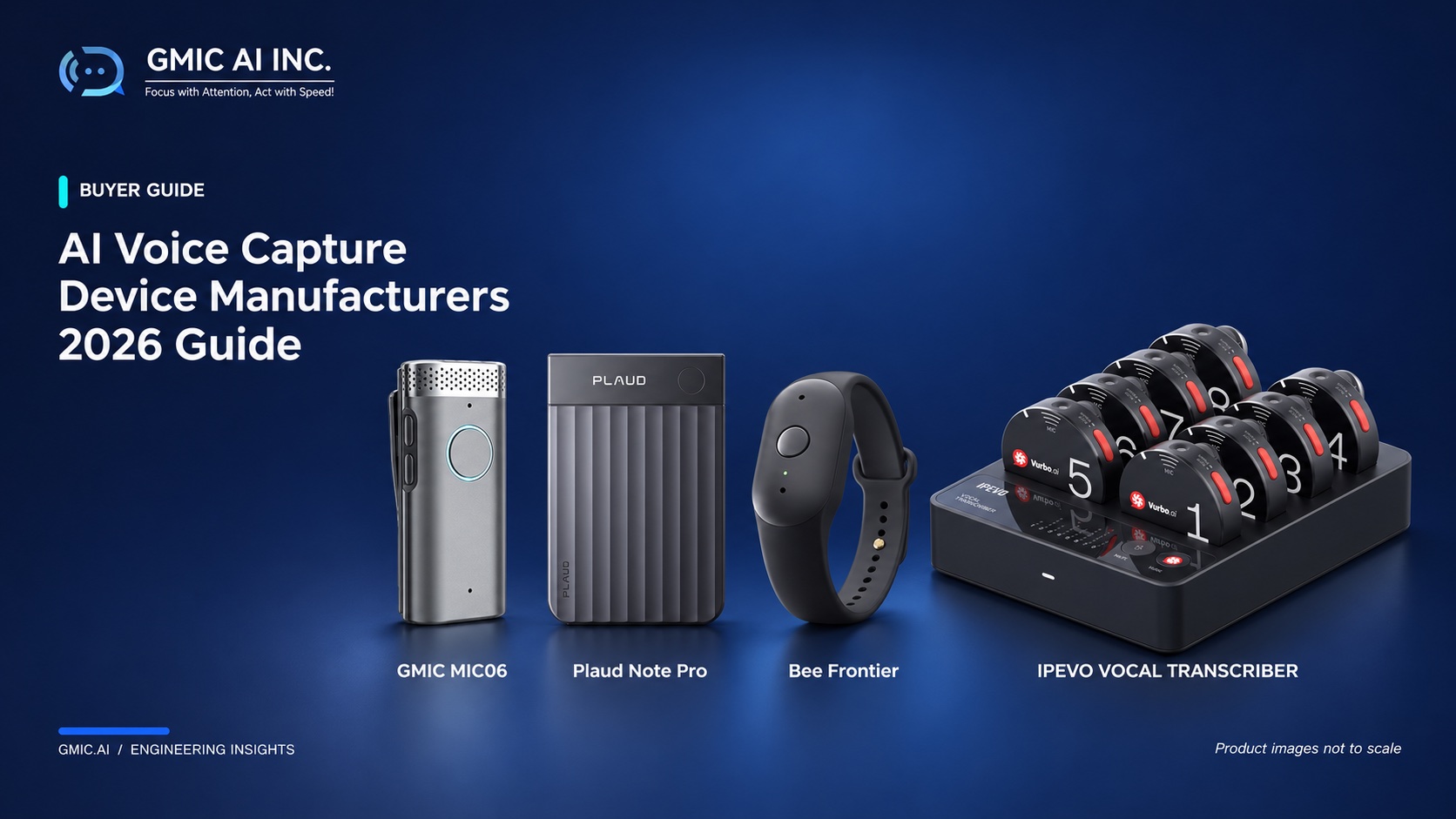
Choosing an AI voice capture device manufacturer starts with one decision: do you need a ready-to-use recorder, or a partner to build hardware for your own product? A packaged device and an OEM/ODM platform solve different problems. This guide compares both routes and explains what to verify before requesting samples or discussing production.
An AI voice capture device records speech for a connected software workflow. Transcription, speaker identification and summaries may run in an app, in the cloud or on supported edge hardware. Do not assume every recorder includes these functions on the device itself.
- Buying a finished device: compare recording behavior, software features, data export, subscriptions and regional availability.
- Launching your own AI product: compare private-label options, firmware control, audio access, integration responsibilities and the path from sample to production.
Published by GMIC.AI, an OEM/ODM provider included in this guide. This is a comparison of product and supplier routes, not an independent hands-on ranking.
Which AI voice capture supplier fits your project?
Evaluate suppliers against your intended workflow rather than a single “best” label. The comparison below separates custom hardware development, packaged recording products and historical examples. Confirm current availability, integration access and commercial terms directly with each provider.
| Provider | Route | Integration & project fit |
|---|---|---|
| GMIC.AI | Voice capture hardware manufacturing, OEM/ODM and private labeling | Audio capture and transfer integration with your own software or platform; hardware and firmware adaptation to fit your workflow |
| Plaud | Packaged AI note-taking devices; developer options | Chosen device, SDK/API eligibility, data workflow and plan requirements |
| Bee | Personal wearable AI | Supported workflow, account requirements, subscriptions and developer access |
| IPEVO | Conference audio and voice capture products | Exact hardware model, paired software, recording/export and room setup |
| Limitless | Historical wearable AI reference | Pendant sales ended December 5, 2025; not a new-device purchasing recommendation |
Tell us how users will record, where the audio needs to go and what you want to customize.
Discuss Your Voice Hardware ProjectAI voice capture manufacturers and brands to evaluate
1. GMIC.AI — OEM/ODM and private-label hardware
GMIC designs and manufactures voice capture hardware and helps software companies integrate that hardware with their own applications and platforms. This includes audio capture and transfer integration, with hardware and firmware adaptation defined around the customer’s software workflow. Its OEM/ODM and integration services connect hardware development, software integration and production.
Suitable starting point: teams developing a branded voice product or connecting capture hardware to their own software. Review the MIC06 voice capture platform as one possible starting point, then confirm the model and configuration against your application.
Before requesting a quote: specify the capture mode, audio transfer path, required changes and intended deployment. MOQ, development fees, certification scope and schedule require a project-specific agreement; customization is not unlimited by default.
2. Plaud — Note Pro and packaged AI note-taking
Plaud Note Pro is a packaged voice recorder within Plaud’s note-taking ecosystem. Plaud also lists wearable products and a Device SDK & API entry point. Developer access should not be confused with permission to redesign or private-label its hardware.
Evaluate when: a finished recorder and its software may meet your needs. Check the selected model, developer terms, audio access, export options and recurring software costs before assuming the integration will fit your product.
3. Bee — personal wearable AI
Bee positions its Frontier wearable AI around conversation summaries, searchable insights and suggested actions. Its site distinguishes hardware options and subscription features. Treat it as a personal AI product route, and assess the account and software workflow alongside the device.
Evaluate when: you want an existing personal assistant experience. For a branded commercial deployment, confirm current developer access, data handling and hardware customization directly; a consumer purchase does not establish an OEM relationship.
4. IPEVO — VOCAL TRANSCRIBER and conference capture
IPEVO VOCAL TRANSCRIBER 8 Mics is listed in its current transcription hardware portfolio. IPEVO also offers other conference audio devices and associated software. Compare exact models and their associated software rather than treating every IPEVO device as having the same AI functions.
Evaluate when: the project centers on meeting-room or shared-space audio. Verify pickup coverage, computer connectivity, recording and export behavior, and whether your required transcription workflow is included or separate.
5. Limitless — a historical wearable example
Limitless’s official notice says Pendant sales to new customers ended on December 5, 2025. It remains relevant to the history of wearable conversation capture, but it should not be presented as an available new-device supplier. Existing users should check current service availability directly.
Private label, OEM or ODM: which route do you need?
Choose the development route by how much of the product must change. Start with a written scope covering branding, enclosure, electronics, firmware and software responsibilities. These labels are used differently across suppliers, so the statement of work matters more than the label.
- Private label: evaluate an existing platform with agreed branding and packaging changes. Confirm exactly which other changes are included.
- OEM: if you already own a design, clarify manufacturing files, testing requirements, design ownership and responsibility for changes.
- ODM: if you need a platform adapted or developed, define which hardware, firmware and mechanical work the supplier delivers.
Use GMIC’s OEM/ODM development overview to discuss scope. Do not assume that a supplier’s available demonstration is already validated for your environment or ready for your production volume.
What should you ask an AI voice recorder manufacturer?
A useful supplier brief explains the recording environment, data path and acceptance criteria. These six questions help turn a general product inquiry into a sample evaluation that both your software team and the manufacturer can assess.
- How will people record? Define continuous capture or button-triggered notes, wearing position, expected distance, background noise and session length.
- How does your software receive audio? Ask about file formats, local storage, transfer methods, SDK/API documentation and recovery after interrupted connections.
- Where does processing happen? Separate recording, transcription and summarization. Identify which steps run on the device, phone, your infrastructure or a vendor service.
- What can be customized? Request a written list covering logo, packaging, enclosure, button behavior, firmware and electronics, with responsibilities and costs.
- How will the sample be accepted? Agree on representative audio tests, battery tests, connectivity checks and measurable pass/fail criteria before approving production.
- What is the production plan? Confirm MOQ, NRE/tooling, pilot quantities, certification responsibilities, quality controls, lead times, warranty and change management.
Recording permission, privacy and security requirements depend on your deployment. Ask for evidence for the proposed device and data architecture; a general certification logo or marketing statement does not answer every project requirement.
Frequently asked questions
Can I connect a voice capture device to my own AI service?
Potentially, if the selected device and commercial terms provide the audio access and integration path you need. Request documentation and validate a sample with your own software. Do not assume that a transcription feature automatically provides raw audio or unrestricted API access.
Can an AI recorder work without a vendor cloud?
Separate offline recording from offline AI processing. A device may store audio locally but still require a connected service for transcription or summaries. Ask the supplier to map every processing step and confirm the behavior when the phone or network is unavailable.
What should I include in a sample request?
Share your application, preferred capture mode, integration requirements, intended market, approximate pilot quantity and project stage. If you are asking about a specific model, include its name so the team can confirm the correct configuration and sample terms.
Discuss your AI voice hardware requirements
If your project needs branded capture hardware or a connection to your own AI workflow, start with the use case and integration requirements. GMIC can review those inputs with you and discuss a suitable platform or development scope.
Include your preferred model if known, the recording environment and the software you want to connect.
Request a Sample or Discuss OEM/ODMSample availability, fees and project timing are confirmed after requirements are reviewed.
Sources and scope
Official product and supplier pages checked November 5, 2026. This guide does not report comparative laboratory testing. Features, availability and commercial terms can change.
- GMIC — OEM/ODM development scope
- Plaud — Note Pro and developer links
- Bee — wearable AI products
- IPEVO — VOCAL TRANSCRIBER product overview
- Limitless — product availability notice
Cover: editorial composite based on official images of GMIC MIC06, Plaud Note Pro, Bee Frontier and IPEVO VOCAL TRANSCRIBER. Products are not to scale.