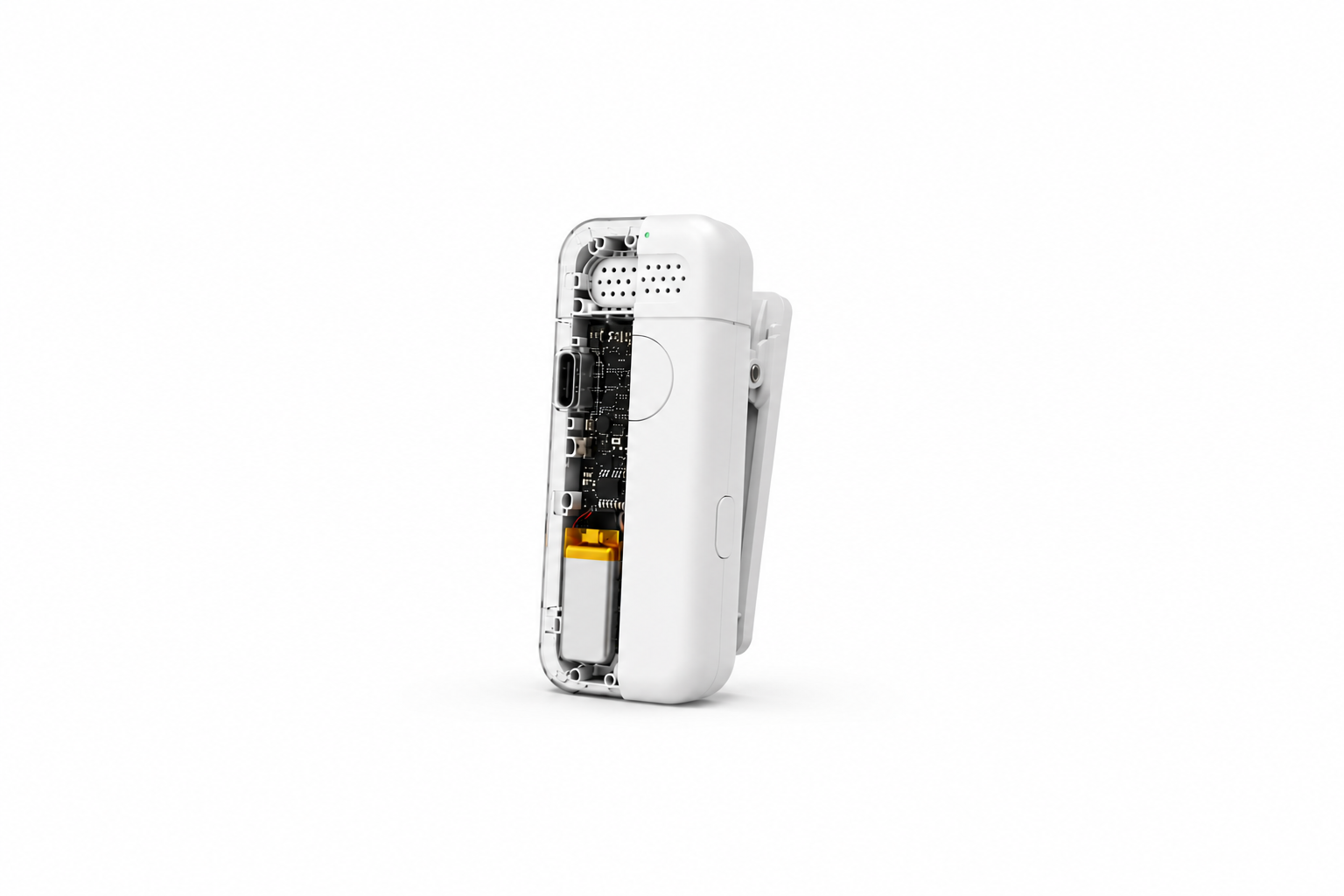
Artificial intelligence has moved far beyond chatbots and cloud-based applications. Today’s AI products increasingly depend on specialized hardware that captures data, processes information, and interacts with the physical world in real time.
From AI-powered meeting assistants and wearable voice recorders to smart glasses and industrial inspection devices, hardware has become the bridge between AI models and real-world environments.
According to Grand View Research, the global AI hardware market is expected to exceed $400 billion by the early 2030s, driven by rapid adoption across healthcare, manufacturing, automotive, and enterprise automation. At the same time, IDC predicts that billions of edge devices will run AI workloads locally rather than relying solely on cloud infrastructure.
For software companies, however, building intelligent hardware is rarely straightforward. Developing electronics, firmware, wireless connectivity, industrial design, manufacturing, and certifications requires expertise that most AI startups simply don’t have in-house.
This is where AI hardware integration becomes essential.
This guide explains what AI hardware integration is, why it matters, the technologies involved, common challenges, and how companies can successfully bring AI-powered devices from concept to production.
AI Hardware Integration: The Complete Guide to Building Intelligent Devices
Artificial intelligence has moved far beyond chatbots and cloud-based applications. Today’s AI products increasingly depend on specialized hardware that captures data, processes information, and interacts with the physical world in real time.
From AI-powered meeting assistants and wearable voice recorders to smart glasses and industrial inspection devices, hardware has become the bridge between AI models and real-world environments.
According to Grand View Research, the global AI hardware market is expected to exceed $400 billion by the early 2030s, driven by rapid adoption across healthcare, manufacturing, automotive, and enterprise automation. At the same time, IDC predicts that billions of edge devices will run AI workloads locally rather than relying solely on cloud infrastructure.
For software companies, however, building intelligent hardware is rarely straightforward. Developing electronics, firmware, wireless connectivity, industrial design, manufacturing, and certifications requires expertise that most AI startups simply don’t have in-house.
This is where AI hardware integration becomes essential.
This guide explains what AI hardware integration is, why it matters, the technologies involved, common challenges, and how companies can successfully bring AI-powered devices from concept to production.
What Is AI Hardware Integration?
AI hardware integration is the process of combining physical hardware, embedded software, connectivity, and AI applications into a complete, production-ready system.
Rather than focusing on a single component, integration ensures that every layer works together reliably.
A typical AI hardware system includes:
- Sensors and microphones for data capture
- Embedded processors and microcontrollers
- AI accelerators or NPUs
- Firmware controlling device behavior
- Wireless communication such as Bluetooth or Wi-Fi
- Cloud services or edge AI models
- Mobile or web applications
- Manufacturing and quality assurance
Unlike traditional consumer electronics, AI devices must continuously balance computing performance, battery life, latency, and user experience.
For example, a wearable AI voice recorder doesn’t simply record audio. It must suppress background noise, maintain Bluetooth connectivity, encrypt recordings, synchronize with cloud services, and deliver clean audio streams for speech recognition—all while fitting inside a compact enclosure that lasts an entire workday.
Why AI Hardware Integration Matters
Many AI startups excel at machine learning, LLM development, or speech recognition, but few possess deep hardware engineering capabilities.
Launching a successful AI device requires expertise across multiple disciplines, including:
- PCB design
- RF engineering
- Embedded firmware
- Audio DSP tuning
- Battery optimization
- Mechanical engineering
- Manufacturing engineering
- Regulatory certifications
Without proper integration, even the most advanced AI software can fail because of poor hardware performance.
Common problems include:
- Excessive background noise
- Unstable Bluetooth connections
- High power consumption
- Device overheating
- Poor microphone placement
- Firmware instability
- Manufacturing inconsistencies
For enterprise AI applications, hardware reliability directly affects customer adoption and long-term product success.
The AI Hardware Integration Stack
A modern AI hardware solution consists of several interconnected layers.
1. Sensors and Data Collection
Every AI device starts by collecting data.
Examples include:
- MEMS microphones
- Cameras
- IMUs
- GPS modules
- Environmental sensors
- Biometric sensors
For Voice AI products, microphone array design often determines transcription accuracy more than the AI model itself.
2. Embedded Processing
Collected data is processed using embedded processors such as:
- ARM Cortex MCUs
- Qualcomm platforms
- MediaTek AI chipsets
- NVIDIA Jetson
- Edge TPUs
- Dedicated NPUs
The processor handles:
- Audio preprocessing
- Wake word detection
- Local inference
- Sensor fusion
- Power management
3. Firmware
Firmware acts as the operating system for embedded hardware.
Responsibilities include:
- Device initialization
- Bluetooth communication
- Wi-Fi networking
- OTA firmware updates
- Power optimization
- Storage management
- Security
Reliable firmware is one of the most overlooked aspects of AI hardware integration.
4. AI Software
The hardware connects to AI applications through APIs or SDKs.
Examples include:
- Speech-to-text engines
- Large Language Models
- Voice assistants
- AI agents
- Computer vision platforms
Depending on the use case, inference may occur:
- Entirely on-device
- At the edge
- In the cloud
- Or using a hybrid architecture
5. Manufacturing
The final stage transforms engineering prototypes into scalable products.
Typical production steps include:
- EVT
- DVT
- PVT
- Certification
- Mass production
- Quality control
Without manufacturing integration, even technically successful prototypes rarely become commercial products.
Common AI Hardware Integration Challenges
Balancing Performance and Battery Life
AI workloads consume significant processing power.
Finding the right balance between responsiveness and battery life remains one of the biggest engineering challenges, especially for wearable devices.
Low-Latency Voice Processing
Voice AI applications require extremely low latency.
Poor microphone placement, inadequate DSP tuning, or unstable wireless transmission can introduce delays that reduce user experience.
Wireless Connectivity
Bluetooth and Wi-Fi must remain stable in real-world environments.
Interference, roaming, and pairing failures often become major customer complaints after launch.
Thermal Management
AI chips generate heat.
Compact devices require careful enclosure design to dissipate heat while maintaining user comfort.
Manufacturing Consistency
Prototype performance does not guarantee production quality.
Component sourcing, tolerance control, testing procedures, and supplier management all affect product reliability at scale.
AI Hardware Integration for Voice AI
Voice AI has become one of the fastest-growing AI hardware categories.
Applications include:
- AI meeting assistants
- Medical AI scribes
- Field service documentation
- Sales coaching
- Smart badges
- AI earbuds
- Smart glasses
- Customer support
These devices require optimized:
- Multi-microphone arrays
- Acoustic chamber design
- Noise reduction algorithms
- Bluetooth optimization
- Long battery life
- Comfortable industrial design
Because speech quality directly impacts transcription accuracy, hardware engineering plays a crucial role in overall AI performance.
Build In-House or Work with an AI Hardware ODM?
Building hardware internally gives maximum flexibility but requires significant investment in engineering, tooling, compliance, and manufacturing.
Working with an experienced AI hardware ODM allows software companies to focus on AI while accelerating product development.
An ODM partner typically provides:
- Hardware architecture
- PCB development
- Firmware engineering
- Audio DSP optimization
- Mechanical design
- Prototype development
- Manufacturing
- Quality assurance
- Global logistics
For many startups, this approach reduces both development risk and time-to-market.
Best Practices for Successful AI Hardware Integration
Organizations that successfully launch AI hardware products often follow several common principles:
- Define hardware requirements before software integration.
- Design for manufacturability from the beginning.
- Prioritize audio quality over adding more AI features.
- Validate prototypes through real-world testing, not only lab environments.
- Plan firmware updates and OTA support before launch.
- Choose manufacturing partners with embedded AI experience rather than general consumer electronics expertise.
Conclusion
As AI moves beyond software into physical products, hardware integration becomes a competitive advantage rather than an afterthought.
Successful AI devices depend on seamless collaboration between embedded electronics, firmware, wireless communication, manufacturing, and AI software.
Whether you’re building an AI meeting assistant, wearable voice recorder, healthcare scribe, or industrial edge AI device, investing in robust hardware integration will reduce development risk, improve user experience, and accelerate commercialization.
Companies that treat hardware and AI as a unified system—not separate disciplines—will be better positioned to bring intelligent products to market.
Frequently Asked Questions
What is AI hardware integration?
AI hardware integration is the process of combining embedded electronics, firmware, connectivity, sensors, and AI software into a complete, production-ready intelligent device.
What is embedded AI hardware?
Embedded AI hardware refers to devices that perform AI-related tasks locally using integrated processors, sensors, and firmware instead of relying entirely on cloud computing.
Why is AI hardware integration important?
Proper integration improves performance, reliability, battery life, and scalability while reducing development risks during product commercialization.
What industries use AI hardware integration?
Common industries include healthcare, field services, manufacturing, logistics, retail, education, public safety, and enterprise productivity.
What is the difference between AI hardware integration and AI hardware development?
Hardware development focuses on designing electronic products, while hardware integration ensures all hardware, firmware, software, connectivity, and AI systems function together seamlessly.
Should AI startups build hardware themselves?
For most startups, partnering with an experienced AI hardware ODM is faster and more cost-effective than building an internal hardware engineering team from scratch.
How long does AI hardware development typically take?
Depending on complexity, developing a production-ready AI hardware device typically takes 6–18 months, including prototyping, validation, certifications, and manufacturing preparation.