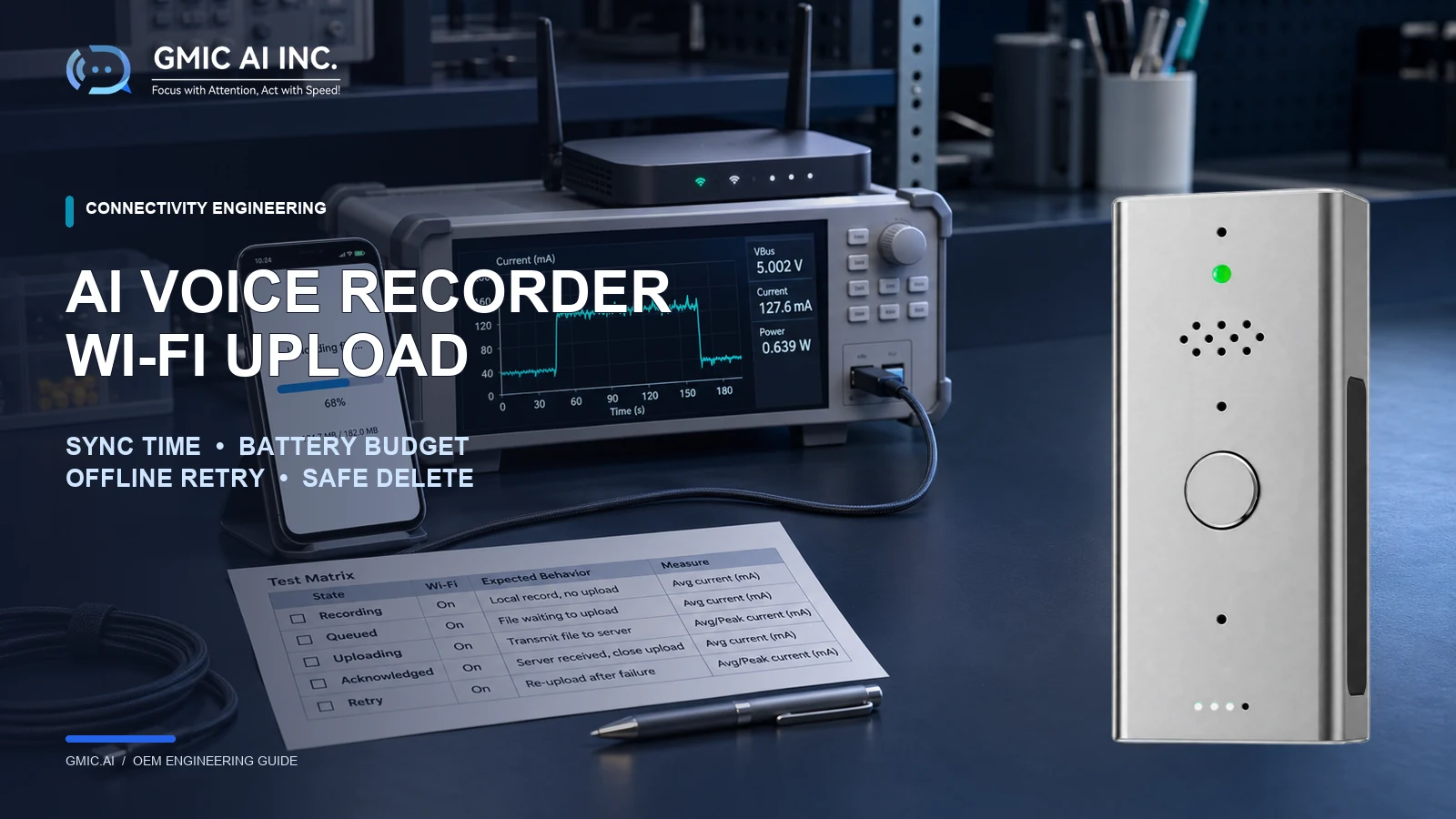
An AI voice recorder should not promise that “one hour of audio uploads in one minute” until the team has defined the audio bitrate, usable Wi-Fi throughput, connection setup time, encryption overhead, retry policy and battery state. A reliable product records locally first, moves each finalized file through a recoverable upload state machine, and deletes the local copy only after an authenticated server acknowledgement.
A reliable AI voice recorder Wi-Fi upload design starts with measurable requirements rather than a best-case radio rate. This guide answers recurring, anonymized buyer questions about Wi-Fi synchronization, direct upload to a private HTTPS endpoint, offline recording, automatic retry and battery impact. It is written for OEM/ODM product, firmware, mobile and backend teams. The numerical examples are engineering calculations, not performance claims for a specific GMIC product; production values must come from measurements on the selected hardware, firmware and network profile.
Why “How fast does one hour of audio sync?” has no single answer
The duration of a recording does not determine its transfer time. File size does.
For a fixed-rate codec:
`file size in megabytes ≈ bitrate in kilobits/second × duration in seconds ÷ 8 ÷ 1,000`
For one hour of audio, illustrative payload sizes are:
| Recording profile | Approximate payload for one hour | What changes the result |
|---|---|---|
| Opus, 32 kbps mono | 14.4 MB | Container, metadata and encryption overhead |
| Opus, 64 kbps mono | 28.8 MB | Same |
| PCM, 16 kHz/16-bit mono | 115.2 MB | Headers and file segmentation |
| PCM, 48 kHz/16-bit mono | 345.6 MB | Headers and file segmentation |
| PCM, 48 kHz/24-bit mono | 518.4 MB | Headers and file segmentation |
FLAC is lossless but variable-rate, so the actual size depends on the signal. Do not turn a typical compression ratio into a guaranteed transfer specification. See the related AI voice recorder audio-format guide for format selection and raw-storage calculations.
Once the file size is known:
`ideal transfer time = file size ÷ measured application throughput`
If a 115.2 MB file moves at a sustained application throughput of 4 MB/s, the payload-only time is about 28.8 seconds. The real user-visible time is longer because the system may also scan, associate, obtain an address, authenticate, negotiate TLS, create an upload session, verify chunks and wait for the backend to commit the object.
The word measured matters. The Wi-Fi PHY rate printed on a chipset or router is not the recorder’s file-upload throughput.
Separate five different “sync time” measurements
A useful performance specification reports more than one timer:
- Wake-to-network-ready: radio start, scan, association, IP configuration and time readiness.
- Network-ready-to-first-byte: DNS, TCP, TLS and application authentication.
- Payload transfer: first audio byte sent to last audio byte accepted by the network stack.
- Server acknowledgement: backend validation, durable storage and receipt creation.
- End-to-end user time: command or automatic trigger to “safely synced” in the app or device state.
Publishing only the fastest of these numbers creates support disputes. A transfer can finish at the socket while the server later rejects the checksum, tenant, credential or metadata. The user should not see “synced” until the product has the acknowledgement required by its data policy.
Choose the upload architecture before optimizing the radio
There are three common paths, and each serves a different product workflow.
| Architecture | Data path | Strength | Main engineering cost |
|---|---|---|---|
| App relay | Recorder → phone → private cloud | Phone handles internet, credentials and UI | Mobile background limits, two transfers and possible extra local copy |
| Wi-Fi Direct / SoftAP | Recorder ↔ phone | Fast local transfer without an existing network | Phone permissions, network switching and platform-specific UX |
| Infrastructure Wi-Fi | Recorder → approved AP → private HTTPS endpoint | Can upload without the phone after provisioning | Credential lifecycle, TLS trust, retry, captive networks and fleet diagnostics |
Android documents Wi-Fi Direct as peer-to-peer connectivity that does not require an access point or internet connection. That does not mean every iOS and Android product can share one identical implementation. Platform permissions, accessory behavior and user interaction must be validated on the supported phone matrix.
Infrastructure Wi-Fi is the clearest match when customers ask for a recorder that uploads to their own endpoint while the phone is off. Wi-Fi Direct is usually a local recorder-to-phone transport, not a direct-to-cloud architecture by itself.
For ownership, provisioning and vendor-dependency questions, use the private-cloud AI voice recorder architecture as the parent design. This article focuses on the upload performance and power contract inside that architecture.
Store-and-forward is safer than continuous upload for many products
A store-and-forward recorder writes audio locally, finalizes a recoverable file or segment, then turns on Wi-Fi for a bounded transfer window. This can:
- preserve recording when the network is unavailable;
- isolate audio capture from variable network latency;
- let the radio sleep between upload sessions;
- batch several files into one association and TLS session;
- give firmware a stable object to checksum and resume;
- avoid treating temporary cloud failure as a recording failure.
Continuous streaming may still be required for live monitoring, remote assistance or real-time transcription. It has a different power, thermal and failure model. Do not use a store-and-forward battery figure to sell a continuously connected product.
The existing local recording versus real-time streaming guide covers that product-level decision. The Wi-Fi upload specification should state which mode is being tested.
Model battery impact with energy per uploaded recording
Battery capacity alone cannot predict runtime. The team needs a current-versus-time trace for each state:
- recording with Wi-Fi off;
- idle with Wi-Fi off;
- scanning and associating;
- connected but not transferring;
- TLS and authentication;
- active upload at several signal levels;
- server wait and verification;
- retry backoff;
- sleep after completion.
For an interval with approximately constant current:
`charge used in mAh = current in mA × time in hours`
For a complete workflow, sum the charge of every interval. A power analyzer or coulomb counter is more useful than one instantaneous current reading.
Illustrative calculation—not a product claim
Suppose a prototype records one hour at an average of 45 mA, then spends 20 seconds connecting at 120 mA and 60 seconds uploading at 180 mA:
- recording: `45 mA × 1 h = 45 mAh`;
- connection: `120 mA × 20/3,600 h ≈ 0.67 mAh`;
- upload: `180 mA × 60/3,600 h = 3 mAh`;
- combined example: approximately `48.7 mAh`, before regulator loss, battery derating and other system loads.
If the same upload repeatedly fails and the device keeps scanning, the retry behavior can consume more energy than the successful transfer. That is why “Wi-Fi only runs for one minute” is incomplete without failure tests.
Espressif’s Wi-Fi low-power documentation illustrates the underlying principle: current depends on how frequently the radio wakes, how long it remains active and the system’s base current. Its published example measurements are chip/platform examples in controlled conditions, not values to copy into a different recorder’s datasheet.
Do not derive runtime by dividing nominal mAh by one lab current
The simple estimate `battery capacity ÷ average current` is useful early, but a released runtime claim needs margins for:
- usable cell capacity at the chosen discharge rate;
- cell aging and cycle count;
- cold and hot operating conditions;
- converter efficiency and cutoff voltage;
- microphone, codec, flash and DSP variation;
- access-point distance, obstruction and interference;
- repeated scans, authentication failures and server timeouts;
- LED, haptic, display and background maintenance load;
- manufacturing tolerance;
- the minimum reserve needed to finalize the active file safely.
The broad voice capture battery life versus weight analysis should remain the site’s general battery-intent page. This Wi-Fi article deliberately targets upload behavior and should link back rather than compete for the same keyword.
Use a persistent upload state machine
Every recording should have a stable identifier and a state that survives reboot. A practical model is:
| State | Meaning | Allowed next step |
|---|---|---|
| Finalized locally | File closed and integrity metadata stored | Queue |
| Queued | Eligible for upload | Connect or wait for policy |
| Uploading | Session and chunk progress recorded | Continue, pause or retry |
| Uploaded, unacknowledged | Payload sent but durable receipt missing | Verify or retry safely |
| Acknowledged | Server confirms the accepted object and identity | Retain or request deletion |
| Deletion authorized | Policy permits local deletion | Delete and verify |
| Deleted | Local payload removed as defined | Preserve non-sensitive audit state |
| Failed/blocked | Human or automated attention required | Recover without losing the source |
Persist the state and upload offset atomically enough that a power loss cannot produce “deleted locally, never accepted by server.” The AI voice recorder file-transfer protocol guide defines chunk IDs, checksums, resume and idempotency in more detail.
Make retries bounded, observable and idempotent
A robust recorder distinguishes temporary failures from permanent ones.
Temporary examples include loss of signal, DNS timeout, server unavailability and a short-lived authentication service failure. Permanent or policy failures may include an invalid device identity, revoked credential, unsupported firmware, rejected tenant or malformed metadata.
The retry policy should define:
- immediate retry count;
- exponential or stepped backoff;
- jitter so a fleet does not reconnect simultaneously;
- maximum radio-on time per session;
- battery threshold below which upload pauses;
- charging-only or trusted-network policies;
- queue order and priority;
- maximum age and capacity of the local queue;
- error codes visible to the app or fleet service;
- recovery after reboot and after credentials are renewed.
Idempotency prevents duplicate cloud records when the recorder retransmits after losing the server’s acknowledgement. The backend should use the stable recording ID, device identity and upload version to return the same accepted result for the same object rather than creating another recording.
Server acknowledgement must mean durable acceptance
Define the acknowledgement contract precisely. A successful HTTP response should not merely mean that a gateway read the last packet. Depending on the product, it may need to confirm:
- authenticated device and tenant;
- expected recording ID;
- accepted byte count;
- whole-file or manifest hash;
- required metadata and format version;
- durable object storage or committed queue handoff;
- replay and duplicate handling;
- receipt ID and server timestamp.
HTTP semantics are standardized in RFC 9110 and modern TLS in RFC 8446, but using HTTPS does not define the application receipt or deletion policy. Those are product requirements.
Delete locally only after the policy’s confirmation point
Customers often ask for “upload successfully, then delete.” That sentence needs four decisions:
- Does “success” mean uploaded, checksum-verified, stored durably or processed by transcription?
- Is deletion automatic, server-authorized or user-authorized?
- What happens if the acknowledgement is received but deletion fails?
- What non-sensitive evidence remains to prevent re-upload or support an audit?
Do not let a weak connection, duplicate command or reboot delete the only valid copy. Conversely, do not retain sensitive recordings indefinitely because the server never advances a state. Define retention limits, storage-full behavior and an escalation path.
Protect credentials without creating a vendor dependency
Direct HTTPS upload normally requires more than a shared API token compiled into every unit. The product should define:
- per-device or per-tenant identity;
- credential provisioning at the factory or during ownership claim;
- secure storage boundary;
- certificate or token rotation;
- server certificate validation and clock requirements;
- revocation and replacement;
- what survives reset and what is erased;
- who operates the endpoint and OTA signing infrastructure.
NISTIR 8259A identifies device identification, data protection, secure software update and cybersecurity state awareness among the core capabilities that manufacturers should consider for IoT devices. The exact implementation depends on the threat model and selected silicon.
See the related secure boot and key provisioning guide and factory reset and secure erasure guide for lifecycle details.
Test difficult networks, not only a lab router
The validation matrix should include:
- strong, medium and edge-of-coverage signal;
- 2.4 GHz congestion and Bluetooth coexistence;
- wrong password and changed credentials;
- access point unavailable at boot;
- DHCP and DNS failure;
- captive portal or network without internet access;
- TLS certificate error and incorrect device time;
- server 4xx and 5xx responses;
- throttled upload and connection reset at several offsets;
- router reboot during transfer;
- device reboot during upload and during acknowledgement storage;
- nearly full local storage;
- low battery and charging transitions;
- a queue containing many small files and several large files;
- simultaneous reconnect of a representative fleet.
Report p50 and worst-case or high-percentile values, not only one best run. Record file size, signal level, access point, phone if used, firmware, backend version, battery state and thermal state with each result.
OEM/ODM acceptance table
| Requirement | Evidence before approval |
|---|---|
| One-hour sync time | Measured per audio profile and network condition |
| Wi-Fi energy cost | Current trace and charge used per completed upload |
| Offline recording | Files remain recordable and queued without a network |
| Retry | Transfer resumes or safely restarts after controlled interruptions |
| Duplicate handling | Repeated upload produces one logical cloud object |
| Integrity | Accepted object matches the finalized local recording |
| Acknowledgement | Receipt contract is documented and tested |
| Safe deletion | Local copy is removed only after the defined confirmation point |
| Queue recovery | State survives reboot, full storage and credential renewal |
| Security | Endpoint validation, credential storage and rotation are reviewed |
| App/platform support | Supported iOS/Android flows are tested, not inferred |
| Diagnostics | Error reason, retry count and queue status are available without exposing audio |
Questions to answer before quoting firmware scope
- Which audio profiles and maximum file durations must upload?
- Is the path app relay, Wi-Fi Direct, SoftAP or infrastructure Wi-Fi?
- Must upload work while the phone is off?
- Is recording allowed to continue during upload?
- What is the minimum sustained application throughput on the supported matrix?
- What is the maximum acceptable time from recording stop to durable acknowledgement?
- How much battery may one hour of recording plus synchronization consume?
- Which failures pause upload, and which require user action?
- What local queue depth and retention period are required?
- What proves that the server received the correct complete object?
- Who authorizes deletion, and what happens if deletion fails?
- Who owns device credentials, endpoint configuration and OTA signing?
- Can endpoint and credentials rotate without returning the unit to the factory?
- Which diagnostics can support a failed field unit without revealing recorded content?
- Which network, temperature, battery-age and interference conditions are part of acceptance?
Frequently Asked Questions
How long should one hour of audio take to upload over Wi-Fi?
Calculate the file size from the actual codec and bitrate, then divide by measured application throughput and add connection, TLS, server-verification and retry time. Recording duration alone is insufficient.
Is Wi-Fi Direct the same as direct cloud upload?
No. Wi-Fi Direct creates a nearby peer-to-peer connection, commonly between the recorder and a phone. Direct cloud upload normally uses infrastructure Wi-Fi and an authenticated internet or private-network endpoint.
Should the recorder upload while it is recording?
Only if the product requires it and the hardware can prove audio integrity, thermal stability, power life and storage behavior under simultaneous load. Store-and-forward is simpler for many offline-first products.
How much battery does Wi-Fi synchronization use?
It depends on connection time, active current, throughput, signal quality, retries, processor work and power-management mode. Measure charge over the complete workflow rather than quoting one Wi-Fi current value.
Can the device delete a file immediately after HTTPS upload?
It should wait for the product’s defined durable acknowledgement and pass any required integrity checks. The deletion command and resulting state must survive duplicates and power interruption.
What happens when Wi-Fi is unavailable?
The recorder should finalize locally, place the recording in a persistent queue, back off without draining the battery, and retry under a documented policy. Queue capacity and full-storage behavior must be specified.
Turn “automatic sync” into a measurable engineering contract
Automatic Wi-Fi upload is not one feature. It is a chain of capture, local storage, network setup, authentication, transfer, integrity verification, server acknowledgement, retention and deletion states. The product is reliable only when every state has an owner, a timeout, a recovery path and measurable acceptance evidence.
GMIC helps product teams translate these requirements into chipset selection, battery and antenna budgets, firmware state machines, mobile integration, private-cloud interfaces and EVT/DVT/PVT validation. The goal is not the fastest lab screenshot; it is predictable delivery of every authorized recording under the networks the product will actually encounter.
Authoritative references
- Espressif ESP-IDF: Introduction to Low Power Mode in Wi-Fi Scenarios
- Espressif ESP-IDF: Wi-Fi API Reference
- Android Developers: Create P2P Connections with Wi-Fi Direct
- IETF RFC 9110: HTTP Semantics
- IETF RFC 8446: The Transport Layer Security Protocol Version 1.3
- NISTIR 8259A: IoT Device Cybersecurity Capability Core Baseline