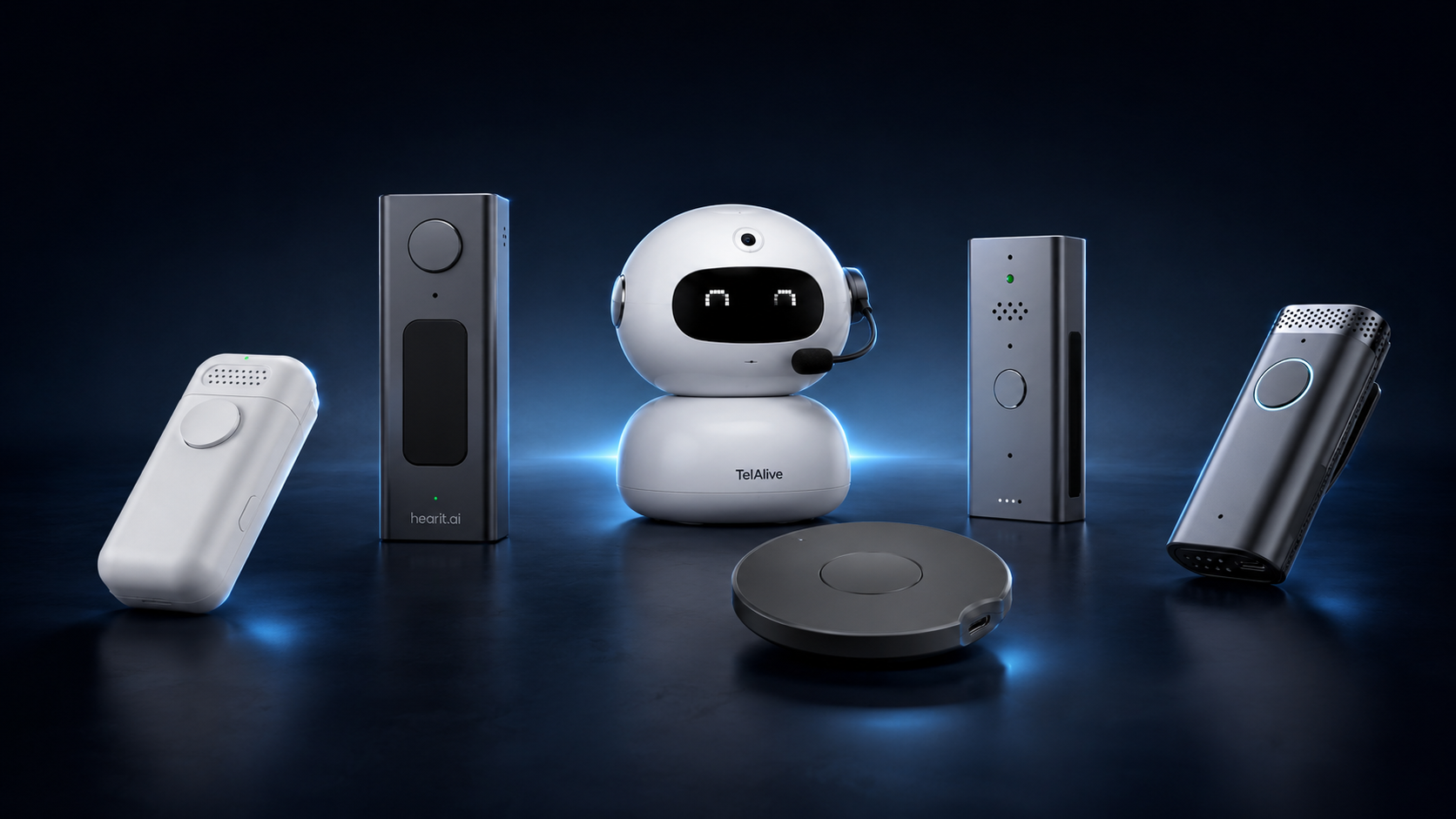
Voice capture battery life is the constraint that decides most wearable audio designs, and it is almost never published in a form you can compare. The device has to last a full shift, and it has to be light enough that people actually wear it. Those two requirements pull against each other, and spec sheets rarely tell you by how much.
We pulled the published specifications for eight shipping voice capture devices in the Hearit.ai hardware line and normalised them to a single figure: milliamp-hours consumed per hour of recording. The result shows the tradeoff more clearly than any datasheet column.
Voice capture battery life across eight devices
| Model | Weight | Battery | Working time | Draw | Radio |
|---|---|---|---|---|---|
| HA-MIC01B | 7.0 g | 80 mAh | 8 h | 10 mAh/h | BT 5.2 |
| HA-MIC01C | 8.8 g | 80 mAh | 8 h | 10 mAh/h | BT 5.4 |
| HA-MIC02 | 30.0 g | 70 mAh | 6 h | 12 mAh/h | BT 5.2 |
| HA-PEN01 | 30.0 g | 160 mAh | 15 h | 11 mAh/h | — |
| HA-MIC04 | 36.0 g | 650 mAh | 10 h | 65 mAh/h | BT 5.3, Wi-Fi02.1 |
| HA-MIC05 | 50.5 g | 950 mAh | 10 h | 95 mAh/h | BT 5.3, Wi-Fi02.1 |
| HA-MIC06A | 56.5 g | 1000 mAh | 9 h | 111 mAh/h | — |
| HA-TR01 | 82.0 g | 1200 mAh | 3 h | 400 mAh/h | BT 5.3, Wi-Fi02.1 |
Wi-Fi costs about six times the power of Bluetooth
The five Bluetooth-only devices average 31 mAh per hour. The three devices that add Wi-Fi average 187 mAh per hour — roughly a sixfold increase.
This is the single biggest decision in a voice capture design, and it is made long before anyone thinks about battery size. HA-MIC01B records for 8 hours on an 80 mAh cell and weighs 7 grams. HA-TR01 carries fifteen times the battery at 1,200 mAh and still only reaches 3 hours, because it is streaming over Wi-Fi rather than buffering locally.
The engineering implication: if a device needs to stream audio continuously, budget for a battery an order of magnitude larger, and accept the weight that comes with it. If the workflow can tolerate recording locally and syncing later, the entire power envelope changes.
Weight is mostly battery
Across the eight devices, weight ranges from 7 g to 82 g — a factor of twelve — while battery capacity ranges from 70 mAh to 1,200 mAh, a factor of seventeen. The two track each other closely, because in a device this small the cell dominates the mass budget.
This matters for adoption. A 7 g clip-on microphone disappears on a lapel. An 82 g unit is a deliberate object that someone has to decide to carry. In clinical and field service deployments we have seen the weight threshold matter more than the feature list, because a device that gets left in a drawer records nothing.
Local storage changes the calculation
HA-MIC05C illustrates the alternative path. It pairs a TDK T5838 omnidirectional MEMS microphone with 1 GB of SD NAND storage and Bluetooth 5.3, plus a dedicated 2.4 GHz channel used only to transfer stored recordings. Audio is captured and written locally; the radio runs in bursts rather than continuously.
That architecture keeps the device at 50.5 g with a 950 mAh cell while avoiding the continuous-stream power penalty. It also removes the dependency on network availability at the moment of capture, which in hospital corridors and warehouse floors is not a minor consideration.
How to specify voice capture battery life
- Decide stream versus store-and-forward first. This sets the power envelope, and therefore the battery, and therefore the weight. Reversing this order leads to redesign.
- Define the real duty cycle. “All-day” rarely means eight hours of continuous recording. A device recording 40% of a shift has a very different battery requirement.
- Set a weight ceiling based on how it is worn. Lapel and badge mounting tolerate far less mass than a handheld or belt-clipped unit.
- Check the radio generation. The devices above span Bluetooth 5.2 through 5.4; newer revisions offer meaningful power improvements for intermittent transfer patterns.
Why this matters for AI voice products
Transcription accuracy is set at the microphone, not at the model. A device that runs out of battery mid-shift, or that users decline to wear because of its weight, produces no audio for the model to work with. Voice capture battery life is therefore upstream of every accuracy metric a voice AI product reports.
GMIC AI builds voice capture hardware for AI software teams, from acoustic front end through certification and volume production. If you are scoping a device and need to pressure-test the power and weight budget before committing to an industrial design, talk to our engineers.
Further reading
- Voice AI hardware: the acoustic front end and why it sets the accuracy ceiling
- Audio DSP tuning for voice AI — beamforming and far-field capture
- AI wearable device development — industrial design and comfort constraints
- MIC05 secure AI voice recorder
References
- Device specifications published at docs.hearit.ai, retrieved 16 September 2026.
- TDK InvenSense, T5838 MEMS microphone — analogue-to-digital MEMS microphone specifications.
- Bluetooth SIG, Bluetooth Core Specification — radio generation feature differences.