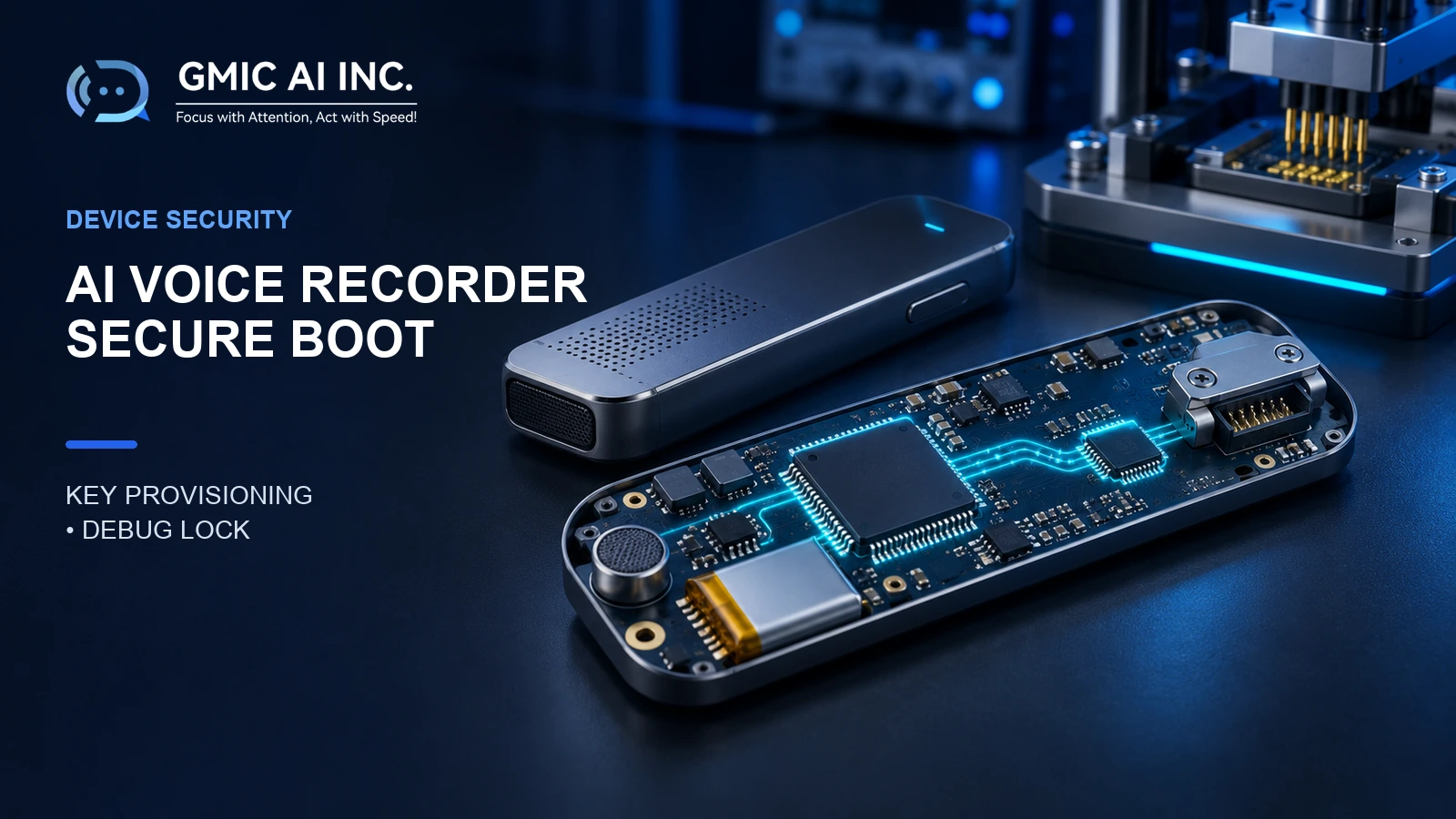
Secure boot for an AI voice recorder is not a single checkbox in a chipset datasheet. It is a chain of decisions covering the immutable boot root, firmware signatures, device identity, key provisioning, debug access, recovery, anti-rollback and the factory records needed to prove that every shipped unit was configured correctly.
This guide translates those decisions into an OEM/ODM production plan. It is based on recurring, anonymized buyer questions about eFuse and OTP support, read protection, JTAG/UART/USB exposure, multiple signing-key slots and customer ownership of production keys. It does not disclose customer identities, commercial terms or project-specific secrets.
Start with the threat model and ownership model
Before selecting a secure MCU or SoC, define what the product must resist:
- unauthorized firmware installed through OTA, USB, UART or a boot strap;
- firmware copied from external flash or extracted through a debug port;
- one compromised unit revealing credentials usable on every other unit;
- rollback to an older signed image with a known vulnerability;
- unauthorized factory overproduction using valid production material;
- a lost signing key making future updates impossible;
- a contract manufacturer retaining the ability to sign customer firmware;
- service tools that bypass the controls applied to ordinary users.
Also define who owns each trust anchor. The brand may own firmware-signing keys and device certificates even when the ODM builds firmware and operates the line. The contract should separate key ownership, permission to use a key, custody of the signing service, and access to production records.
Secure boot establishes which code may run. It does not by itself encrypt stored recordings, authenticate a mobile app or secure a cloud API. Those controls should connect to the same device lifecycle but remain separate requirements.
What secure boot actually verifies
A typical embedded chain of trust works like this:
- An immutable boot ROM or hardware-protected first stage starts at reset.
- It reads a trusted public-key hash or root-of-trust value from ROM, OTP, eFuse or locked secure storage.
- It verifies the signature and policy of the next boot stage.
- Each verified stage authenticates the next component before execution.
- The application runs only if the complete chain is valid and the image version satisfies anti-rollback policy.
The private signing key should not be stored in the recorder or embedded in factory firmware. The device normally stores a public key, certificate or digest that can verify a signature but cannot create one. Espressif’s secure-boot documentation, for example, describes storing a public-key digest in eFuse while keeping the private key in a protected signing environment. Arm’s Platform Security Architecture similarly describes a root-of-trust public key or hash held in immutable or one-time-programmable storage.
An OEM acceptance test must prove more than “secure boot enabled.” It should demonstrate that the production unit:
- boots a correctly signed release image;
- rejects an unsigned image;
- rejects an image signed by an unauthorized key;
- rejects a modified image whose signature no longer verifies;
- enforces the intended rollback policy;
- enters a defined recovery state rather than exposing an unrestricted loader.
eFuse, OTP and locked flash are policy anchors—not secret vaults by default
One-time-programmable memory is useful for storing device lifecycle state, public-key digests, revocation bits, debug policy and sometimes device-unique secrets. Its exact behavior is chip-specific. Some fields can be written only once; some can be read-protected; some locks affect an entire block; and some lifecycle transitions cannot be reversed.
That irreversibility is valuable only after the configuration has been verified. NXP’s secure-provisioning guidance recommends programming lifecycle and debug locks after secure boot has been proven functional. Infineon’s PSoC documentation likewise distinguishes development and secure claimed lifecycle states and describes production provisioning in a secure facility.
For every candidate MCU or SoC, request a written matrix:
| Control | Questions to answer before design freeze |
|---|---|
| Root of trust | Where is the trusted public-key hash stored, and can it be changed? |
| Key slots | How many roots or signing-key digests are supported? |
| Revocation | Can a compromised key be revoked without bricking valid units? |
| Anti-rollback | What monotonic counter or version policy is available? |
| Flash protection | Does the platform support authenticated boot, encryption, readout protection or all three? |
| Debug policy | Can JTAG/SWD be disabled, authenticated or conditionally reopened? |
| Boot interfaces | Can UART, USB DFU and alternate boot pins be restricted in production? |
| Unique identity | Is there a hardware unique key, device ID or secure-element option? |
| Lifecycle | Which transitions are irreversible, and how are failed units handled? |
Do not infer that “eFuse supported” means recordings, credentials or firmware are automatically protected.
Use separate keys for separate jobs
A practical architecture avoids one universal secret. Typical roles include:
| Key or credential | Purpose | Recommended ownership and location |
|---|---|---|
| Firmware signing key | Authorizes bootable and update images | Brand-controlled HSM or protected signing service |
| Secondary/rotation signing key | Allows planned rollover or emergency recovery | Separately controlled and tested before shipment |
| Per-device identity key | Authenticates one recorder to an app or backend | Generated or injected per device; private portion non-exportable where possible |
| Storage encryption key | Protects recordings at rest | Device-bound derivation or wrapped per-device key |
| Session/transport keys | Protect BLE, Wi-Fi or application sessions | Derived during authenticated pairing or connection |
| Factory authorization credential | Permits a bounded provisioning operation | Short-lived, line-specific and auditable |
A shared key compiled into every unit creates a fleet-wide failure domain. If one product is extracted successfully, every product using the same secret may be exposed. Per-device credentials limit the blast radius and allow individual revocation.
The brand should also decide whether the ODM may sign release firmware, only submit unsigned artifacts to a customer signing service, or use a delegated service whose audit logs and permissions remain under customer control.
Plan key rotation before the first production run
Two signing-key slots are useful only if the boot policy and update flow can use them safely. A workable rotation sequence might be:
- Ship devices trusting current key A and reserved key B, or a root that can authorize key changes.
- Deliver a signed transition image that activates or installs trust in key B.
- Confirm fleet adoption and recovery coverage.
- Begin signing releases with key B.
- Revoke key A only after the accepted migration threshold and recovery plan are satisfied.
Test the same sequence on production-equivalent devices. Include interruption, low battery, corrupt update, partial fleet rollout and an app version that does not yet understand the new key identifier.
Key rotation is related to—but not identical to—the AI voice recorder OTA firmware update workflow. OTA moves an image; secure boot decides whether that image is authorized to run.
Lock debug access without destroying serviceability
JTAG, SWD, UART consoles, USB DFU and vendor ROM loaders are useful during development and dangerous when left unrestricted in production. A debug interface may expose memory, firmware, cryptographic operations or boot-policy configuration even when the application itself is well protected.
Production options commonly include:
- permanently disabling debug access;
- enabling authenticated debug with a controlled challenge-response process;
- limiting access by lifecycle state;
- allowing a destructive unlock that erases user data and secrets;
- using a separate service image signed under a restricted service policy.
The right choice depends on repair, returns and regulatory obligations. “Disable JTAG” is incomplete if UART boot, USB recovery pads, test points or alternate boot straps still provide an easier path. Review the PCB, fixture, boot ROM and enclosure together.
Do not rely on removing a connector. Test pads can still be reached. Conversely, do not burn irreversible debug locks on early engineering boards unless the team accepts that those boards may become unrecoverable.
Secure factory provisioning step by step
Production provisioning is where abstract security becomes an auditable process. A robust line flow can include:
- Authenticate the station and operator to the provisioning service.
- Read the silicon identifier and verify that the unit is expected on this work order.
- Load a signed provisioning image or enter the approved vendor lifecycle.
- Generate a device key on-chip, or inject a uniquely assigned credential through a protected channel.
- Store only the public certificate or required association in the backend.
- Program the secure-boot root, lifecycle, rollback and debug policies.
- Flash the customer-approved production image.
- Reboot and run positive and negative secure-boot tests.
- Verify that forbidden interfaces and readout paths are closed.
- Record a non-secret provisioning result tied to serial number and work order.
- Remove temporary factory authorization and place the unit in the final lifecycle state.
The line should never export private fleet credentials into an ordinary CSV or log. A factory record may contain the serial number, public certificate fingerprint, firmware version, policy version, station ID, timestamp and pass/fail result without containing the secret itself.
Decide where device keys are generated
There are three common patterns:
On-device generation
The secure element or MCU generates a private key internally and returns only a public key or certificate request. This can reduce exposure because the private key never crosses the fixture. It requires reliable entropy, supported key-generation APIs and a certificate enrollment flow.
Secure injection
A protected service creates a unique credential and sends it through an authenticated provisioning path. This may be required by a selected ecosystem or legacy backend. The process must prevent line logs, fixture memory or operator tools from retaining the secret.
Hardware-derived identity
A hardware unique key or silicon-bound secret derives device-specific keys. The design must specify the derivation function, key separation, reset behavior and whether the raw hardware secret is ever readable. A chip identifier printed on a label is not equivalent to a cryptographic device secret.
Whichever method is selected, the backend should be able to revoke one device without rotating the entire fleet.
Secure boot, flash encryption and recording encryption solve different problems
These controls are often confused:
| Control | Primary protection | What it does not guarantee |
|---|---|---|
| Secure boot | Only authorized firmware executes | Confidentiality of firmware or recordings |
| Firmware/flash encryption | Reduces usefulness of copied external flash | Authorization of the code unless combined with signature verification |
| Recording encryption | Protects stored user audio | Integrity of the boot chain |
| Authenticated BLE/Wi-Fi session | Protects data in transit and peer identity | Security of audio already stored on the device |
| Debug lock | Restricts privileged physical access | Protection against every software vulnerability |
A recorder containing sensitive speech usually needs several of these controls. The factory reset and secure erasure guide explains why deleting an index is not the same as making encrypted audio unrecoverable. The private-cloud voice recorder architecture covers ownership of the service path beyond the device.
Design anti-rollback and recovery together
Signature verification alone may accept an older, correctly signed but vulnerable release. Anti-rollback compares the image security version with a monotonic device policy and rejects versions below the permitted floor.
Before advancing an irreversible counter, confirm that:
- the new image has booted and passed health checks;
- the recovery slot is compatible with the new floor;
- required bootloader and application versions move together safely;
- factory rework tools cannot reinstall a prohibited version;
- the customer understands when rollback will become impossible.
Recovery should accept only authenticated artifacts. A “safe mode” that exposes unrestricted USB flashing defeats the production trust model. If recovery uses a separate key, document who owns it and how it can be rotated or revoked.
Protect the signing system, not just the device
A secure MCU cannot compensate for a leaked release-signing key. The release process should include:
- signing in an HSM or controlled service rather than on developer laptops;
- role separation between build approval and signing approval;
- immutable logs of artifact hash, signer, time and key ID;
- access review and removal when staff or suppliers change;
- offline or separately controlled recovery material;
- documented key-loss and key-compromise procedures;
- reproducible linkage between source revision, build artifact and signed release.
The ODM can integrate this process without possessing the customer’s long-term private key. One approach is for the ODM to deliver a reproducible unsigned image and manifest; the customer service verifies the artifact and returns the signed package.
Production acceptance matrix
| Test | Required evidence |
|---|---|
| Authorized release | Production device boots the approved signed image |
| Unauthorized signer | Device rejects an image signed by an untrusted key |
| Modified image | One-byte modification causes verification failure |
| Rollback | Image below the permitted security version is rejected |
| Recovery | Corrupt primary image enters authenticated recovery |
| Readout | Locked production unit resists the defined flash/debug read procedure |
| Alternate boot | UART, USB and strap-based loaders follow production policy |
| Device uniqueness | Two units do not share the same private identity credential |
| Key rotation | Staged transition from key A to key B succeeds and key A can be revoked |
| Factory record | Serial, public fingerprint, policy and firmware version reconcile |
| RMA flow | Service access does not expose retained recordings or fleet keys |
Keep a small set of deliberately misconfigured negative-control units. They prove the test system can detect an unlocked debug port, wrong root, duplicated identity or missing rollback policy rather than reporting “pass” for every unit.
Questions to put in an OEM/ODM security specification
- What immutable component begins the chain of trust?
- Where is the root public-key hash stored?
- How many signing-key slots and revocation mechanisms exist?
- Who owns and operates the production signing service?
- Are private device keys generated on-chip, injected or derived?
- Can one device be revoked independently?
- Which JTAG, SWD, UART, USB and ROM-loader paths exist on the final PCB?
- Is production debug disabled, authenticated or destructive-unlock only?
- How is anti-rollback enforced across bootloader and application images?
- Which recovery images and keys remain valid after rollback counters advance?
- What non-secret evidence does the factory retain for each serial number?
- How are failed provisioning, rework, scrap and RMA units handled?
- Can the customer audit provisioning scripts, access logs and fixture behavior?
- What happens if the signing key is lost or suspected compromised?
- How does the architecture integrate with the firmware integration interface and AI hardware development process?
Frequently Asked Questions
Does secure boot encrypt an AI voice recorder’s firmware?
Not necessarily. Secure boot authenticates code before execution. Firmware encryption is a separate confidentiality control, although many platforms support both.
Should the ODM hold the customer’s firmware-signing key?
It is not required. The ODM can build and submit an artifact to a customer-controlled signing service. If delegated signing is used, scope, auditability, revocation and key custody should be contractual requirements.
Is one signing key slot enough?
It can work, but a tested secondary slot or root-authorized rotation mechanism improves recovery from planned rollover or compromise. The exact design depends on the silicon and boot policy.
Can a production debug port remain available?
Yes, if it is strongly authenticated, lifecycle-restricted or destructive to user secrets. An unrestricted port is inconsistent with a design intended to resist physical firmware or key extraction.
Does readout protection stop every physical attack?
No. It raises the cost of ordinary extraction but does not guarantee resistance to invasive analysis, fault injection or every implementation flaw. The product threat model should define the required attack cost.
What should happen when provisioning fails halfway?
The unit should enter a controlled quarantine or rework state. The process must determine which irreversible fields were written, revoke any issued credential if necessary, and prevent the unit from being released as a normal product.
Treat provisioning as part of the product architecture
Secure boot succeeds only when hardware capability, boot policy, key ownership, factory controls, OTA behavior and service operations agree. A datasheet feature cannot decide who may sign firmware, how a compromised key is replaced or how a factory proves that debug access was locked on a particular serial number.
GMIC helps teams turn those security requirements into MCU/SoC selection, bootloader policy, provisioning fixtures, release workflows and production evidence. The goal is not to make irreversible settings as early as possible. It is to make the correct settings verifiable, repeatable and owned by the party responsible for the product throughout its lifetime.