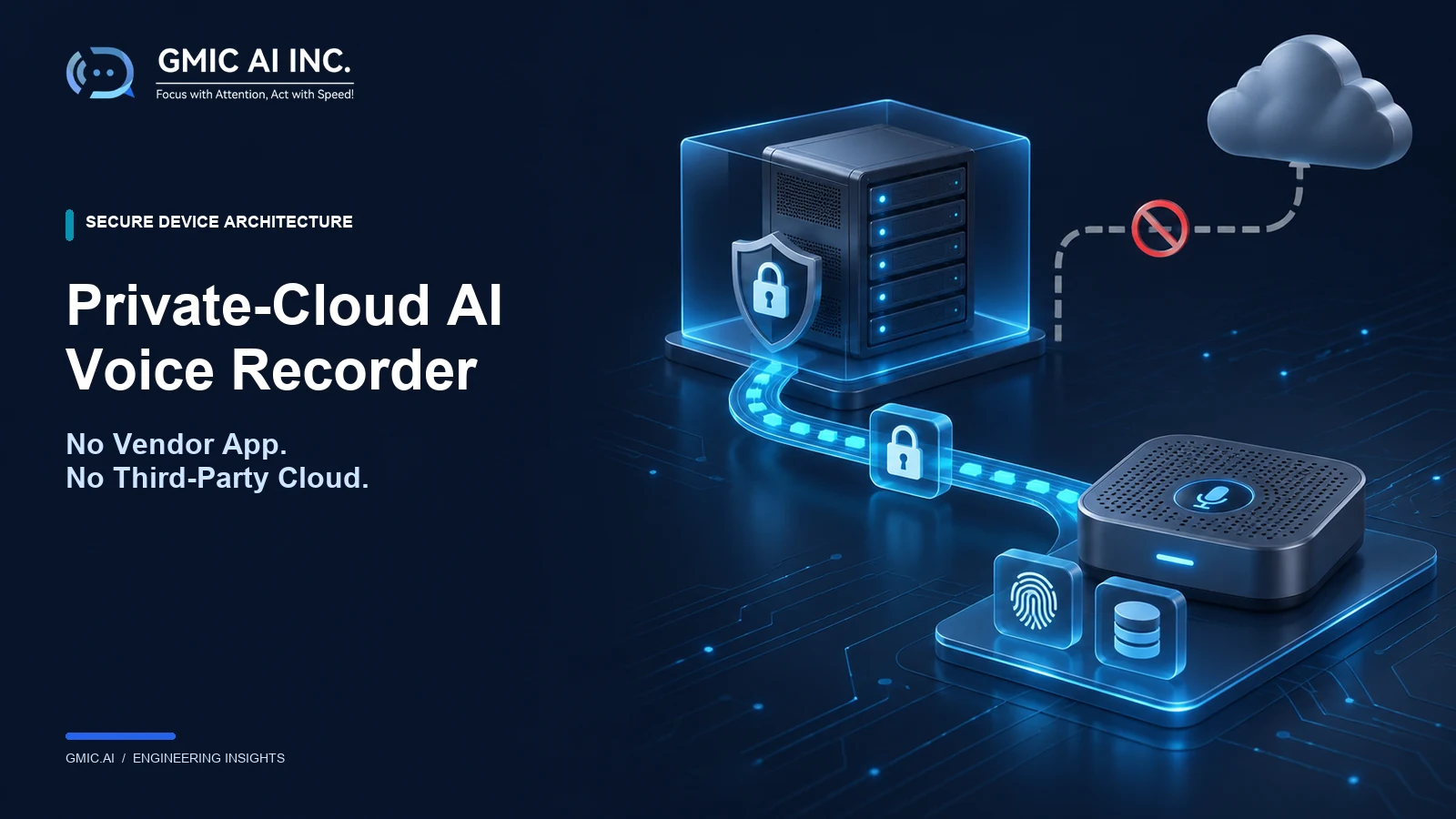
A private-cloud AI voice recorder should capture audio locally, transfer it only to endpoints controlled by the product owner, and remain operable without the hardware vendor’s app, account, analytics service, or cloud. Achieving that outcome requires more than changing an upload URL. Device identity, key provisioning, offline storage, transfer recovery, deletion, OTA signing, diagnostics, and ownership of the mobile and backend interfaces all have to be defined together.
This guide is for product, security, and engineering teams evaluating an OEM or ODM voice recorder platform. It explains the architecture decisions and acceptance evidence needed to build a recorder around your own app and private infrastructure. It is not a claim that any particular product is compliant with a law or security standard.
Why buyers are asking for private-cloud voice recorder hardware
In an internal review of 317 merged customer questions across 54 customer and service entries from August through November 2026, recurring concerns included SDK and protocol access, encryption and key ownership, file transfer, certification evidence, battery life, and the ability to operate without a manufacturer-controlled cloud. The questions varied by industry, but the architectural requirement was consistent: the buyer wanted control of the data path and the product lifecycle, not merely a private-label enclosure.
That requirement is becoming more important as dedicated recorders move into healthcare, enterprise meetings, field service, and other workflows where audio may contain personal, confidential, or regulated information. Local recording can reduce dependence on continuous connectivity, but local storage alone does not establish privacy. The device still needs a controlled path for provisioning, transfer, updates, support, and deletion.
The reference architecture in one view
A practical private-cloud recorder can be divided into five trust zones:
- Capture and local processing: microphones, audio front end, optional DSP, file creation, timestamps, and local metadata.
- Protected device storage: recordings, upload state, configuration, credentials, and diagnostic records.
- Provisioning and control: your mobile app, desktop utility, local web interface, or enterprise device-management workflow.
- Transfer channel: BLE, USB, Wi-Fi, or a combination, with authenticated sessions and recoverable file transfer.
- Customer-controlled services: your API gateway, object storage, transcription service, device registry, OTA service, and audit systems.
The manufacturer’s cloud should not sit silently between zones. If a vendor service is required for activation, endpoint discovery, key delivery, OTA, analytics, or remote commands, the product is not fully independent even if audio files are uploaded elsewhere.
Define “no vendor cloud” as testable requirements
The phrase can mean several different things. Turn it into an explicit dependency matrix before selecting a platform.
| Function | Product owner should define | Evidence to request |
|---|---|---|
| Activation | Whether an account is required and who operates it | Test a factory-new device while vendor domains are blocked |
| Device identity | Identifier format, certificate or credential owner, renewal method | Provisioning record and device registry entry |
| Recording | Trigger rules, formats, retention, stop conditions | Firmware requirements and repeatable test cases |
| Transfer | Protocol, endpoint, authentication, retry and integrity checks | Protocol specification plus packet and file-level tests |
| Storage | Encryption boundary, key location, capacity and full-storage behavior | Threat model, storage inspection and fault tests |
| Deletion | Who authorizes deletion and what confirms it | Deletion state machine and verification results |
| OTA | Who builds, signs, approves and distributes firmware | Signing procedure, rollback test and release records |
| Diagnostics | Allowed fields, retention and export control | Log schema showing that content is excluded by default |
This distinction matters for procurement. A supplier may correctly say that it does not transcribe audio, while its app still depends on a manufacturer account or its firmware still contacts a vendor update service. Ask about every network destination and every function, not only the audio upload.
Choose the data path before choosing the radio
The product workflow should determine whether audio moves through a companion app or directly from the recorder.
Device-to-app-to-private-cloud
The recorder transfers files to your iOS, Android, or desktop application. The app authenticates to your backend and uploads the file. This design can simplify Wi-Fi provisioning and reuse the phone’s network connection, but it introduces mobile operating-system constraints, background-transfer limits, pairing flows, and another local copy of the recording.
The interface specification should define file listing, transfer initiation, chunk size, integrity checks, resume behavior, duplicate handling, deletion authorization, device state, and firmware compatibility. An “SDK” should not be treated as sufficient evidence until the team knows whether it is a complete maintained library, sample code, or only a command protocol.
Device-to-private-cloud
The recorder joins an approved Wi-Fi network and uploads directly to an HTTPS endpoint controlled by the product owner. This removes the phone from the data path after provisioning, but the device must manage network credentials, time, endpoint trust, authentication, retries, certificate changes, and captive or unavailable networks.
The backend should issue an unambiguous receipt only after the file and required metadata are durably accepted. The recorder can then move the item from “uploaded but not acknowledged” to “eligible for deletion.” Do not delete immediately after the last network packet leaves the device.
Local export by USB
USB can provide fast, predictable transfer for managed desktop workflows, but the security model must be deliberate. Decide whether the recorder appears as mass storage, uses MTP, exposes a custom protocol, or requires an authenticated application. If removable-drive behavior is not acceptable, disabling it in the commercial configuration should be a verified requirement rather than a sales promise.
For a deeper comparison of connectivity trade-offs, see Bluetooth vs Wi-Fi for AI voice recorders. The purpose of this article is different: it defines ownership and trust boundaries regardless of the transport selected.
Build offline behavior as a state machine
Private-cloud products often have to record when the network is unavailable. A robust design gives each recording a persistent identifier and a recoverable state, for example:
- recording;
- finalized locally;
- queued;
- transferring;
- uploaded, awaiting server acknowledgement;
- acknowledged;
- deletion authorized;
- deleted or retained under policy;
- failed, with a reason code.
Power loss, app termination, a dropped BLE link, a Wi-Fi change, or a server timeout should not create an unknown state. Transfer can use chunks with integrity verification and an idempotent session so that retries do not create duplicate records. The acceptance test should include interrupted transfers at multiple points, reboot during upload, full storage, expired credentials, server rejection, and a device clock that has lost synchronization.
Separate encryption from key ownership
“AES encrypted” is not a complete architecture. Teams need to know who creates each key, where it is stored, which component can use it, how it is rotated, and what happens during reset, repair, or compromise.
A stronger design avoids one shared secret across a production batch. Depending on the product risk model, each device may receive a unique identity and protected credentials during provisioning. Content-encryption keys can be derived or wrapped under a defined hierarchy, while backend services enforce device and tenant boundaries. Production test systems should not retain unrestricted access to commercial secrets.
NIST’s key-management guidance treats key generation, storage, distribution, use, recovery, and destruction as one lifecycle rather than isolated cryptographic choices. The NIST key-management guidance is a useful reference when translating a security claim into responsibilities and evidence.
Transport encryption is another layer. TLS can protect data between authenticated endpoints, but it does not determine who controls the endpoint, what happens after decryption, or whether the device validates the intended server correctly. The IETF specification for TLS 1.3 describes confidentiality, integrity, and endpoint authentication properties; product requirements still need to specify certificate validation, credential renewal, and failure behavior.
Secure boot and OTA protect the data path over time
A recorder cannot maintain a trusted private-cloud boundary if unauthorized firmware can replace the transfer logic or extract credentials. Evaluate whether the selected processor and platform can support a verified boot chain, signed updates, rollback protection where required, locked production debug interfaces, protected key storage, and recovery from an interrupted update.
OTA ownership must also be explicit:
- Who compiles production firmware?
- Who holds signing authority?
- Can the product owner approve or distribute releases?
- Can an old but valid image be reinstalled?
- What happens if power fails during an update?
- Are recordings and credentials preserved correctly?
- How long will the BSP and security-update path be supported?
NIST’s Secure Software Development Framework provides high-level practices for reducing software vulnerabilities across development and response. NIST’s IoT guidance also identifies device identification, configuration, data protection, interface access control, software update, cybersecurity state awareness, and device security as core capability areas. See the NIST IoT cybersecurity capabilities catalog.
Privacy by design includes minimization and deletion
Sending audio to a private server does not remove the need to limit collection, access, and retention. The design should separate raw audio, transcripts, derived metadata, operational logs, and account data because each can have a different purpose and retention rule.
Under the EU GDPR, Article 25 addresses data protection by design and by default, including data minimization and limits on accessibility. Article 32 describes measures appropriate to risk, including encryption and a process for testing the effectiveness of security measures. The official text is available through EUR-Lex. Product teams should obtain legal advice for their roles, markets, and use cases rather than treating architecture as a compliance certificate.
For the wider privacy engineering checklist, read GDPR-compliant on-device AI hardware.
What a buyer should receive from the OEM or ODM
A private-cloud claim should be supported by project-specific deliverables:
- a data-flow and trust-boundary diagram;
- a complete network destination and port inventory;
- the device/app/backend interface specification;
- credential-provisioning and key-lifecycle documentation;
- a firmware signing and release procedure;
- a storage and deletion state diagram;
- test results for transfer interruption, reboot, full storage and reset;
- a production debug-lock and provisioning record;
- a software component inventory and version traceability;
- a documented support and vulnerability-response process.
The NIST IoT baseline is not a product certification, but it gives buyers and manufacturers a useful vocabulary for defining device capabilities. NIST describes its core baseline as a starting point that can be tailored to a product and risk context, not as a universal one-size-fits-all checklist.
A practical acceptance test for vendor independence
Before approving production, run a controlled independence test:
- Start with a factory-new device and documented production firmware.
- Block all known manufacturer domains at the network boundary.
- Provision the device using only the product owner’s approved workflow.
- Record while offline, reboot, and confirm that the file and state persist.
- Restore connectivity and transfer to the private endpoint.
- Interrupt transfer, repeat it, and confirm integrity without duplicates.
- Verify that server acknowledgement—not attempted transmission—controls deletion.
- Rotate or revoke a credential and observe the defined recovery flow.
- Attempt an unauthorized firmware or rollback path.
- Factory-reset the device and verify removal of recordings, bindings, credentials, and configuration according to the requirement.
- Inspect DNS, TLS, and application traffic for undocumented destinations.
- Confirm that the final hardware, firmware, app, and backend versions match the evidence pack.
This test does not prove that a system is invulnerable or legally compliant. It does expose hidden dependencies that are easy to miss in a feature list.
Questions to ask before choosing a private-cloud recorder platform
- Can the recorder operate without the manufacturer’s app, account, DNS, analytics, OTA, or cloud services?
- Does “SDK” mean maintained native libraries, source code, sample code, or only a protocol document?
- Who owns the device identity, endpoint configuration, firmware signing keys, and production credentials?
- What happens to a recording through every transfer, retry, acknowledgement, and deletion state?
- Can the device upload directly to a customer HTTPS endpoint, and how is that endpoint authenticated and changed?
- Which interfaces can expose recordings or credentials in production?
- What evidence shows that factory reset and secure deletion behave as specified?
- How are firmware vulnerabilities, BSP changes, certificate expiry, and component end-of-life handled?
- Can the supplier demonstrate the full workflow while its own domains are blocked?
How GMIC can support a private-cloud recorder program
GMIC can evaluate the hardware, firmware, connectivity, storage, acoustic, enclosure, and manufacturing implications of a customer-controlled voice workflow. The engineering scope should begin with the required trust boundaries and validation evidence, then select or adapt a platform that can support them. No processor, encryption label, or ODM relationship by itself proves a particular security or compliance outcome.
Teams comparing development scope can also review custom AI hardware modules vs finished products and GMIC’s AI hardware ODM services.
Frequently asked questions
Can an AI voice recorder work without the manufacturer’s app?
Yes, if the firmware exposes a documented interface for your app, desktop utility, USB workflow, or direct network upload. The requirement must also remove hidden dependencies for activation, endpoint discovery, updates, analytics, and remote commands.
Is direct HTTPS upload enough to make a recorder private?
No. HTTPS protects a transfer channel when implemented and authenticated correctly, but privacy also depends on local storage, key ownership, endpoint control, retention, logs, updates, user controls, and what the receiving service does with the audio.
Should audio upload through a phone or directly over Wi-Fi?
Either can be valid. App-mediated transfer simplifies some provisioning and connectivity tasks; direct Wi-Fi removes the phone from the normal data path. Compare background behavior, power, transfer volume, security, recovery, and user experience for the actual workflow.
What should happen when the network is unavailable?
The recorder should finalize and protect the local file, preserve a persistent transfer state, retry according to policy, and avoid deletion until the receiving service has acknowledged durable acceptance. Exact behavior should be specified and tested.
Does private-cloud architecture make a product GDPR-compliant?
No. It can support data minimization, controlled access, and defined retention, but compliance depends on the complete processing activity, organisational measures, legal roles, notices, lawful basis, data-subject rights, transfers, and risk assessment.
Engineering note: this article incorporates anonymized patterns from recent buyer questions. It does not identify customers, disclose commercial terms, or represent unverified project requirements as shipped GMIC capabilities. Last reviewed: November 2026.