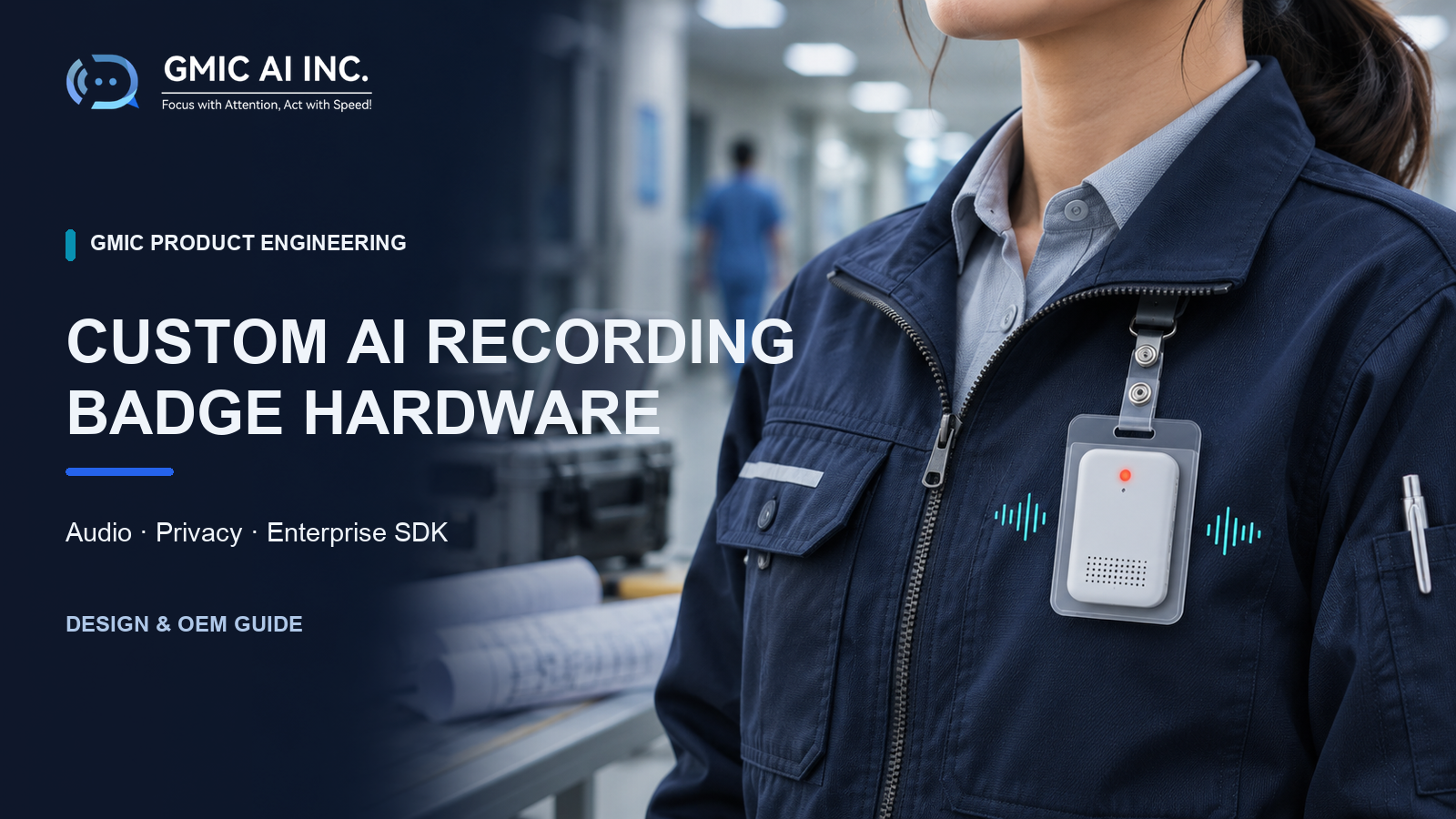
Custom AI recording badge hardware can capture meetings, field observations and hands-free voice notes from a stable chest-level position. Compared with a ring or wristband, a badge offers more enclosure volume and a more consistent microphone orientation, but it must manage clothing noise, body shadowing, visible recording feedback, attachment security and enterprise identity requirements.
In brief: Choose a badge when conversation capture, long wear and visible status matter. Define whether it streams live audio, stores recordings locally or does both. Then validate microphone position on real clothing, consent cues, file recovery, private-backend integration and the interaction between audio, NFC access and employee identity.
What Is an AI Recording Badge?
An AI recording badge is a chest-worn voice device that captures speech or triggers a voice workflow. It may include microphones, local storage, BLE or Wi-Fi, a button, LEDs, haptics, NFC, an ID display and a rechargeable battery. Transcription and AI inference commonly run on a phone, edge gateway or private cloud rather than inside the badge.
For form-factor selection, see the wearable voice AI hardware guide.
Custom AI Recording Badge Hardware: What Makes It Different?
| Design factor | Badge advantage | What must be validated |
|---|---|---|
| Microphone position | Relatively stable chest-level placement | Orientation, body shadowing and clothing noise |
| Enclosure volume | More space than a ring for battery and storage | Weight, thickness and attachment security |
| User feedback | Visible LED can inform nearby participants | Brightness, viewing angle and state clarity |
| Enterprise identity | Can share a familiar ID-badge form | NFC, credentials, provisioning and trust boundaries |
Clip, Magnet, Lanyard or Integrated ID Holder?
A clip fixes orientation but may not fit every garment. A magnet can support fast attachment but requires a backing piece and a plan for loss, interference and restricted environments. A lanyard fits many users but introduces swing and fabric contact. An integrated ID holder creates a familiar workplace object but adds display, printing, identity and access-control decisions.
Microphone Layout and Clothing Noise
Microphone ports should remain exposed in intended attachment positions. Port direction, acoustic membranes, mechanical isolation and enclosure cavities affect the signal. DSP may include gain control, noise reduction, voice activity detection and beamforming, but each block must be evaluated on the final enclosure.
- Test different wearer heights and body types.
- Include near, side and off-axis talkers.
- Measure fabric rub, lanyard swing and badge impacts.
- Check wind, HVAC, vehicles and tools where relevant.
- Inspect channel matching and port variation across units.
Test the badge on shirts, jackets, uniforms, scrubs and protective clothing. Include the wearer speaking, another person across a desk, side conversations, walking, bending and a badge that has rotated. A microphone-count claim is not a substitute for scenario evidence.
Visible Recording Status and Consent
A badge can make recording status more visible than a hidden device, but only if the indicator is unambiguous. Define idle, ready, recording, paused, transferring, completed and error states. Verify that the LED is visible in bright light and from relevant viewing angles. Haptics can confirm actions to the wearer but do not inform nearby participants.
Indicator design does not replace applicable consent, disclosure and retention requirements. These vary by jurisdiction and use case and require qualified review.
Battery, Storage and the Real Duty Cycle
Separate connected idle, active capture, local write, live streaming, file transfer, Wi-Fi upload, indicators, haptics, NFC, display and OTA states. Average current is not enough: radio and storage peaks can expose battery or regulator limits. “All-day” claims should state the capture and transfer duty cycle used for measurement.
Local storage needs full-volume behavior, stable recording IDs, timestamp rules, encryption, integrity evidence, interrupted-transfer recovery and confirmed deletion. A badge should not silently overwrite unsynchronized audio unless the product policy explicitly permits it.
BLE, Wi-Fi and Private-Backend Integration
BLE can carry control, status and file transfer. Wi-Fi can accelerate uploads but adds provisioning, antenna, power and security scope. Define background reconnection, locked-screen behavior, transfer resume, duplicate handling, device authentication and OTA ownership.
For customer-owned infrastructure, document every manufacturer account, server, analytics endpoint and remote command. Review AI voice recorder SDK integration, file-transfer protocol design and private-cloud recorder architecture.
NFC, Employee Identity and Access Control
An audio badge can also carry NFC or another identity credential, but the functions should not be treated as one undifferentiated security boundary. Define which processor or secure element owns the credential, whether audio firmware can access it, how devices are provisioned, what happens when employment ends and what factory reset removes.
A lost badge may contain both recordings and an access token. Risk analysis should cover device authentication, storage encryption, credential revocation, debug interfaces, signed firmware and ownership transfer.
Security and Device Ownership
For sensitive audio, define encryption at rest and in transit, key provisioning, secure boot, debug locking, App authentication, factory reset and deletion verification before firmware architecture is fixed. For customer-owned applications, document source access, protocol licensing, manufacturer cloud dependencies, OTA signing and long-term maintenance.
What Should the First Prototype Prove?
| Area | Prototype question | Useful evidence |
|---|---|---|
| Audio | Does chest placement capture intended speakers? | Scenario recordings and recognition metrics |
| Attachment | Does orientation stay stable on real clothing? | Wear trials and rotation observations |
| Privacy | Can wearer and participants understand status? | Visibility and usability tests |
| Power | Does the measured duty cycle meet the target? | State current, peaks and temperature |
| Data | Can interrupted files recover without duplication? | Fault injection and integrity checks |
| Enterprise | Can identity, OTA and backend ownership be administered? | Provisioning and reset tests |
Use the AI hardware development process and prototype validation guide to define phase gates.
Questions to Give an OEM or ODM Partner
- Is the badge live-audio, local-recording or hybrid?
- Which clothing, positions and speaker distances define acceptable audio?
- How does the user and nearby participants know recording status?
- What happens when storage, battery, radio or upload fails?
- Who owns firmware, protocol, App integration and OTA signing?
- Can the production data path exclude manufacturer services?
- How are NFC credentials separated from audio functions?
- Which market and certification requirements apply?
Frequently Asked Questions
Is a badge better than a wristband for conversation recording?
A badge usually provides a more stable chest-level position. A wristband offers faster hand access and richer haptic interaction. The better choice depends on ambient conversation capture versus deliberate raised-wrist input.
Can an AI badge work without a phone?
Yes, if it has local storage and a complete recording, encryption and synchronization design. Live-only products require a host connection.
How many microphones should a recording badge use?
There is no universal number. More microphones help only when geometry, port design and processing provide measurable improvement in the target scenario.
Can the badge use a customer-owned App and cloud?
Yes, when protocol, authentication, OTA, diagnostics, licensing and support boundaries are defined. The agreement should identify every remaining manufacturer dependency.
Can the same badge include NFC access control?
Potentially, but access credentials and audio functions should have defined trust boundaries, provisioning and lost-device procedures. Compatibility must be verified for the intended access system.
Design the Badge Around the Workplace
Custom AI recording badge hardware succeeds when it combines a predictable acoustic position with clear recording status, recoverable data and manageable enterprise ownership. Validate it on real people, clothing, phones and workflows before finalizing the enclosure.
Contact GMIC to scope a custom AI recording badge hardware project.
Author and review note: This is a product-development guide, not a specification, legal opinion or certification claim. Requirements must be confirmed for the selected design and market.
Sources: