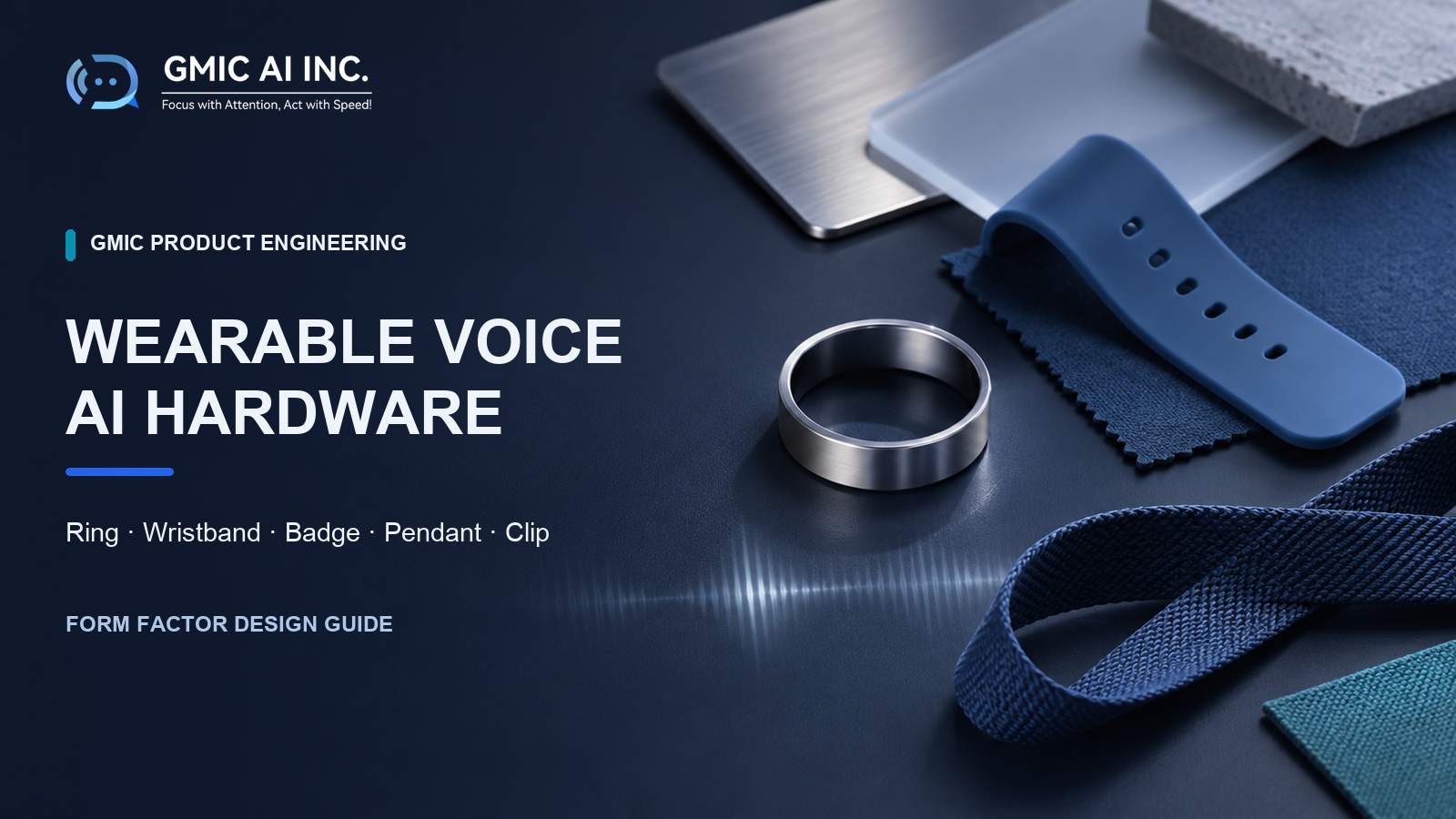
Wearable voice AI hardware turns speech into a low-friction input for notes, assistants, clinical documentation and field workflows. The right form factor is not simply the smallest enclosure. A ring, wristband, recording badge, pendant, clip and magnetic card place the microphone at different distances from the mouth, allow different battery sizes and create different expectations about recording, privacy and user control.
In brief: Choose a ring for deliberate push-to-talk interaction, a badge or pendant for stable chest-level conversation capture, a wristband for fast access and haptic feedback, a clip for flexible placement, and a card-style recorder when longer battery life and local storage matter more than continuous wear. Validate microphone position, motion noise, consent feedback, connectivity and data recovery before committing to an enclosure.
What Is Wearable Voice AI Hardware?
Wearable voice AI hardware is a body-worn device that captures speech or triggers a voice workflow and connects the result to an application, speech-recognition service or AI agent. Depending on the architecture, the wearable may stream audio, store recordings locally, send short voice commands or act only as a physical controller for a phone or headset.
The AI model does not need to run inside the wearable. In many practical designs, the wearable handles audio capture, user input, local buffering, encryption and wireless transfer while a phone, edge gateway or cloud service performs transcription and inference.
Which Wearable Voice Form Factor Fits the Product?
| Form factor | Best suited to | Primary engineering advantage | Main constraint to validate |
|---|---|---|---|
| AI voice ring | Push-to-talk commands, short voice notes and discreet interaction | Always accessible to the hand and supports deliberate activation | Very limited battery, antenna, microphone and storage volume |
| AI voice wristband | Hands-busy work, quick capture and haptic notifications | Space for controls, vibration and a larger battery than a ring | Distance from the mouth and motion or contact noise |
| AI recording badge | Clinical, retail, meeting and field-service conversations | Relatively stable chest-level microphone position | Clothing noise, orientation and visible recording indication |
| AI voice pendant | All-day personal capture and conversational workflows | Useful acoustic position with more internal volume than a ring | Swing, fabric contact and lanyard noise |
| AI voice clip | Professional teams needing removable, flexible placement | Can be positioned near the wearer’s mouth | Inconsistent placement between users |
| AI recorder card | Calls, meetings and longer local recording sessions | More room for battery, storage, antennas and multiple microphones | Less natural for continuous body-worn use |
AI Voice Ring: Best for Intentional Voice Input
An AI voice ring works best when the user deliberately brings the hand closer to the mouth and presses or touches a control. This reduces ambiguity about when the microphone is active and avoids the power demand of continuous capture.
Three architectures should be evaluated separately:
- Control ring: the ring sends a button or gesture event while a phone or earbud captures speech.
- Streaming microphone ring: the ring captures and sends live audio to a paired host.
- Local-recording ring: the ring stores a voice segment and synchronizes it later.
These are not interchangeable. A control ring provides the longest potential operating time but is not an independent recorder. Live audio streaming adds bandwidth and power requirements. Local recording requires storage, file integrity, synchronization and deletion rules.
A Microsoft Research wearable-ring prototype combined capacitive push-to-talk input, a PDM MEMS microphone and haptic feedback, illustrating how a ring can act as a low-friction interface for voice-first AI. A research prototype is evidence of an interaction approach, not proof that every commercial ring will achieve the same battery life or audio performance.
Review GMIC’s customizable AI hardware platforms or explore the upcoming AI voice ring product cluster.
AI Voice Wristband: Fast Access With More UX Options
A wristband offers more room than a ring for a battery, vibration motor, button, status light and charging contacts. It can support quick voice notes, work instructions and safety workflows without requiring a screen.
The acoustic challenge is position. A relaxed wrist may be far from the mouth and point the microphone away from the speaker. Walking, sleeve contact and wrist movement can create low-frequency noise and transient impacts. Product teams should test normal arm positions, deliberate mouth-level use and real work movements rather than relying only on a stationary bench recording.
Questions to answer before design freeze include:
- Must the user lift the wrist before speaking?
- Does the device record continuously, on demand or after a wake event?
- How does the user know capture started, stopped or failed?
- Can the microphone opening remain clear of the wrist, sleeve and water seal?
- How much audio must be retained when the phone is unavailable?
AI Recording Badge: Stable Placement for Conversation Capture
A recording badge usually provides the most predictable microphone position among small wearable formats. Chest-level placement can capture the wearer and nearby speakers without asking the user to hold a device. It also provides more internal space than a ring for multiple microphones, battery capacity, local storage and wireless hardware.
However, a badge does not automatically isolate the intended conversation. Microphone count alone does not guarantee better transcription. Geometry, enclosure openings, DSP, distance, reverberation and competing speech all affect the result. A product intended to retain speech from 0.5–2 metres while reducing unrelated voices farther away needs scenario-specific testing; a generic noise-cancellation claim is not sufficient.
Mounting is also part of the acoustic system. Magnetic, pin, clip and lanyard mounts can change orientation and contact with clothing. The validation plan should include expected garments, movement and plausible misplacement.
For healthcare applications, see healthcare AI scribe hardware and wearable clinical dictation for home visits.
Local Recording, Live Streaming or Hybrid?
| Architecture | Advantage | Risk or trade-off | Best fit |
|---|---|---|---|
| Live streaming | Low delay to transcription or an AI agent | Depends on radio conditions and consumes more power | Interactive assistants and live captions |
| Local recording | Works when the phone or network is unavailable | Requires protected storage and reliable file synchronization | Voice notes, meetings and field work |
| Hybrid capture | Supports live use with a local recovery path | More complex state, deduplication and deletion logic | Workflows where missing audio is unacceptable |
| Control only | Smallest wearable and lowest device-side audio workload | Another device must capture the voice | Push-to-talk control and agent shortcuts |
For a hybrid design, define what happens when the connection drops, how chunks are identified, whether retransmission is bit-exact, when local audio can be deleted and how the application identifies a gap. “Supports Bluetooth” does not answer these workflow questions.
Microphone Placement Matters More Than Form-Factor Marketing
The microphone should be evaluated as installed in the final mechanical design. Port size, membrane, adhesive, mesh, gasket, housing cavity and nearby surfaces can change the response. The final test should include representative users, speech levels, distances, orientations, motion, clothing and background conditions.
Useful evaluation outputs include:
- Intelligibility and speech-recognition error by position and environment.
- Critical-term recall for the intended vocabulary.
- Clipping, wind, touch and fabric-noise events.
- Capture failure and incomplete-file rate.
- Correction time in the final workflow.
See GMIC’s guides to AI voice recorder microphone design and audio DSP tuning for voice AI.
Privacy Must Be Visible in the Hardware UX
Wearable audio products need an understandable capture model. A user should be able to tell whether the device is idle, listening for an activation event, actively recording, transferring data or unable to complete an action. Depending on the product, feedback may use an LED, haptic pattern, audible cue or a combination.
Push-to-talk can provide a clearer privacy boundary than continuous capture, but it does not replace applicable consent, disclosure, security and retention requirements. Requirements differ by jurisdiction and use case, so the product team should obtain appropriate legal and compliance review.
The NIST AI Risk Management Framework emphasizes documenting context, risks and measurements across an AI system’s lifecycle. For wearable voice products, that means evaluating the complete path from activation and audio capture through transfer, processing, storage, user review and deletion.
Connectivity, SDK and Customer-Controlled Infrastructure
Product teams should define whether the wearable will operate through a manufacturer application, a customer-owned mobile app or a direct connection to private infrastructure. The decision affects firmware scope, authentication, OTA control, provisioning and long-term support.
An integration specification should cover:
- BLE services, characteristics, commands, responses and error codes.
- Audio or file format, chunking, checksums and resume behavior.
- Device identity, binding and multi-phone rules.
- Time synchronization and stable recording identifiers.
- Firmware signing, rollback behavior and update ownership.
- Storage encryption, key provisioning and factory reset.
- Diagnostic data and any external service dependency.
Bluetooth specifications define the radio and protocol foundation, but a reliable product still needs an application-level transfer and recovery design. Review AI voice recorder SDK integration and multi-phone pairing and BLE bonding.
How to Choose the Right Form Factor
- Define the speech event. Is it a command, short note, full meeting or continuous work context?
- Define the intended microphone position. Do not choose the enclosure before establishing the acoustic geometry.
- Define offline behavior. Decide what happens when the phone, network or cloud service is unavailable.
- Define the privacy interaction. Specify how recording starts, stops and becomes visible to the user.
- Build the energy budget. Separate idle, capture, processing, transfer and peak-current states.
- Prototype more than one form factor. Compare real workflow performance rather than appearance alone.
- Set acceptance criteria. Include audio, battery, transfer reliability, usability, security and manufacturing variation.
Frequently Asked Questions
Can a smart ring record voice?
Yes, if it includes a microphone and either a live-audio link or local storage. Some rings instead act only as a controller for a phone or earbud. Buyers should verify which architecture is implemented rather than relying on the term “AI ring.”
Is a wristband or badge better for conversation recording?
A badge generally offers a more stable chest-level microphone position. A wristband offers faster hand access and richer haptic interaction but may need to be raised toward the mouth. The better choice depends on whether the workflow prioritizes ambient conversation capture or deliberate voice input.
How many microphones should an AI recording badge use?
There is no universal number. A second or additional microphone can support spatial processing, but only when the geometry, synchronization, enclosure and DSP are designed and tuned together. Validate the final assembly in the intended environment.
Can a wearable voice device work without a phone?
It can record without a phone if it has local storage, sufficient power and firmware for file management. Transcription or AI processing may still occur later on a phone, gateway or server. The offline duration and synchronization behavior must be specified.
Can GMIC customize a wearable voice product for a customer-owned app?
GMIC evaluates hardware, firmware, protocol, SDK and customer-infrastructure requirements as part of project scoping. Feasibility depends on the selected platform, audio architecture, security model, certification scope and production volume. Required capabilities should be confirmed in a written specification before development.
Build the Wearable Around the Voice Workflow
The right wearable voice device is the one whose microphone position, interaction, power budget and data path match the real workflow. Begin with what must be captured, who activates it, what happens offline and how the user knows the system worked. Then choose the ring, wristband, badge, pendant, clip or card architecture that can be validated against those requirements.
Contact GMIC to evaluate a wearable voice AI hardware concept or learn about the AI hardware development process.
Author and review note: This guide is intended for product-planning and engineering evaluation. Product specifications, certification requirements and legal obligations must be confirmed for the intended design and market.
Sources: