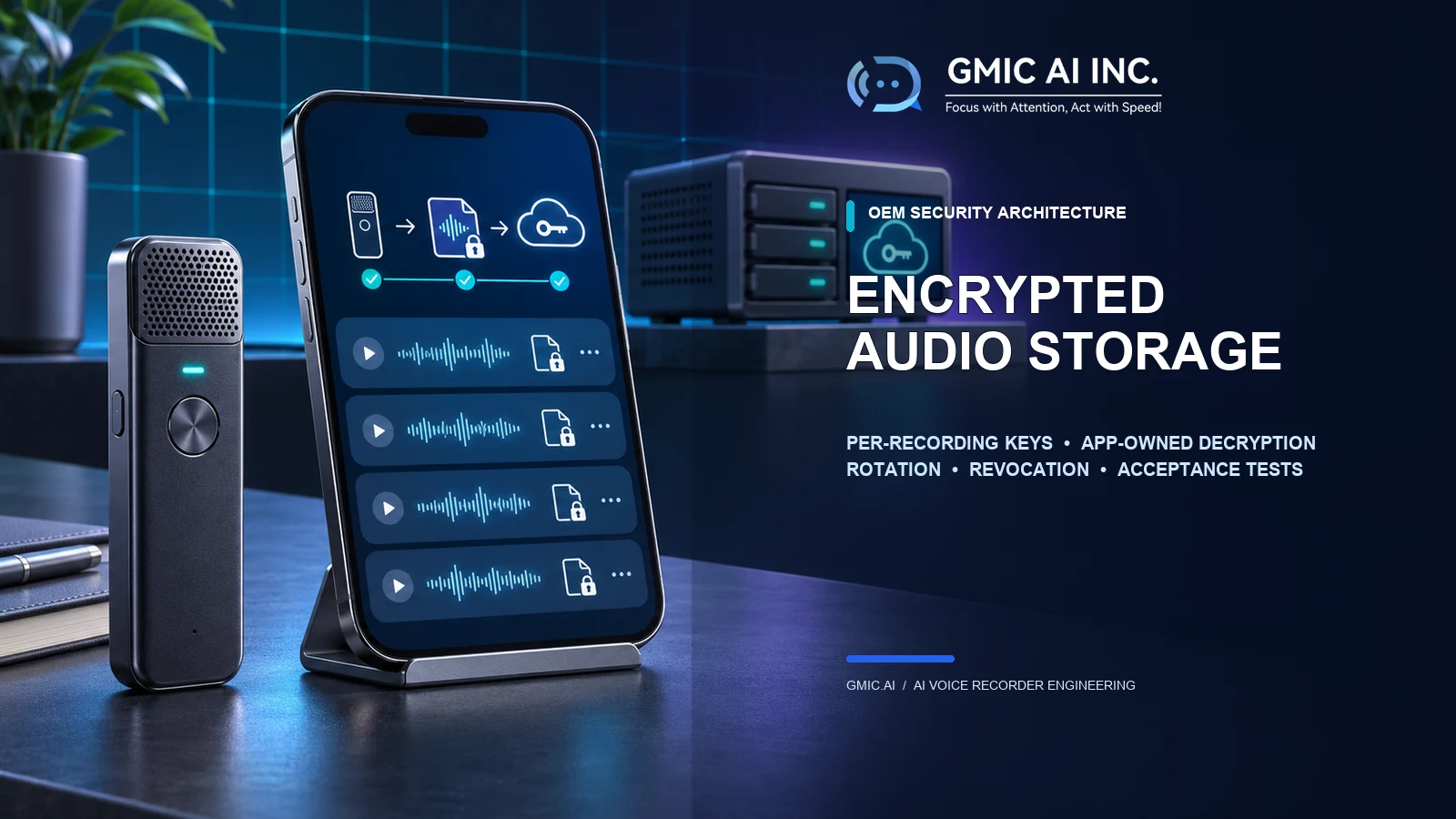
AI voice recorder encrypted audio storage should protect each recording before it reaches non-volatile memory, keep decryption authority separate from transport access, and remain recoverable only by an explicitly authorized app or customer-controlled service. A claim such as “AES-256 supported” is not a complete architecture. Product teams must define the key hierarchy, file format, device identity, transfer protocol, rotation, deletion, recovery and production evidence together.
This guide is for OEM buyers, product managers, security engineers and mobile teams evaluating a private-label or custom voice recorder. It focuses on stored and transferred recordings—not firmware confidentiality or the boot chain. Those adjacent topics are covered in GMIC’s secure boot and factory provisioning guide.
The short answer
A practical design normally separates four things:
- a non-exportable device identity or authentication credential;
- a fresh data-encryption key (DEK) for each recording or bounded recording segment;
- a key-encryption key (KEK), public key or customer key service used to wrap the DEK; and
- Bluetooth, USB or Wi-Fi transport protection used while the encrypted object moves.
The audio file should be encrypted with an authenticated-encryption construction so unauthorized changes are detected, not merely concealed. The encrypted file should carry a versioned header containing non-secret metadata needed to identify the algorithm, key ID, recording ID and chunk order. Plaintext audio, exportable master keys and debug logs containing secrets should never become accidental side channels.
This is a reference architecture, not a certification claim. The correct design depends on the processor, secure-storage capability, threat model, markets, data sensitivity and recovery policy.
Why “AES-256” does not answer the buyer’s real question
Across anonymized customer questions reviewed by GMIC, buyers repeatedly asked whether a lost recorder could reveal audio, whether a factory or vendor could decrypt files, whether their own app could control the keys, whether USB could bypass protection, and what happened after an app was removed or a device was reset. These are ownership and lifecycle questions.
Encryption strength alone does not say:
- where the key is generated;
- whether every unit shares the same key;
- whether the key can be read through firmware, debug or a service tool;
- whether recordings are briefly written in plaintext;
- who can authorize a new phone;
- whether copied ciphertext can be replayed into another account;
- how a compromised key is rotated; or
- whether deletion removes every usable copy and wrapping key.
NIST’s IoT cybersecurity catalog treats cryptographic key management and secure storage as explicit capabilities, including generating, securely storing and changing keys. NIST SP 800-57 describes key management across the full lifecycle rather than as a single algorithm choice.
Define the threat model before choosing the key hierarchy
An OEM specification should name the attackers and failures the design is expected to resist. At minimum, evaluate:
| Threat or failure | Required design question |
|---|---|
| Lost or stolen recorder | Can storage be copied or files be downloaded without an authorized app? |
| Unauthorized phone | Can a new phone pair, bond or request a wrapped DEK? |
| Malicious USB host | Does USB expose plaintext files, a mass-storage volume or privileged commands? |
| Factory or repair access | Can production tools, shared keys or service firmware decrypt customer audio? |
| Copied encrypted file | Is the object bound to a recording ID, device, tenant and authenticated metadata? |
| Interrupted write | Can a partially written encrypted recording be detected and recovered safely? |
| Compromised app account | Can access be revoked without replacing every deployed recorder? |
| Compromised device credential | Is there an incident path for quarantine, replacement and evidence preservation? |
Avoid promising protection against an undefined physical attacker. A processor with secure boot, readout protection and isolated key storage can raise the cost of extraction, but the assurance level depends on the exact silicon, configuration and validation.
Use a key hierarchy, not one fleet-wide secret
A clean design assigns one purpose to each key.
| Key or credential | Purpose | Recommended ownership and handling |
|---|---|---|
| Device identity private key | Authenticates one recorder | Unique per unit; generated or injected under controlled provisioning; non-exportable where supported |
| Recording DEK | Encrypts one file or bounded segment | Random per recording/segment; never reused with the same nonce space |
| KEK or recipient public key | Wraps the DEK | Controlled by the customer app, customer backend or a defined tenant key service |
| BLE long-term key | Protects a bonded BLE link | Managed by the Bluetooth security process; not reused as the recording DEK |
| OTA signing key | Authorizes firmware | Kept outside the device; separate from audio encryption and device identity |
Using one symmetric key across an entire production run creates a fleet-wide failure domain. Extracting or leaking that key can expose every unit using it. A per-device master key is better, but a per-recording DEK further limits the amount of ciphertext exposed by one key and makes selective deletion or re-wrapping practical.
An OEM should also define where random values come from. The key generator, nonce construction and power-loss behavior need review on the target platform. “Hardware AES” describes an accelerator; it does not prove that keys and nonces are generated, stored or rotated correctly.
Encrypt before writing audio to persistent storage
The safest boundary is clear: captured audio may exist briefly in volatile buffers needed for processing, but authenticated ciphertext—not plaintext PCM—should be committed to flash.
A recording pipeline can follow this order:
- create a stable recording ID;
- generate a fresh DEK and required nonce material;
- create a versioned encrypted-file header;
- encrypt bounded audio chunks as they are finalized;
- authenticate sequence number, recording ID and permitted metadata as associated data;
- persist each complete chunk and an integrity record;
- finalize duration, chunk count and file-level status; and
- wrap the DEK for the authorized recipient and erase unnecessary plaintext buffers.
Authenticated encryption is important because confidentiality alone does not detect modified ciphertext. The selected AEAD algorithm and parameters must match platform support and the security review; the architecture should not invent a proprietary cipher.
Decide what metadata remains visible
Some applications need a recording list before downloading or decrypting audio. That can justify a small plaintext index containing fields such as recording ID, start time, approximate duration, encrypted size, firmware version and synchronization state. Other fields may reveal sensitive behavior and should be encrypted.
Classify each field rather than assuming metadata is harmless:
- filename and user-entered title;
- timestamp and time zone;
- location or device assignment;
- tenant and user identifiers;
- audio duration;
- error and diagnostic reason; and
- deletion or upload status.
The header must be authenticated even when some fields remain readable. Otherwise an attacker may alter a timestamp, tenant, chunk count or algorithm identifier without detection.
Separate recording encryption from BLE and Wi-Fi security
Bluetooth link encryption protects traffic during an active connection. It does not automatically protect a file stored on the recorder, a copy placed in app storage or an object uploaded to a backend.
Bluetooth LE Secure Connections establishes keys for link protection. The Bluetooth specification distinguishes pairing, bonding, authentication and encryption, and notes that authenticated MITM protection depends on the association method and device capabilities. A displayless single-button recorder may not support numeric comparison directly, so the OEM design must define how ownership is proven—such as an out-of-band secret, QR/NFC bootstrap, physical confirmation or customer-service recovery flow.
The encrypted recording object should remain protected end to end across BLE, USB or Wi-Fi. Transport encryption such as BLE link encryption or TLS then provides an additional layer and protects protocol metadata, authentication tokens and commands in transit.
For detailed transfer behavior, see the AI voice recorder file transfer protocol guide and the Wi-Fi upload reliability guide.
Make customer-controlled decryption explicit
“No vendor cloud” is testable only when every dependency is documented. A customer-controlled architecture should specify:
- who generates or controls the recipient KEK or key pair;
- whether the manufacturer ever receives a usable private key;
- how a recorder is assigned to a tenant and claimed by an app;
- how an authorized second phone receives access;
- how access is removed from a lost phone;
- how backend or app keys are rotated;
- whether old recordings remain decryptable after rotation; and
- which recovery party, if any, can regain access.
Mobile platforms can help protect app-held credentials. Android Keystore can make key material non-extractable and may back it with a trusted execution environment or StrongBox on supported devices. Apple’s Secure Enclave can generate keys whose plaintext private material is not exported. These features have hardware, algorithm and background-use constraints; the mobile app must verify actual capability rather than assuming every handset provides the same protection.
Decide whether the product supports recovery. A no-recovery design can provide stronger separation but permanently loses audio when every authorized key is lost. Escrow or account recovery improves availability but creates another high-value path that needs authentication, audit and separation of duties.
Plan rotation, revocation and re-wrapping before launch
NIST defines a cryptoperiod as the time during which a key is authorized for use. The appropriate period depends on key purpose, volume, environment and consequence of compromise; it is not one universal number for every recorder.
The file format should identify which key protected each object. Rotation can then introduce a new KEK for future recordings while retaining the old key only as long as policy requires. With envelope encryption, existing DEKs may be re-wrapped under a successor KEK without decrypting and re-encrypting the audio itself.
Define at least four events:
- Routine rotation: introduce the successor key, verify new writes and retire old-key encryption.
- App or phone revocation: prevent the removed client from receiving future DEKs and new device authorization.
- Device credential compromise: quarantine the device, stop uploads or claims, preserve evidence and replace credentials only through an authorized path.
- Backend key compromise: stop affected key use, re-wrap recoverable DEKs where appropriate and audit every access.
Do not make a firmware update the only possible route to change backend credentials or recipient keys. OTA signing and audio decryption use different trust decisions and should remain separate. See the OTA update and rollback guide for the firmware lifecycle.
Treat factory reset as a security state transition
A reset policy should state whether it destroys:
- recording DEKs and wrapped-key records;
- encrypted audio and indexes;
- BLE bonds and authorized phone records;
- Wi-Fi credentials and endpoint tokens;
- tenant assignment and owner credentials; and
- diagnostic logs containing sensitive metadata.
It should separately state whether the permanent manufacturing identity, serial number and hardware calibration remain. A reset that erases only a file index may leave recoverable ciphertext and keys. A reset that destroys the permanent device identity may make legitimate re-provisioning impossible.
The factory reset and secure erasure guide provides a dedicated acceptance matrix for this transition.
OEM acceptance tests for encrypted audio storage
Security requirements become useful when a production sample can pass repeatable tests.
| Test | Evidence expected |
|---|---|
| Raw-flash inspection | No recognizable plaintext audio after normal recording and interrupted recording |
| Wrong-key decryption | Decryption fails without releasing partial plaintext |
| Ciphertext modification | Changed header, chunk, order or tag is detected |
| Nonce/key uniqueness | Production logs or test instrumentation show no prohibited reuse |
| Cross-device copy | File copied to another recorder cannot be accepted as its own authorized object |
| Unauthorized phone | Cannot list, download, unwrap or delete recordings |
| USB bypass | USB cannot expose plaintext or privileged key commands outside the specification |
| Interrupted power | Finalized chunks remain verifiable; incomplete data is clearly marked, not silently accepted |
| Rotation | New recordings use the successor key; authorized older recordings remain available according to policy |
| Revocation | Removed app/account loses future access and cannot reclaim the recorder without the approved flow |
| Factory reset | Defined keys, bonds, files and credentials are removed; permanent identity follows policy |
| Production audit | Each serial number maps to provisioning results without storing exportable private keys in ordinary logs |
Include negative tests. A demo that decrypts one successful recording proves functionality, not resistance to unauthorized states.
What to request from an AI voice recorder OEM
Before approving a platform, ask for a versioned security package containing:
- a key hierarchy and trust-boundary diagram;
- exact processor and secure-storage capability;
- encrypted file format, versioning and chunk-integrity rules;
- pairing/claiming and lost-phone recovery sequence;
- BLE, USB and Wi-Fi authorization matrix;
- factory provisioning flow and per-unit audit fields;
- rotation, revocation and incident procedure;
- reset and secure-erasure behavior;
- OTA ownership and signing separation;
- SDK/API error codes for authentication, integrity and key-state failures; and
- an acceptance report tied to the production hardware and firmware version.
The AI voice recorder SDK evaluation checklist explains how to verify protocol coverage, source-code access, licensing and version control around these security functions.
FAQ
Does AES-256 automatically make an AI voice recorder secure?
No. AES-256 names an algorithm and key size. Security also depends on the mode, nonce uniqueness, authenticated metadata, random generation, key storage, access control, debug exposure, rotation, deletion and implementation quality.
Should every recording use a different encryption key?
A fresh DEK per recording or bounded segment is a strong, practical pattern because it limits the failure domain and supports selective key wrapping and deletion. The final design must fit the processor, file format and recovery requirements.
Can BLE encryption replace audio-file encryption?
No. BLE encryption protects an active wireless link. It does not automatically protect recordings stored in flash, copied over USB, held by the mobile app or uploaded to a backend.
Can the hardware vendor decrypt customer recordings?
That depends on key ownership and system design. A customer-controlled architecture should make it technically and contractually clear whether the vendor ever possesses a usable decryption or recovery key. This should be verified through design review and acceptance testing, not assumed from a “private cloud” label.
What happens when a phone is lost?
The product needs a defined revocation and recovery policy. The lost phone should lose future authorization, while the owner can reclaim the recorder only through an authenticated process. Whether old recordings remain accessible depends on the key and backup policy.
Does factory reset securely delete encrypted audio?
Only if the reset sanitizes every key required to recover the ciphertext and handles plaintext copies, indexes, backups and debug paths according to the approved policy. Reset behavior must be tested on the target storage and firmware.
Conclusion
Encrypted audio storage is an end-to-end ownership decision, not a chipset checkbox. The strongest OEM specification separates device identity, per-recording encryption, key wrapping and transport security; keeps secrets out of ordinary firmware and logs; and defines rotation, revocation, reset and recovery before mass production.
GMIC can evaluate these requirements against a target recorder platform, mobile workflow and manufacturing process. The engineering phase should produce a threat model, key hierarchy, interface specification and acceptance matrix before any security claim is used in a product brief.
Authoritative references
- NIST IoT Device Cybersecurity Requirement Catalog: Data Protection
- NIST SP 800-57 Part 1 Rev. 5: Recommendation for Key Management
- Bluetooth Core Specification: Security Manager
- Bluetooth Security and Privacy Best Practices Guide
- Android Keystore System
- Apple Developer: Protecting Keys with the Secure Enclave
- OWASP Key Management Cheat Sheet