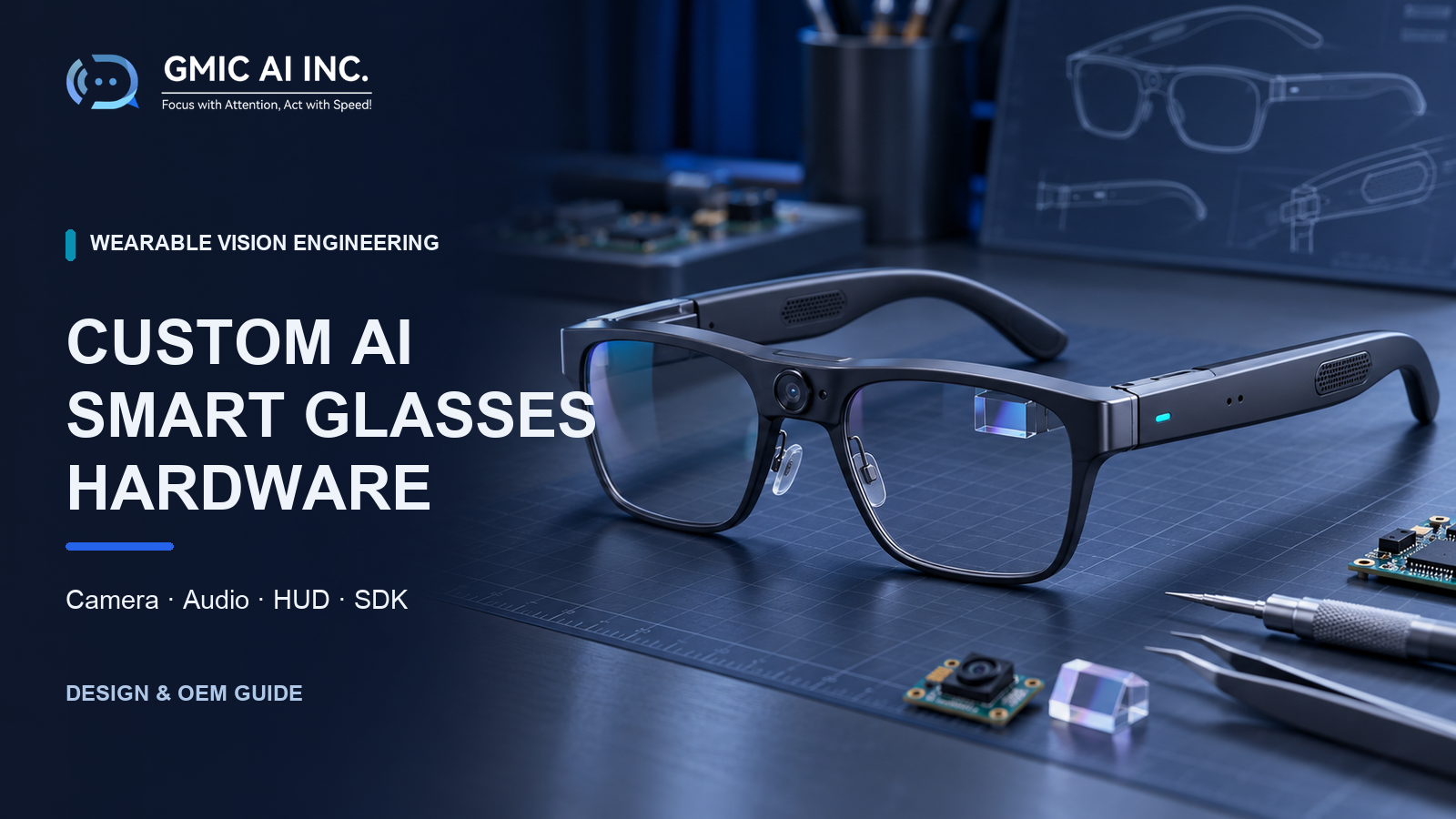
Custom AI smart glasses hardware can give an application a first-person camera, voice input and hands-free audio without forcing every workflow into a phone screen. The difficult part is not adding every available feature. It is choosing which sensing, output and processing architecture can fit the intended frame, battery, thermal envelope, privacy model and customer-owned software stack.
In brief: Start by choosing one of three product classes: audio-first glasses, camera-and-audio glasses, or display-enabled glasses. Then define exactly which raw camera, microphone, button and sensor data the customer App can access. Validate heat, weight balance, recording indication, wind and speech capture, radio recovery and prescription-frame compatibility before committing to tooling.
What Is Custom AI Smart Glasses Hardware?
Custom AI smart glasses hardware is eyewear that combines selected electronics—such as microphones, speakers, cameras, inertial sensors, touch controls, radios or a near-eye display—with firmware and a companion application. The glasses may capture audio and images for an AI service, play spoken responses, show short prompts, or support a customer-specific workflow.
The AI model does not need to run entirely in the frame. A practical system may divide work among the glasses, a paired phone, a customer-controlled edge service and the cloud. The glasses can handle capture, wake events, buffering, local controls and encrypted transfer while a phone performs speech recognition, vision inference or user-interface logic.
That division reduces compute and heat in the temples, but it makes the data protocol, SDK, authentication, offline behavior and service ownership part of the hardware specification.
Choose the Product Class Before the Chipset
| Product class | Main hardware | Best suited to | Primary constraint |
|---|---|---|---|
| Audio-first glasses | Microphones, open-ear speakers, buttons and BLE | Voice assistants, calls, reminders and hands-free notes | Speech capture in wind and noisy environments |
| Camera-and-audio glasses | Camera, microphones, speakers, storage and Wi-Fi/BLE | Visual assistance, field capture, first-person documentation | Heat, battery, privacy indication and upload bandwidth |
| Display-enabled glasses | Camera/audio plus monocular or binocular display | Prompts, captions, translation, navigation or teleprompting | Optical alignment, eye comfort, weight and software complexity |
A low-cost HUD is not a minor option added late in the program. It changes mechanical stack-up, optical calibration, power, thermal behavior, display drivers, user-interface testing and certification planning. If the workflow only needs spoken responses, audio-first or camera-and-audio glasses may provide a lighter and less complex product.
Qualcomm describes its Snapdragon AR1 platform as purpose-built for smart glasses and lists camera, audio, connectivity, display and on-device AI capabilities. Those platform capabilities are a starting point, not evidence that a finished frame will meet a particular battery-life, temperature or image-quality target. The final assembly and workload must be measured.
Camera Architecture: Define the Evidence, Not Just Megapixels
Camera requirements should begin with the AI or documentation task. A barcode reader, scene-description assistant, remote support workflow and continuous first-person recorder do not need the same field of view, frame rate, exposure behavior or data path.
Define:
- still capture, short video, continuous stream or event-triggered frames;
- required field of view and useful working distance;
- acceptable motion blur in walking and head-turn scenarios;
- low-light and high-dynamic-range scenes;
- stabilization and orientation metadata;
- whether raw frames, encoded video or only inference results leave the device;
- local storage behavior during phone or Wi-Fi loss;
- camera indicator behavior tied to actual sensor state.
A high sensor resolution can increase bandwidth, memory and heat without improving the downstream model. Test task-level outcomes—such as readable labels, correct object recognition or usable remote-support footage—on the final lens, frame position and encoder settings.
Microphones and Open-Ear Audio Are a Coupled System
Smart glasses place microphones near the temples, where wind, hair, hinge movement, speech direction and open-ear speaker leakage affect capture. Multiple microphones help only when their spacing, port geometry, clocking and signal processing produce a measurable improvement.
Test the wearer’s voice, nearby speakers, street noise, vehicles, machinery, wind from multiple directions and simultaneous speaker playback. Include head turns, walking, glasses adjustment and hair or hat contact. For voice-agent workflows, measure wake or push-to-talk success, clipped first words, recognition of critical terms, echo during spoken responses and user correction time.
Open-ear speakers preserve environmental awareness but leak sound and have limited low-frequency output. Their position changes with head shape and temple fit. Audio tuning must cover speech intelligibility, maximum safe output, privacy leakage, feedback paths and left/right balance rather than only a laboratory frequency response.
Where Should the AI Run?
| Architecture | Advantage | Main tradeoff |
|---|---|---|
| Glasses-first | Lower latency and less raw-data transfer | More heat, memory, power and software work in the frame |
| Phone-assisted | Uses phone compute, network and user identity | Requires a reliable companion App and background behavior |
| Cloud-assisted | Supports larger models and centralized updates | Network dependency, latency, cost and data-governance scope |
| Hybrid | Can select local, phone or cloud paths by task | More state, version and failure-recovery complexity |
An architecture diagram should identify every component that receives camera, audio, sensor or user-account data. It should also show what happens when the phone is locked, the App is suspended, Wi-Fi changes, cloud access fails or the user revokes permission.
SDK and BSP Access Must Be Defined Before Purchase
“SDK available” is not a complete answer. A demonstration App may expose only high-level commands while the customer needs continuous microphone access, camera frames, button events, timestamps, storage control or custom OTA.
The evaluation checklist should identify:
- supported Android and iOS versions;
- C/C++, Java, Kotlin, Swift or cross-platform interfaces;
- camera modes, frame access and encoder control;
- microphone channels, formats and timestamps;
- speaker routing and echo-control ownership;
- IMU, touch, button, LED and battery events;
- BLE services, Wi-Fi transport and reconnect behavior;
- file listing, checksum, resume and confirmed deletion;
- device provisioning and per-unit identity;
- firmware signing, rollback and update ownership;
- logs, diagnostics and manufacturing-test interfaces;
- licensing, source access and long-term maintenance obligations.
For customer-owned AI, require a working sample that sends the needed original data to a customer-controlled App and endpoint. A PDF API list is not a substitute for that end-to-end proof.
Thermal Design and Weight Balance
The temples touch the head and offer little volume for batteries, processors, cameras, antennas and speakers. Average power alone does not show whether a burst of video encoding, Wi-Fi upload, charging or on-device inference creates an uncomfortable hot spot.
Measure temperature at the skin-adjacent temples, hinges, bridge and battery locations across representative workloads and ambient conditions. Record both steady state and short peaks. Define workload duty cycles rather than claiming “all-day” battery life without a capture, streaming and standby profile.
Total weight is only one comfort variable. Front weight, left-right imbalance, temple pressure, nose-pad load and cable or flexible-PCB stiffness can make a lighter prototype feel worse than a better-balanced one. Test multiple head sizes, prescription configurations and intended wear durations.
Privacy Indicators Must Represent Real Capture State
A camera LED that follows a button press rather than the sensor power state can give false assurance. The system should define how the wearer and nearby people can tell when imaging or audio capture is active, paused, transferring or disabled.
Depending on the workflow, controls may include a visible indicator, physical camera shutter, sensor power isolation, microphone mute, audible cue or administrator policy. None automatically resolves consent, workplace, biometric or recording-law obligations. Legal and sector requirements must be reviewed for the target markets and use cases.
The NIST AI Risk Management Framework provides a lifecycle structure for mapping, measuring and managing AI-related risk. Apply that structure to capture necessity, bystander exposure, access, retention, human review, model error and deletion—not only to model selection.
Storage, Connectivity and Recovery
Camera and audio data should not silently disappear when a phone disconnects. Define whether the glasses stop, buffer locally or continue a limited workflow. Each recording or capture session needs stable identifiers, timestamps, integrity checks and explicit completion states.
BLE may be appropriate for control, status and small data, while Wi-Fi or USB may be needed for larger media. The product specification should distinguish pairing from account binding and state whether a previously bonded phone can access content after ownership changes.
If local storage is used, define full-storage behavior, encryption at rest, lost-device recovery, interrupted writes, secure deletion and factory-reset scope. Review related design patterns in GMIC’s AI voice recorder file-transfer protocol guide and private-cloud AI voice recorder architecture.
Prescription Lenses, Hinges and Serviceability
Electronics cannot be treated separately from eyewear. Lens insertion force, frame flex, hinge cycles, sweat, cosmetics, hair, dust and repeated folding can affect optical alignment, microphone ports, antennas and flexible interconnects.
Decide whether prescription lenses are installed by the factory, an optical partner or the user’s local provider. Document supported lens ranges, frame variants and the effect of lens mass. For replaceable temples or batteries, validate connectors and sealing across the intended service life.
What Should the First Prototype Prove?
| Area | Prototype question | Useful evidence |
|---|---|---|
| Fit | Can intended users wear it for the required duration? | Pressure, slip, balance and prescription-fit trials |
| Camera | Does captured imagery support the actual task? | Scenario footage and task-level accuracy |
| Audio | Does speech remain usable with wind and speaker playback? | Original recordings and recognition metrics |
| Thermal | Are skin-adjacent temperatures acceptable? | Workload-specific temperature traces |
| Data | Can capture recover from disconnects and full storage? | Fault injection and integrity checks |
| Privacy | Do indicators match actual sensor state? | State-transition and hardware-control tests |
| SDK | Can the customer App access required data and controls? | End-to-end reference integration |
| Manufacturing | Can every unit be calibrated and tested? | Camera, audio, radio and indicator fixtures |
Move from an architecture prototype to engineering validation and production-intent builds. The AI hardware development process and hardware prototype validation guide provide useful phase gates.
Anonymized Buyer Pattern: Camera, Audio, HUD and an Open SDK
Recent buyer inquiries often combine a camera, microphone array, open-ear or bone-conduction audio, a low-cost display and full C/C++ SDK access in one target. The important engineering lesson is that these are not independent checkboxes. Adding a display changes power and mechanical architecture; exposing raw camera and audio changes firmware, security and App work; and a low sample-price target may be compatible with platform evaluation but not with a fully custom production design.
A responsible first step is a feature-to-evidence matrix: identify which capabilities exist on a reference platform, which are exposed by the SDK, which require new firmware or hardware, and which have been measured on the exact sample. This preserves the customer’s technical intent without promising unverified specifications, pricing or certification.
Questions to Ask an OEM or ODM Partner
- Is the product audio-first, camera-and-audio, or display-enabled?
- Which raw data and controls are available through the customer SDK?
- Can the product operate with a customer-owned App and backend?
- What functions remain dependent on manufacturer accounts or servers?
- What happens during phone, Wi-Fi, storage or cloud failure?
- How are recording indicators coupled to camera and microphone state?
- Which workload defines battery life and worst-case temperature?
- How are prescription lenses, frame sizes and weight balance validated?
- Who owns firmware signing, source access, tooling and production tests?
- Which final-design samples are used for radio, battery and market-access testing?
Frequently Asked Questions
Do custom AI smart glasses need a display?
No. Voice assistants, first-person capture and remote-support products can use cameras, microphones and open-ear audio without a display. Add a HUD only when visual output materially improves the workflow and justifies the optical, power and validation scope.
Can smart glasses connect directly to a customer-owned AI backend?
Yes, if the architecture, authentication, protocol, App, OTA and support boundaries are designed for it. Confirm every remaining manufacturer service and prove the customer-controlled data path on a representative sample.
Is a C/C++ SDK enough for product development?
Not by itself. Confirm which camera, audio, sensor, storage, radio and update functions it exposes, which platforms it supports, and whether production licensing and maintenance are included.
How many microphones should smart glasses use?
There is no universal number. More microphones help only when their placement, synchronization and processing improve the target speech scenarios on the final frame.
Can a sample price predict the production program cost?
No. A platform sample validates selected functions. Custom frame design, optics, electronics, firmware, App integration, tooling, fixtures, certification support and production volume need separate scope and commercial terms.
Build the Data Path and Wearability Together
Custom AI smart glasses hardware succeeds when the frame, sensing, audio, compute, SDK, privacy controls and customer-owned workflow operate as one testable system. Choose the product class first, then require evidence for the real camera, audio, thermal, connectivity and software scenarios before freezing the enclosure.
Contact GMIC to scope a custom AI smart glasses hardware project.
Author and review note: This page is a product-development guide, not a product specification, medical or legal opinion, certification claim or quotation. Capabilities and requirements must be confirmed for the selected design, workload and market.
Authoritative sources: