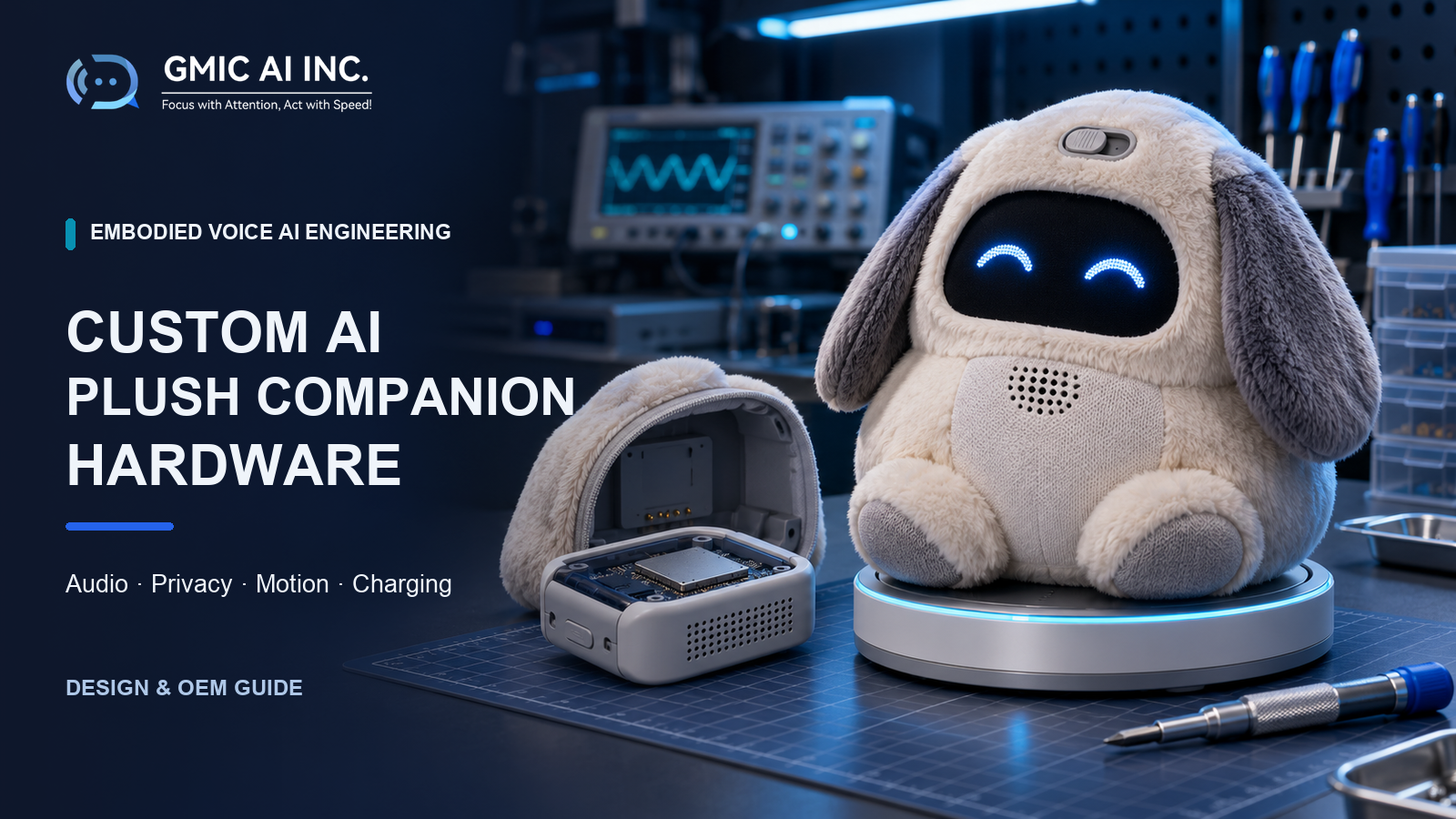
Custom AI plush companion hardware turns a soft character into a voice product with microphones, a speaker, wireless connectivity, optional display eyes or motion, and a service that manages speech and AI responses. The hard part is not placing electronics inside a toy. It is making acoustics, heat, privacy, cleaning, charging and the customer-owned AI stack work together inside a soft, changing enclosure.
In brief: Choose the AI and connectivity architecture before the plush form is frozen. Treat fabric, filling and seams as part of the acoustic design; place electronics in a removable, protected module where practical; give users an unambiguous way to mute capture; and validate the complete voice path, thermal behavior and failure recovery during EVT. If the product is directed to children, data practices and parental controls must be designed with qualified legal and safety review.
What Is Custom AI Plush Companion Hardware?
Custom AI plush companion hardware is an interactive soft product built around a reusable or custom electronics platform. A typical system can include one or more microphones, a speaker and amplifier, a low-power processor, Wi-Fi and BLE, a battery and charger, buttons or touch sensors, LEDs or display eyes, and optional camera or motor control.
The companion may use an on-device wake word and send the remaining request to a phone or cloud service. A more capable local processor can run speech or vision functions on the product, while a hybrid design keeps sensitive or latency-critical tasks local and uses the cloud for larger models. These are architecture choices with different power, cost, privacy and support consequences—not interchangeable marketing labels.
Choose Local, Phone-Assisted, Cloud or Hybrid AI
| Architecture | Best fit | Main advantage | Main engineering constraint |
|---|---|---|---|
| Phone-assisted | Mobile companion App owns internet access and AI | Lower product power and simpler credentials | Depends on phone proximity and background App behavior |
| Direct cloud | Home or managed Wi-Fi product | Standalone conversation after provisioning | Network setup, latency, service cost and outage behavior |
| Local AI | Narrow offline commands, wake word or private workflows | Fast response and less transmitted data | Processor, memory, heat and model-update limits |
| Hybrid | Local trigger and controls with cloud conversation | Balanced latency, privacy and capability | More states, routing rules and test cases |
Start with a sequence diagram for wake, capture, speech processing, agent response and playback. Mark where audio, text, account identifiers and diagnostics are created, stored and deleted. Then define behavior when Wi-Fi disappears, the AI service times out, the account is revoked or the firmware update fails.
Espressif’s public AI companion reference illustrates a practical hardware split: microphone capture, speaker playback, connectivity, display, camera and a rotating-base interface can be separate boards while the voice pipeline connects to local or cloud processing. A production plush product still needs its own acoustic, safety, privacy and manufacturability validation.
Plush Fabric Is Part of the Acoustic System
Fabric, embroidery, foam and loose filling absorb and scatter sound. Their position also changes as the product is hugged or placed against a surface. A microphone that performs well on an open development board can lose level or frequency response behind a dense textile, while the speaker can couple through the internal frame and feed back into the microphone.
Design the final acoustic path deliberately:
- keep a controlled opening or acoustically transparent zone in front of each microphone;
- prevent loose fibers and filling from touching the microphone port;
- give the speaker a defined front volume, vent path and mechanical support;
- isolate the microphone structure from speaker and motor vibration;
- tune echo cancellation with the final shell, filling and volume limits;
- test upright, lying down, held close, partly covered and pressed against furniture;
- retain original recordings so recognition results can be traced to the physical design.
Far-field performance cannot be accepted from a component datasheet alone. Set test distances, angles, room noise, playback level and speech set, then compare the engineering sample with the final plush construction.
Use a Removable Electronics Pod Where the Product Allows It
A protected electronics pod can simplify assembly, service and cleaning. It may contain the PCB, battery, audio components and connectors while the fabric shell carries the character form. The interface needs controlled orientation, retention and strain relief so the module cannot shift, rattle or expose accessible parts.
The pod concept must answer:
- can the textile be cleaned only after electronics are removed;
- can a caregiver remove the module while a child cannot access it unintentionally;
- are seams, zippers, fasteners and cables compatible with the age and market claim;
- does reassembly preserve microphone and speaker alignment;
- can factory service replace the battery or board without destroying the plush;
- does removal securely disconnect power and erase or protect stored data.
If the electronics are permanently enclosed, the cleaning instructions, sealing strategy, battery service policy and end-of-life plan must be defined before mass production.
Display Eyes, Camera and Motion Should Be Optional Subsystems
Display eyes can communicate listening, thinking, muted and error states, but brightness, animation rate and idle power need limits. A camera adds a much larger privacy and data-flow scope. If vision is essential, use a physical shutter or other direct mechanical control where feasible, and ensure the user can verify the true capture state without relying only on software.
Motion should begin with a specific interaction goal. A rotating base, head turn or small gesture needs motor current, position sensing, pinch and entanglement review, stall detection, noise control and cable management. Record motor noise through the product microphones during a real voice session. A mechanism that looks quiet in free air can dominate the audio after it is attached to a fabric shell and internal frame.
Separate these modules in the product requirements so a screen-free, camera-free or motion-free configuration can reuse the core voice architecture without carrying unnecessary cost and risk.
Privacy, Parental Controls and Data Ownership
For a child-directed product, audio files containing a child’s voice can be personal information under U.S. COPPA rules. The FTC guidance also describes a narrow enforcement policy for audio used only as a substitute for written words and retained briefly for that purpose. Product teams should not generalize that exception; obtain qualified legal advice for the exact audience, data flow, retention and market.
Useful system requirements include:
- parent or administrator provisioning and account recovery;
- a physical mute or power control that blocks the actual capture path;
- clear listening, processing, playback and offline states;
- approved contacts, skills, content, languages and operating hours;
- defined audio, transcript, memory and diagnostic retention;
- access, export, deletion and device-transfer controls;
- per-device credentials, revocation and secure factory reset;
- signed OTA updates, rollback and staged deployment;
- an endpoint inventory showing every production service and subprocessor.
Avoid vague claims such as “private by design” unless the product specification and evidence define what stays local, what leaves the device, how long it remains and who can access it.
For a customer-controlled deployment, see GMIC’s private-cloud AI voice recorder architecture and AI voice recorder SDK evaluation checklist.
Battery, Charging and Thermal Design Inside Fabric
Plush filling reduces convection and can trap heat around the processor, battery, charger and speaker amplifier. Measure temperature with the final textile, filling density and internal frame during charging, repeated conversations, maximum-volume playback, motor operation and OTA updates. Do not infer safe behavior from an uncovered PCB.
Define current for shipping, off, idle, wake-word, Wi-Fi connection, capture, upload, inference wait, playback, display, motion, charging and fault recovery. Peak radio, speaker and motor loads can overlap, so average current alone is not enough to size the cell and power path.
A wired port, removable pod, pogo-pin cradle and wireless charging base create different tradeoffs. A rotating wireless base also needs alignment tolerance, foreign-object and temperature behavior, motor control and a recovery state when charging or rotation fails. Claim Qi compatibility only when the selected design and certification path support it.
Customer-Owned App, Cloud and Model Integration
Many buyers already have an App, LLM gateway, content system or character engine. Prove that integration on an engineering sample before the enclosure is frozen. The interface specification should include:
- provisioning, account binding and device transfer;
- wake, start, stop, cancel, mute and barge-in events;
- audio format, timestamps, buffering and packet recovery;
- request IDs, duplicate handling and response timeout;
- playback, volume, expression and motion commands;
- authentication, certificate rotation and endpoint configuration;
- OTA ownership, signing, staged release and rollback;
- logs and diagnostics that minimize voice content;
- offline and degraded-mode behavior;
- every manufacturer service that remains after production handoff.
Use GMIC’s AI hardware development process to align system definition, prototype gates and production ownership, and the hardware prototype validation guide to define measurable evidence before design freeze.
EVT, DVT and PVT: What Each Stage Must Prove
| Stage | Main question | Example evidence |
|---|---|---|
| EVT | Does the architecture work in the intended form? | End-to-end voice traces, acoustic recordings, current and temperature data, camera/mute verification |
| DVT | Does the design survive real use and applicable requirements? | Drop, pull, seam, cleaning, battery, radio, ESD, thermal and software fault results |
| PVT | Can the factory build and test it repeatedly? | Work instructions, programming logs, fixture capability, acoustic limits, traceability and yield |
| MP | Can quality and software support remain controlled? | Change control, AQL plan, OTA rollout, returns analysis and component monitoring |
Certification labels should follow the final configuration and target market. Radio authorization, battery transport, materials, toy or consumer-product safety, charger and environmental requirements can all change with the product, age claim, region and included accessories. Ask the responsible laboratory and compliance specialists to confirm the applicable scope.
Anonymized Buyer Pattern: Local AI Plush Desktop Companion
Recent product inquiries combine a soft desktop character with far-field voice, optional camera and physical shutter, expressive eyes, quiet motion, a rotating charging base and a customer-owned AI service. The request often includes multiple prototype and pilot stages plus a need to understand which functions can move from modules to a lower-cost chip-down design later.
The lowest-risk first build is not the most feature-complete version. It is a modular EVT unit that proves the voice loop, privacy controls, thermal behavior, removable electronics, one expression path and one charging method. Camera, motion and advanced local AI should enter the build only when they support a defined user task and have their own measurable acceptance criteria. This preserves evidence when the BOM or enclosure changes and reduces the chance that several unproven subsystems fail at once.
Frequently Asked Questions
Can a plush companion run AI locally?
It can run a wake word, narrow commands or selected speech and vision functions locally when the processor, memory, thermal and power budgets support them. Larger conversational models often use a phone, gateway or cloud service. A hybrid architecture can keep triggers and controls local while routing permitted requests to the cloud.
How do you stop fabric from muffling the microphone and speaker?
Use controlled acoustic openings, protect microphone ports from fibers, give the speaker a defined chamber and tune the system in the complete plush assembly. Test multiple positions, filling densities and real handling conditions rather than relying on an open-board sample.
Should the electronics be removable?
A removable pod can improve cleaning, service and platform reuse, but its retention, orientation, connectors and access controls must be engineered. It is not automatically suitable for every age group or form factor.
Does a physical camera shutter solve privacy compliance?
It reduces ambiguity about image capture but does not address audio, accounts, transcripts, model memory, logs, retention or third-party services. Privacy and legal review must cover the complete data lifecycle.
Can the product connect to a customer-owned App and LLM?
Yes, if the protocol, authentication, endpoint control, audio path, OTA ownership and failure behavior are specified and proven. The production endpoint inventory should make any remaining manufacturer dependency visible.
What should the first prototype test?
Test the complete voice session, acoustic performance inside the final materials, actual mute and shutter behavior, wireless recovery, power peaks, temperature, cleaning or pod removal, and the customer-owned AI path. Add optional motion or vision only with separate acceptance criteria.
Build a Testable Companion, Not a Feature List
Custom AI plush companion hardware succeeds when the soft form, acoustics, electronics, privacy controls, charging and AI service behave as one supportable product. Freeze the architecture and data lifecycle before styling the enclosure, then use EVT, DVT and PVT evidence to decide which features are ready for production.
Contact GMIC to scope a custom AI plush companion hardware project.
Author and review note: This page is a product-development guide, not a product specification, legal opinion, safety certification or quotation. Requirements must be confirmed for the selected design, age group, workflow and market.
Authoritative sources: