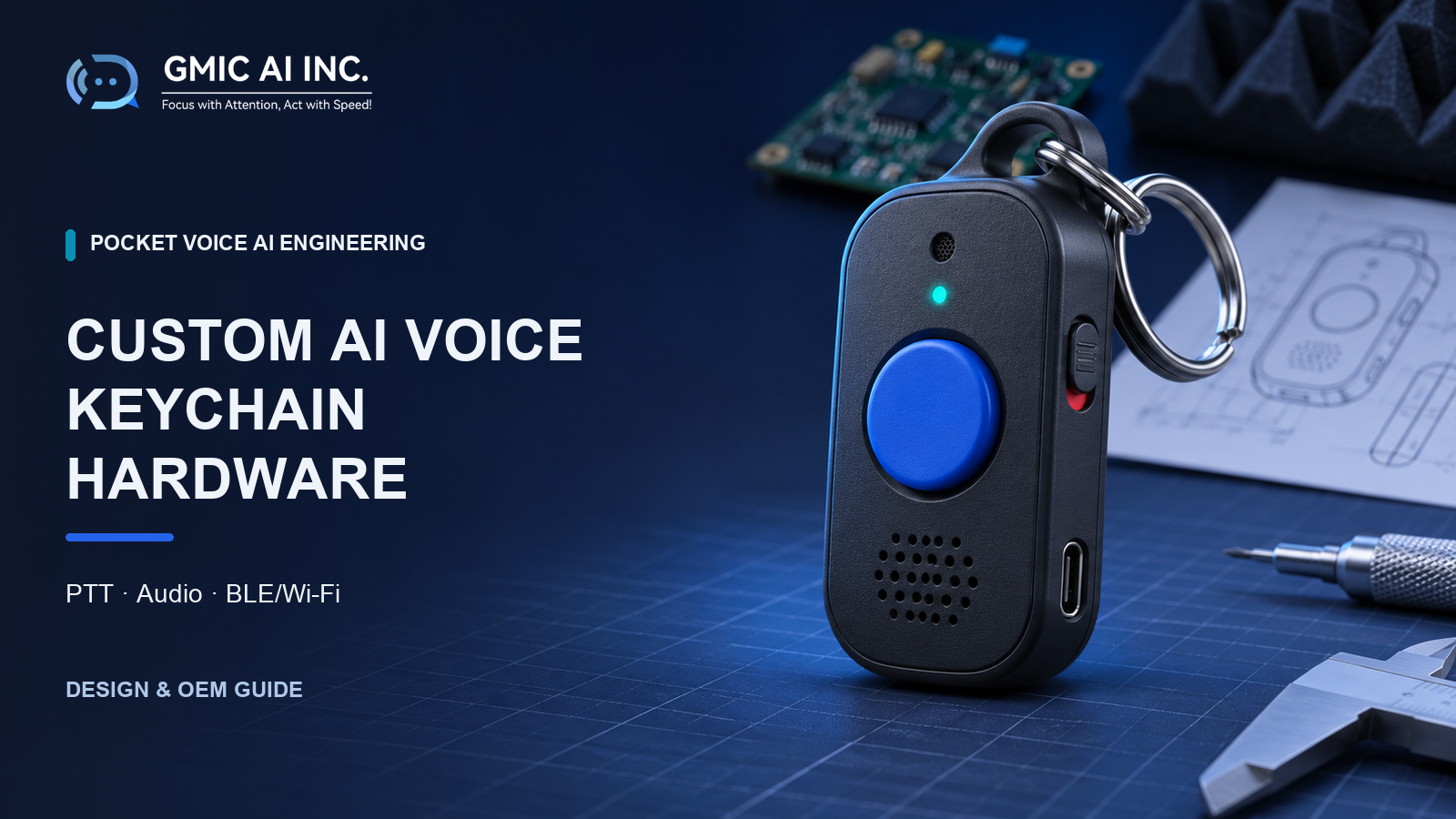
Custom AI voice keychain hardware can give users a dedicated push-to-talk path to an AI agent without requiring them to unlock a phone. A small enclosure can contain a microphone, speaker, physical controls, BLE or Wi-Fi, status feedback and a rechargeable battery—but the useful product is the complete voice session, not the list of parts.
In brief: Decide whether the keychain is a phone accessory, a standalone Wi-Fi voice agent or a hybrid device. Use a deliberate push-to-talk control for clear consent and battery behavior, separate microphone capture from speaker playback, and prove the customer-owned App or cloud path before committing to the enclosure. For child-directed products, parental notice, consent, retention and account controls must be designed into the system rather than added after launch.
What Is Custom AI Voice Keychain Hardware?
Custom AI voice keychain hardware is a pocket-sized device that captures a spoken request and returns audio or another controlled response. It may attach to a backpack, lanyard or key ring, or operate as a removable clip. Typical building blocks include a digital microphone, audio codec or I2S interface, compact speaker and amplifier, push-to-talk and mute controls, LEDs or haptics, flash memory, BLE, optional Wi-Fi and a rechargeable battery.
The AI model usually does not need to run in the keychain. The device can capture, buffer and encrypt audio while a paired phone, private server or cloud service performs speech recognition, agent logic and text-to-speech. That division makes the protocol, credentials, offline behavior and data ownership part of the hardware specification.
Choose the Connectivity Architecture First
| Architecture | Best fit | Advantage | Main constraint |
|---|---|---|---|
| BLE phone accessory | A companion App owns connectivity and AI | Lower radio power and simpler provisioning | Depends on phone proximity and background App behavior |
| Standalone Wi-Fi | Home, school or managed-site use | Direct cloud connection without a phone | Provisioning, roaming and higher power |
| Hybrid BLE + Wi-Fi | Mobile setup plus direct operation on approved networks | Flexible deployment and recovery | More firmware states, credentials and testing |
| Local gateway | Enterprise, classroom or privacy-sensitive fleet | Customer-controlled network and policy | Gateway installation and fleet management |
BLE is useful for setup, controls and compact data; continuous or large audio transfer needs a measured throughput and power budget. Wi-Fi simplifies direct cloud access but creates credential, roaming, captive-portal and offline questions. Define what the device does when no approved path is available: reject the request, buffer it, provide a local response or enter a clearly indicated error state.
Push-to-Talk, Wake Word or Open Conversation?
A physical push-to-talk button creates a visible user action, bounds the captured audio and reduces accidental activation. It is usually the cleanest starting point for a keychain. The firmware must still define debounce, press-and-hold timing, clipped first words, release behavior, cancellation and what happens if connectivity fails mid-request.
Wake-word operation can feel more natural but increases connected-idle power and false-activation risk. Open conversation requires echo cancellation, turn-taking, interruption handling and stronger privacy controls. These modes should be treated as different products or test configurations, not as interchangeable settings.
The user should be able to distinguish ready, listening, processing, playing, muted, disconnected, low-battery and error states without opening an App. Feedback should represent the actual system state rather than only a button press.
Microphone and Speaker Design Share One Enclosure
The speaker can leak directly into the microphone through air, plastic and the PCB. A keychain hanging from a bag also experiences rubbing, impact, wind and changing orientation. Audio validation should include the final enclosure, attachment hardware and expected carrying positions.
Test:
- near-mouth push-to-talk and arm-length use;
- speech while walking, outdoors and inside vehicles;
- zipper, key, fabric and backpack contact;
- speaker playback followed by an immediate user interruption;
- simultaneous playback and capture if full duplex is required;
- quiet speech, child speech and different accents only where the target market requires them;
- microphone blocking, water droplets and pocket use;
- maximum speaker output, distortion and sound leakage.
One well-positioned microphone may outperform multiple poorly spaced microphones. Add a second microphone only when the final geometry and DSP deliver measurable improvement. The speaker needs a defined acoustic chamber and vent path; simply fitting a larger driver does not guarantee clearer speech.
Customer-Owned App, Cloud and LLM Integration
Buyers often want to connect the device to their own App, cloud and model rather than a manufacturer account. Prove that path on an engineering sample before treating the platform as suitable.
The integration specification should cover:
- pairing, account binding and approved-device rules;
- start, stop, cancel and mute events;
- audio format, packet size, timestamps and integrity checks;
- request IDs and duplicate-response handling;
- playback control, volume and interruption;
- device state, battery and error reporting;
- authentication, per-device credentials and revocation;
- endpoint configuration and certificate rotation;
- OTA signing, rollback and long-term support;
- diagnostics that exclude unnecessary voice content;
- every manufacturer service remaining in production.
For a private deployment, review GMIC’s private-cloud AI voice recorder architecture and AI voice recorder SDK evaluation checklist.
Privacy and Parental Controls
If the product is directed to children, voice recordings can be personal information under applicable law. The U.S. Federal Trade Commission’s COPPA guidance discusses parental notice and consent obligations and specifically addresses audio files containing a child’s voice. Product teams should obtain qualified legal review for the intended market and data flow.
Hardware and service requirements may include:
- parent or administrator provisioning;
- approved contacts, skills, content and operating hours;
- a physical mute or power control;
- clear capture and network indicators;
- minimal collection and defined deletion behavior;
- access, export and account-deletion controls;
- no hidden advertising or third-party endpoints;
- age-appropriate response and escalation policies;
- secure factory reset and reassignment.
Do not claim that an LED or push-to-talk button alone makes a product compliant. The full lifecycle—from capture through transcription, inference, logs, review, retention and deletion—must match the policy and legal scope.
Battery, Charging and Thermal Limits
Define named power states: shipping, off, idle, advertising, connected, listening, uploading, processing wait, playing, updating and fault recovery. Measure current and peak load in each state. Speaker playback and Wi-Fi transmission can create peaks that an average-current estimate hides.
A small battery must be qualified with its protection circuit, charger and enclosure. Validate temperature during charging, repeated voice sessions and OTA updates. “All-day” should be replaced by a workload such as a stated number and duration of requests plus standby time.
USB-C, pogo pins and a charging dock create different sealing, cost and child-access considerations. The charging interface should not expose debug or storage access unless the product intentionally supports it.
Mechanical Safety and Real-World Durability
A keychain is dropped, swung, pulled, crushed in bags and exposed to keys, dust and moisture. The attachment point is a structural feature, not decoration. Validate pull, twist, repeated attachment cycles and drop orientations with the intended ring, clip or lanyard.
For child-accessible products, evaluate small parts, battery access, sharp edges, cord or lanyard configuration, charging behavior and applicable toy or product-safety requirements with qualified specialists. Market and age claims change the compliance scope.
What Should the First Prototype Prove?
| Area | Prototype question | Useful evidence |
|---|---|---|
| Interaction | Can users start, cancel and recover without looking? | Task completion and false-trigger logs |
| Audio | Is speech usable across carrying positions and noise? | Original recordings and recognition metrics |
| Playback | Is the response intelligible without excessive leakage? | Listening tests and acoustic measurements |
| Connectivity | Does the session survive phone, Wi-Fi and cloud failure? | Fault injection and recovery traces |
| Privacy | Do mute and indicators match actual capture state? | State-machine and sensor-path tests |
| Power | Does the defined request workload meet the target? | State current, peaks and temperature |
| Mechanical | Does attachment survive realistic use? | Pull, cycle, drop and environmental tests |
| Integration | Can the customer system operate without hidden dependencies? | Endpoint inventory and reference App proof |
Anonymized Buyer Pattern: A Small Voice Agent for a Child
Recent inquiries ask for a child-oriented keychain or clip with microphone, speaker, push-to-talk, mute, BLE, optional Wi-Fi, a customer-owned cloud or LLM and spoken responses. The important product decision is not whether those components fit. It is whether the complete system can make capture deliberate, restrict who and what the agent can access, recover from connectivity loss, manage voice data and survive daily use.
The first build should therefore prove a narrow end-to-end workflow with a parent-controlled account, explicit capture, bounded retention and a small set of approved responses. Broader conversation modes should be added only after the policy, audio, safety and support boundaries are validated.
Frequently Asked Questions
Can an AI keychain work without a phone?
Yes, with Wi-Fi or another direct network path, but provisioning, credentials, offline behavior and power consumption must be designed. A BLE-only product normally depends on a paired phone or gateway.
Should it use push-to-talk or a wake word?
Push-to-talk is usually the clearer first architecture for consent, battery and predictable sessions. Wake words require continuous listening, false-activation testing and a larger idle-power budget.
Can it connect to a customer-owned LLM?
Yes, if the protocol, authentication, audio path, endpoint configuration and OTA ownership are defined. Verify every remaining manufacturer dependency on a working sample.
Does the device need local storage?
Not always. A small buffer can protect against short radio interruptions, while full offline recording requires encryption, file integrity, synchronization and deletion rules.
Is a child-friendly enclosure enough for a children’s product?
No. Mechanical safety, battery access, data practices, parental controls, content behavior, market claims and applicable regulatory requirements all need review and validation.
Build the Voice Session, Not Just the Gadget
Custom AI voice keychain hardware succeeds when physical interaction, audio, connectivity, privacy, power and the customer-owned AI service behave as one testable system. Begin with a bounded push-to-talk workflow and explicit data lifecycle, then validate the real carrying, network and user conditions before design freeze.
Contact GMIC to scope a custom AI voice keychain hardware project.
Author and review note: This page is a product-development guide, not a product specification, legal opinion, safety certification or quotation. Requirements must be confirmed for the selected design, age group, workflow and market.
Authoritative sources: