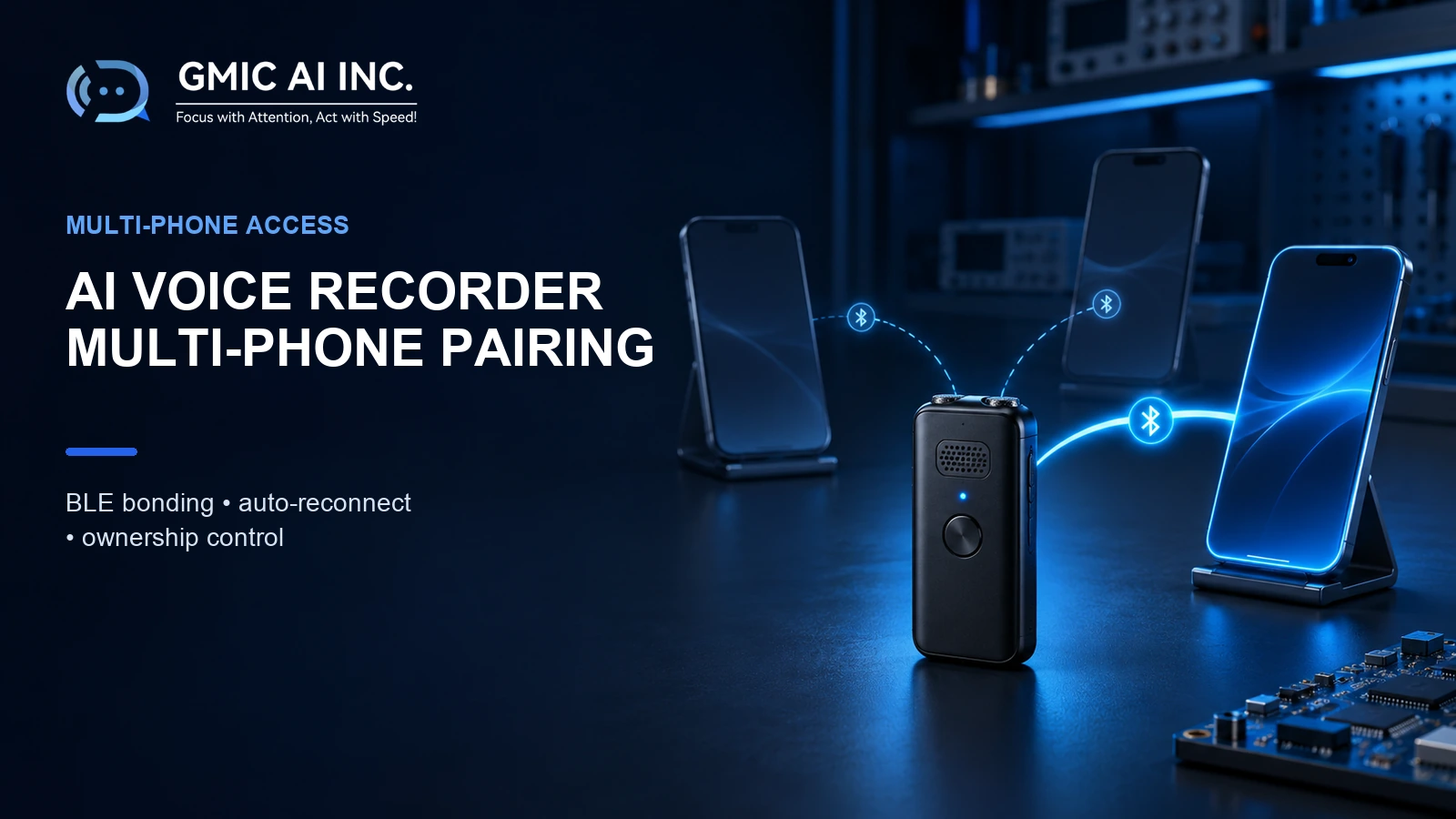
Supporting several phones on one AI voice recorder is not simply a matter of increasing the BLE bond-table size. A production design must separate Bluetooth bonding from product ownership, decide which phone may become active, prevent two apps from fighting for control, recover safely in the background, and provide an authorized path for replacement phones without exposing recordings.
This guide is for OEM and ODM teams defining recorder firmware, mobile SDK and backend behavior. It focuses on a common enterprise requirement: store two to four authorized phones, allow only one active control and transfer session, reconnect predictably, and keep recording safe when no phone is available.
Why “pair with four phones” is an incomplete requirement
Consumer instructions usually explain how to pair or forget one device. An integrated recorder needs a lifecycle and arbitration model.
In anonymized buyer questions reviewed by GMIC, teams asked whether a recorder could retain at least two and preferably four phone relationships, connect to only one at a time, automatically return to the most recently used phone, support locked-screen reconnection, expose the bond list inside their app, and remove every prior phone during an ownership reset. These are separate decisions.
Define these terms first:
| Term | Meaning in the product | Common mistake |
|---|---|---|
| Pairing | Negotiation that establishes security material | Treating the UI event as permanent ownership |
| Bonding | Retaining keys for future authenticated connections | Assuming a bond authorizes every app command |
| App authorization | Product-level permission to control or read the recorder | Relying only on the phone OS bond list |
| Ownership | Account or tenant relationship governing the device | Equating the last connected phone with the owner |
| Active connection | Current BLE link and session | Allowing every bonded phone to seize it |
| Trusted recovery | Authorized enrollment of a replacement phone | Opening unrestricted pairing mode after failure |
The Bluetooth bond table is one security layer, not the complete ownership database.
Choose the multi-phone operating model
The phrase “supports multiple phones” can mean several architectures.
Multiple stored bonds, one active connection
The recorder remembers several phones but maintains one active GATT session. This is often the clearest model for file transfer, firmware update and destructive controls because one app owns the transaction at a time.
Multiple simultaneous BLE connections
The peripheral maintains links to more than one central. This can be useful for separate roles, but it increases RAM, scheduling, power, radio airtime and state-machine complexity. The controller and stack limit must be verified on the chosen chipset; Bluetooth version alone does not guarantee a particular practical connection count.
One owner plus temporary guests
An owner account controls enrollment and sensitive actions, while a guest phone receives limited, time-bound access. This is usually safer than treating all stored bonds as peers.
For most screenless recorders, multiple stored authorizations with one active control session is easier to explain and validate. If the use case genuinely requires concurrent phones, specify exactly which services and commands each connection may use.
Separate OS bonding from application authorization
BLE bonding lets two devices reuse stored security keys. It does not tell firmware whether the connecting app belongs to the right customer tenant, whether a former employee should still have access, or whether a phone restored from backup may read recordings.
After the encrypted BLE link is established, require a product-level authenticated session. Depending on the threat model, this may use a device-specific credential, an account-issued token, a challenge-response protocol or another approved method.
Store separate records for:
- controller identity or resolvable address information needed by the stack;
- bond/key slot and security properties;
- product authorization ID;
- account or tenant ID, if applicable;
- role and command permissions;
- enrollment time and method;
- last successful authenticated use;
- revocation state and credential version.
This separation allows the app and backend to revoke authorization even if stale Bluetooth keys remain on one side. It also prevents “bonded” from automatically meaning “may erase, export or re-provision.”
For stronger physical enrollment, the authorization step can work with the NFC authentication model for AI voice recorders.
Define how a phone wins the active connection
If several bonded phones are nearby, uncontrolled auto-reconnect can make them compete. One phone connects, another opens the app, the first drops, and transfers or commands fail unpredictably.
Choose and document a priority policy:
| Policy | Advantage | Risk to manage |
|---|---|---|
| Most recently active | Familiar consumer behavior | Old phone may keep reclaiming the device |
| Explicit primary phone | Predictable | Recovery required if primary is lost |
| Owner first, guest second | Matches role model | Backend/app roles must stay consistent |
| Physical-selection window | Strong user intent | Needs clear LED/button UX |
| First authorized request after idle | Simple | Nearby apps may race |
| Backend-issued lease | Strong fleet control | Requires connectivity and lease expiry logic |
A practical single-connection design can advertise normally while idle, connect only to an authorized phone, then stop accepting competing control connections until the active session ends or a takeover policy succeeds.
Do not disconnect an active file transfer, OTA update or erase operation merely because a higher-priority phone appears. Define transaction locks and safe cancellation boundaries.
Design a deterministic connection state machine
The recorder, app and backend need consistent states. One example is:
- unclaimed: accepts only the approved ownership-enrollment flow;
- owned and idle: advertises for authorized phones under the reconnect policy;
- connecting: establishes link security and product authentication;
- active control: one phone holds the control session;
- active transfer: file or update transaction owns a lease;
- handoff pending: another authorized phone has requested takeover;
- recovery: normal owner phone unavailable; restricted recovery rules apply;
- reset pending: destructive reset is authenticated and durable;
- service mode: diagnostic access is separated from customer ownership.
Every transition should define timeouts, error codes, LED/haptic feedback and the state after power loss. A screenless recorder must not rely on an app message that may never appear.
Store bond records safely and handle capacity explicitly
Bond tables are finite. Specify the maximum, storage location, replacement policy and behavior when full.
Do not silently evict an arbitrary bond. That can lock out an owner or leave a phone believing it is still trusted. Options include:
- reject enrollment and return `bond_table_full`;
- require the owner to choose a phone to remove;
- evict only an expired guest authorization;
- allow a physical, authenticated replacement flow;
- reserve one protected owner slot and separate guest slots.
Bond records and product authorization records should update atomically or with a recoverable journal. Test power loss between key creation, authorization commit and confirmation to the app.
The phone and recorder can become asymmetric: one side forgets the bond while the other retains it. Detect key-missing and authentication failures, then enter a defined re-pair or revocation flow instead of looping forever.
Background reconnect is an OS contract, not a firmware promise
Recorder firmware can advertise and accept a known central, but mobile operating systems control when an app may scan, connect or run in the background.
Apple documents Core Bluetooth background modes and state preservation/restoration for eligible apps and pending Bluetooth work. It also documents conditions where restoration will not relaunch an app, including user actions such as force-quitting in relevant OS versions. See Apple’s Core Bluetooth background processing guide and Bluetooth state restoration relaunch rules.
Android likewise applies general background-work restrictions to BLE. Its official background BLE guidance distinguishes connection approaches and notes that disconnection behavior depends on how the GATT connection is established.
Therefore, do not promise “always reconnects in the background.” Specify testable conditions:
- app in foreground, background, suspended or terminated by the OS;
- app explicitly force-quit by the user;
- Bluetooth toggled off and on;
- phone rebooted and not yet unlocked;
- recorder out of range and returning later;
- OS battery optimization enabled;
- several authorized phones simultaneously nearby;
- permissions revoked or changed after an OS update.
Product documentation should explain which user actions disable background behavior.
Keep recording independent of the phone connection
If the recorder is intended for offline capture, disconnecting the phone must not stop or invalidate recording. Treat capture, control and synchronization as separate subsystems.
Define what happens when the active phone disappears:
- recording continues locally according to policy;
- open audio is finalized safely if the user stops recording on-device;
- metadata and a stable recording ID persist;
- unsynchronized count remains accurate;
- another authorized phone may connect only under the takeover policy;
- deletion waits for an acknowledged complete transfer if that is the configured rule;
- no untrusted phone can infer sensitive recording names or counts.
The transfer layer should resume by stable recording and chunk IDs, not by whichever phone happens to connect. See the AI Voice Recorder File Transfer Protocol.
Design ownership transfer and lost-phone recovery separately
Changing phones is not necessarily changing owners. Provide distinct flows.
Replacement phone, same owner
The backend or an existing authorized channel proves account ownership, the recorder enters a time-limited enrollment window, and the new phone receives an appropriate role. The old phone can be retained or revoked explicitly.
Lost phone
Do not require the missing phone to approve its own removal. Use a controlled recovery path combining account proof, device possession and, where appropriate, an admin or physical credential. Rate-limit attempts and notify the account when a new phone is enrolled.
New owner or tenant
Remove all old product authorizations, BLE bonds and tenant credentials under the ownership-transfer reset policy. Preserve only the intended manufacturing identity and approved firmware state. The detailed reset data map belongs in the AI Voice Recorder Factory Reset and Secure Erasure guide.
Service access
A repair phone should not become a customer owner. Use a separate, restricted service credential and ensure diagnostic tooling cannot read recordings or permanent secrets unless the service policy explicitly permits it.
Expose bond and authorization management in the app
The owner should see a human-readable list of authorized phones without relying on raw MAC addresses, which may be private, randomized or unstable at the application layer.
Useful fields include:
- user-assigned phone name;
- role: owner, admin, member, guest or service;
- enrolled date and method;
- last authenticated use;
- active/inactive state;
- credential version;
- revoke action and confirmation;
- whether OS-level unpairing is also required.
Avoid displaying only generic model names such as “iPhone” when several family members use the same model. Do not expose a permanent hardware identifier to every guest unless it is required.
Revocation should update the backend and recorder. If the recorder is offline, show a pending state and define when the local revocation becomes effective.
Protect pairing mode and takeover commands
An always-open pairing mode invites nearby enrollment attempts. Require clear user intent, for example a physical action, authenticated owner command, NFC credential or time-limited challenge.
Security requirements should include:
- LE Secure Connections where supported by the complete platform;
- an association model appropriate to the threat environment;
- limited pairing duration and failed-attempt rate limits;
- replay protection for product-level authentication;
- no hard-coded fleet-wide enrollment secret;
- authenticated commands for add, remove, handoff and reset;
- production debug interfaces locked under policy;
- logs that record status and identifiers but never recording content or reusable keys.
A six-digit comparison is useful only when the device and user experience can actually present and verify it. A screenless product needs another authenticated out-of-band or physical-presence design rather than pretending a numeric comparison occurred.
Coordinate OTA and schema changes across every phone
Different authorized phones may run different app versions. The BLE protocol should expose firmware version, capability bits and schema version before a phone attempts a transaction.
During an OTA update:
- one phone owns the update lease;
- competing control sessions are rejected or restricted;
- the bond and authorization database is migrated safely;
- rollback preserves compatible records;
- recordings and transfer checkpoints survive unless policy states otherwise;
- old apps receive a clear unsupported-version error instead of corrupting state.
See AI Voice Recorder OTA Firmware Updates for the broader signed-update and rollback model.
Build a multi-phone acceptance matrix
Test with real iOS and Android devices, not only a desktop BLE tool.
| Test | Expected result |
|---|---|
| Enroll first owner phone | Ownership and bond commit atomically |
| Enroll second and fourth phone | Each gets the intended role without replacing owner |
| Attempt fifth phone at capacity | Explicit policy response; no silent eviction |
| Two authorized phones open app | Deterministic active-session winner |
| Second phone requests takeover | Handoff follows policy; active transaction is protected |
| Active phone leaves range | Recorder continues recording and returns to idle/reconnect policy |
| Recently used phone returns | Reconnect follows defined priority |
| Phone force-quits app | Behavior matches documented OS limits |
| Phone forgets bond only | Recorder detects asymmetric state and provides recovery |
| Recorder deletes one bond | Removed phone cannot authenticate with stale state |
| Lost phone recovery | New phone enrolls only after approved proof and physical presence |
| Ownership transfer reset | All previous phones and credentials are rejected |
| Reboot during bond update | Previous valid or complete new state is recovered |
| OTA with several stored phones | Database survives migration/rollback and old apps fail safely |
Record phone model, OS version, app build, recorder hardware and firmware revision, security level and observed reconnect timing. “Worked once” is not a release criterion.
Questions for an OEM or ODM requirements document
- How many bonds and product authorizations must the recorder store?
- Is only one phone active, or are concurrent connections required?
- Which phone wins when several authorized phones are nearby?
- Which operations lock the active session against takeover?
- How is product ownership proven after the BLE link is encrypted?
- What roles and command permissions exist?
- What happens when the bond table is full?
- How are asymmetric bonds detected and repaired?
- Which iOS and Android background states must be supported and tested?
- Does recording continue independently when every phone is disconnected?
- How does a lost-phone owner enroll a replacement safely?
- Which records are removed during unbind versus ownership reset?
- How do OTA migration and rollback preserve authorization data?
- What evidence proves that a revoked phone cannot reconnect or read recordings?
These decisions should be defined with firmware integration for AI devices and the broader voice AI hardware architecture.
Frequently Asked Questions
Can one AI voice recorder be paired with several phones?
Yes, if the chipset, BLE stack and firmware store several bonds and the product defines authorization and priority. Several stored bonds do not automatically mean several simultaneous active connections.
What is the difference between pairing and bonding?
Pairing establishes security material; bonding stores it for future connections. Product ownership and permission still require a separate application-level policy.
Should the most recently connected phone always win?
Not during protected operations such as file finalization, OTA or secure erase. Use an explicit priority and transaction-lock policy rather than unconditional last-phone-wins behavior.
Can an iPhone app always reconnect in the background?
No. iOS provides background Bluetooth and state-restoration mechanisms, but eligibility depends on app configuration, pending operations, OS state and user actions such as force-quitting. Validate and document the supported conditions.
What happens when one phone forgets the recorder?
The bond may become asymmetric. Firmware and the app should detect missing-key or authentication failures and guide the user through an authorized repair or revocation flow.
How should a lost phone be removed?
Use a recovery flow based on account authority and physical device possession or another approved factor. Do not require the missing phone, and do not open unrestricted pairing mode.
Should factory reset remove every phone?
An ownership-transfer reset normally removes all phone bonds and product authorizations, along with the relevant tenant credentials. Preserve permanent manufacturing identity only if the reset specification requires it.
Design relationships, not just connections
Reliable multi-phone support comes from separating BLE bonds, application authorization, ownership, connection priority and recovery. The connection event is only one transition in that larger lifecycle.
GMIC helps product teams convert multi-phone recorder workflows into chipset, firmware, SDK, security and validation requirements. Define phone roles, active-connection policy, offline recording, recovery and ownership transfer before platform selection so the product behaves predictably when several real users and mobile operating systems interact with it.