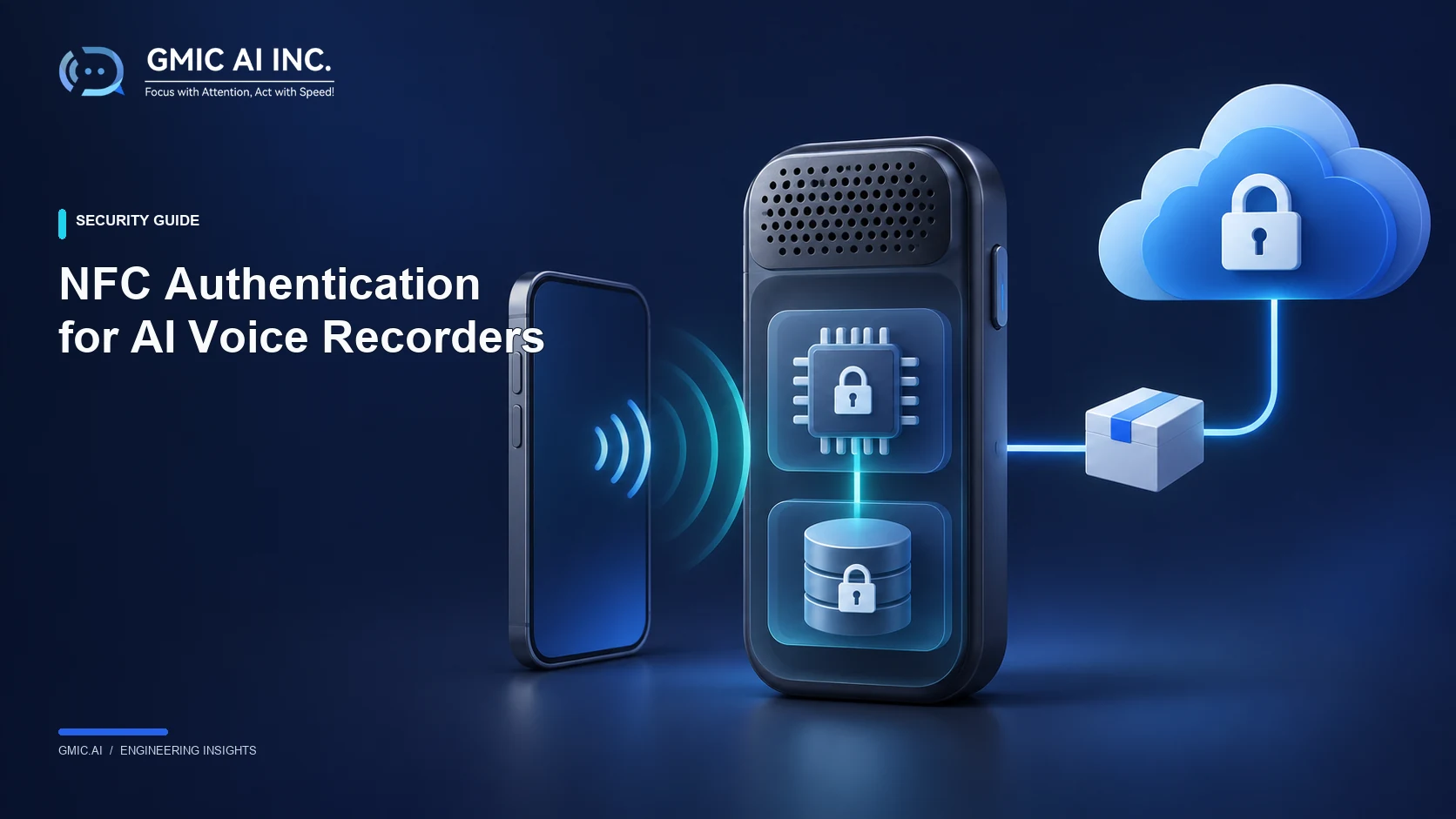
An enterprise AI voice recorder is secure only when the device, user, firmware, app, and backend can establish the right trust at the right moment. NFC authentication in AI voice recorders can make identity checks or workflow authorization intentional and convenient, but NFC alone does not secure recordings, prove firmware integrity, protect cloud credentials, or revoke a lost device.
This guide explains how to turn features such as NFC, encrypted firmware, device identity, signed updates, local storage protection, and access control into a coherent security architecture. It is written for product teams evaluating an AI recorder platform, private-label device, or custom ODM program—not as a claim that any single component automatically makes a deployment compliant or secure.
The short answer
A secure AI voice recorder should answer six questions:
- What device is this? Give each unit a controlled identity created during manufacturing or enrollment.
- Who may use it? Bind users, applications, roles, or enterprise owners through an explicit claiming and authorization flow.
- What code may run? Verify firmware authenticity and integrity before execution and before accepting updates.
- Where may data go? Authenticate applications and endpoints, constrain upload destinations, and protect credentials.
- What happens when trust changes? Support revocation, ownership transfer, factory reset, key rotation, recovery, and end of support.
- Who controls the security assets? Define brand, ODM, factory, app, cloud, and customer responsibilities in writing.
NFC can be used to start or confirm one of these actions, such as claiming a device, selecting a user, authorizing a workflow, or reading a controlled identifier. The security result depends on the protocol, credentials, backend decision, firmware state, and operational controls around that tap.
Start with a recorder-specific threat model
AI recorders sit at the boundary between physical conversations and software systems. They may hold raw audio, account tokens, network credentials, device keys, firmware, diagnostic data, and metadata linking a recording to a person or workflow. A generic “IoT security” checklist is useful, but the product team also needs to model recorder-specific events.
| Event | Security question | Required product behavior |
|---|---|---|
| A device is found or stolen | Can another person access recordings or upload as the owner? | Protected data, bounded attempts, revocation, and clear recovery |
| A recorder is reassigned | Are the previous user’s data and credentials removed? | Controlled unbind, wipe, re-enrollment, and audit state |
| An unauthorized app connects | Does pairing grant more access than intended? | Authenticated commands, scoped permissions, and device claiming |
| Firmware is modified | Can altered code read audio, keys, or endpoints? | Verified boot or equivalent trust checks, signed updates, and rollback policy |
| A cloud endpoint changes | Can data be redirected to an attacker or wrong tenant? | Authenticated endpoint configuration and controlled credential rotation |
| A factory or service tool connects | Can production access remain open in the field? | Separated production credentials, locked debug, and service authorization |
| An update fails | Does the product become insecure or unusable? | Atomic update, recovery image or safe rollback, and visible error state |
Rank threats by the actual workflow and deployment. A personal note device, a clinic-managed recorder, and a field-service fleet do not share the same users, administrators, retention rules, network boundaries, or consequences.
What NFC can—and cannot—do
NFC is valuable because it creates a short-range, intentional interaction. A tap can select a device, identify a badge, initiate enrollment, approve a workflow, or transfer a small controlled value. In an enterprise recorder, that can reduce ambiguity compared with choosing one device from a long Bluetooth discovery list.
Useful NFC roles
- Device claiming: tap the recorder to an authorized phone or enrollment station before it joins an account or tenant.
- User selection: associate a session with an approved user, role, or workflow.
- Step-up authorization: require an intentional tap before a sensitive action such as export, mode change, or reassignment.
- Provisioning bootstrap: deliver or reference limited enrollment information before a protected channel is established.
- Asset and service workflow: identify the unit at receiving, repair, inspection, or redeployment.
What an NFC tap does not prove by itself
- That the tag, card, phone, or reader is genuine.
- That the person holding the credential is still authorized.
- That the firmware on the recorder is trusted.
- That stored audio is encrypted with properly managed keys.
- That the receiving application or cloud endpoint is legitimate.
- That a copied identifier cannot be replayed.
- That access will be removed when employment, ownership, or policy changes.
NIST’s current digital identity guidance treats authenticator security as a system property, including key protection, verifier communication, resistance to replay, and authenticator lifecycle. Its authenticator guidance also notes protection requirements when activation secrets are transmitted over short-range wireless technologies. Product teams should choose an appropriate credential and protocol for their risk level rather than treating proximity as authentication.
Layer 1: establish a device identity
A serial number helps inventory a recorder, but it is not necessarily a cryptographic identity. A stronger design gives each unit—or a defined product group—key material that can prove possession during enrollment or connection. The backend, app, or enterprise environment then decides whether that identity is trusted and what it may do.
- Create identity material in a controlled provisioning step.
- Protect private keys from ordinary firmware reads and debug access where the hardware permits.
- Keep a trustworthy mapping among unit identity, product variant, manufacturing record, ownership, and lifecycle state.
- Separate development, test, factory, demonstration, and production credentials.
- Define who can issue, rotate, revoke, and recover identities.
- Plan how the device proves identity to the app or server without exposing reusable secrets.
Identity architecture must match the hardware. Some platforms provide secure elements, trusted execution features, one-time programmable storage, hardware unique keys, or protected key stores; others provide fewer isolation guarantees. Ask the ODM for the actual processor and security capabilities, not a generic promise of “hardware encryption.”
Layer 2: bind the recorder to the right owner and user
Device identity answers “which unit?” Ownership and authorization answer “who controls it, and for what?” Keep these states separate so a device can be manufactured, stocked, shipped, claimed, assigned, temporarily used, returned, repaired, wiped, and reassigned without confusing factory identity with current ownership.
| Lifecycle state | Allowed actions | Security evidence |
|---|---|---|
| Manufactured | Factory test and controlled provisioning | Production record and approved factory credential |
| Unclaimed | Discovery and enrollment only | Device identity plus proof of authorized claiming |
| Tenant-owned | Managed configuration and policy | Enterprise or service ownership record |
| User-assigned | Recording and workflow actions within role | User or role authorization |
| Service mode | Limited diagnostics or repair | Time-bound service authorization and audit |
| Revoked | No normal upload or protected-data access | Revocation state recognized by app and backend |
| Retired | Wipe, decommission, or approved disposal | Lifecycle closure and key/data handling record |
An NFC badge might identify a user at the start of a shift, while the enterprise backend decides whether that badge and recorder combination is permitted. A phone tap might claim a new recorder, while the service verifies account authorization and records the ownership transition. Keep sensitive decisions at a trusted verifier when the product can reach one, and design an explicit offline policy when it cannot.
Layer 3: protect the firmware trust chain
Firmware controls microphones, storage, radios, credentials, indicators, updates, and data routing. If unauthorized firmware can run, higher-level app and cloud controls may be bypassed. A recorder security plan should therefore define how code is authenticated from boot through update.
- Immutable or protected root: a trusted boot component or hardware mechanism anchors verification.
- Authenticated firmware: the device verifies that executable images were approved by the authorized signer.
- Integrity failure behavior: the product enters a known recovery or fail-safe state rather than silently continuing.
- Signed updates: firmware packages are verified before installation.
- Rollback policy: older vulnerable firmware cannot be installed unless an explicitly controlled recovery process allows it.
- Key separation: development and production signing keys are not interchangeable.
- Release governance: build, review, signing, approval, and publication are auditable responsibilities.
The exact implementation depends on the processor and boot architecture. The general principle is well established: code should be accepted because it is cryptographically authorized, not merely because it arrived through the official app. NIST’s Platform Firmware Resiliency Guidelines organize firmware protection around protecting, detecting, and recovering from unauthorized change.
Layer 4: protect recordings and credentials at rest
“Encrypted storage” is incomplete without a key story. Ask what data is encrypted, when encryption begins, where keys are generated, whether keys are unique, what unlocks them, what happens after factory reset, and whether service tools can bypass protection.
- Separate raw audio, derived text, configuration, credentials, and diagnostics by sensitivity.
- Protect file metadata when it reveals users, times, locations, workflows, or account relationships.
- Design power-failure-safe writes and authenticated metadata so corruption is detectable.
- Keep network credentials and tokens out of ordinary logs and export paths.
- Define deletion semantics for flash storage realistically; distinguish logical deletion from physical media sanitization.
- Use a documented lost-device and reassignment procedure.
- Restrict factory, debug, and repair interfaces in production builds.
Encryption does not replace access control, and access control does not replace data minimization. If a workflow does not require indefinite raw-audio retention, the product should not keep it by accident. See GMIC’s on-device AI privacy-by-design checklist for the wider data lifecycle.
Layer 5: authenticate apps, servers, and commands
A legitimate recorder can still send data to the wrong place if the app, endpoint, or configuration channel is not authenticated. Protect both directions: the service should verify the device, and the device should verify the software or server asking it to act.
- Authenticate sensitive BLE, Wi-Fi, USB, NFC-triggered, and local commands according to risk.
- Use scoped, expiring credentials where practical rather than one permanent shared secret.
- Validate server identity before uploading recordings or telemetry.
- Bind configuration changes to an authorized owner, administrator, or signed policy.
- Prevent replay of commands that claim, wipe, export, change endpoints, or alter security state.
- Separate user actions from factory and service operations.
- Make the device’s recording, transfer, and error state visible through trustworthy indicators.
The companion application is part of the security boundary. Mobile operating-system storage, permissions, backups, screenshots, logs, analytics SDKs, exported files, and account recovery can undermine an otherwise careful embedded design. The NIST Secure Software Development Framework provides a useful structure for assigning development and vulnerability-response practices across device, app, backend, and supplier teams.
Layer 6: plan OTA updates and vulnerability response
A connected recorder will outlive its launch firmware. Product security therefore depends on the ability to discover vulnerabilities, prepare a trusted release, distribute it safely, recover from failure, and support deployed versions for a defined period.
| Update control | Question to resolve before launch |
|---|---|
| Signing ownership | Who holds the production signing authority: brand, ODM, platform provider, or a controlled service? |
| Release approval | Who reviews and authorizes a production image? |
| Transport | How does the device obtain the package, and how is interruption handled? |
| Verification | What signature, version, product, and integrity checks occur before installation? |
| Recovery | What happens after power loss, corrupt image, failed migration, or incompatible configuration? |
| Rollback | When is rollback permitted, and how are known-vulnerable versions blocked? |
| Fleet visibility | Can administrators see versions, failures, and unsupported devices without collecting unnecessary content? |
| End of support | How long are fixes provided, and what happens when support ends? |
Do not wait for the first field incident to decide who can sign firmware. Signing keys, build infrastructure, release approvals, and recovery tooling should be production deliverables with named owners.
Manufacturing and ODM responsibilities
Security architecture reaches the factory. Production may inject identities, program firmware, run radio and storage tests, create labels, bind records, and package devices. Each step can become a trust boundary.
- Document which keys, certificates, tokens, and identifiers exist and who owns each one.
- Use controlled provisioning stations and authenticated production software.
- Restrict the number of systems and people able to access production credentials.
- Prevent development or sample keys from reaching saleable units.
- Record successful provisioning without logging private secrets.
- Define handling for failed, reworked, scrapped, returned, and replacement boards.
- Lock or disable unnecessary debug and factory modes before shipment.
- Test identity, secure update, reset, and revocation—not only basic recording.
The statement of work should specify deliverables for boot security, key custody, signing, provisioning, app authentication, backend integration, OTA, diagnostics, incident response, and lifecycle support. GMIC’s module-versus-finished-product guide explains why these responsibilities must match the selected ODM scope.
How MIC06 can support secure workflow design
GMIC’s MIC06 AI voice platform combines NFC, firmware encryption, Wi-Fi, Bluetooth 5.3, local NAND storage, slide-touch controls, motion sensing, and multi-sensory status feedback. These are building blocks for intentional authentication, controlled interaction, connected transfer, and user-visible device state.
The deployment still determines the security result. Product teams must specify the credential type, claiming flow, user and tenant binding, firmware trust model, key ownership, app protocol, upload endpoints, storage policy, reset behavior, OTA authority, and incident process. MIC06 can be configured for companion-app, designated-cloud, or enterprise integration paths; each path needs its own threat model and validation evidence.
Security validation checklist
- Attempt enrollment with an unauthorized account, app, badge, and device.
- Replay NFC, BLE, API, and configuration messages where the protocol should reject reuse.
- Try to access recordings after loss, unbinding, reassignment, revocation, and factory reset.
- Install modified, corrupted, wrong-product, older, and interrupted firmware packages.
- Inspect production units for test keys, open debug, default passwords, and factory services.
- Change server certificates, device clocks, network paths, endpoints, and credentials.
- Verify that status indicators match real recording, transfer, mute, error, and update states.
- Test power loss during recording, encryption, metadata update, installation, and wipe.
- Confirm logs and analytics exclude voice content, secrets, and unnecessary identifiers.
- Exercise the support path for a lost administrator, expired certificate, failed update, and compromised signing authority.
Run these checks across engineering units and production-representative builds. Security settings often change during manufacturing, and a prototype configured by engineers may not match the device that ships. Integrate the tests into EVT, DVT, and PVT phase gates.
Questions to ask an AI recorder supplier
- What exactly does NFC do in the proposed configuration?
- Is the NFC credential static, dynamic, cryptographic, or only an identifier?
- How is each recorder identified and claimed?
- Which processor security and protected-key features are actually enabled?
- Is boot firmware authenticated, and are application updates signed?
- Who owns and controls production signing and device credentials?
- How are development, factory, demo, and production keys separated?
- What data is encrypted locally, and how are keys created, protected, rotated, and destroyed?
- How does a customer revoke, wipe, reassign, and retire a unit?
- What source code, tools, documentation, and transition rights are included?
- How long will vulnerabilities and mobile-operating-system changes be supported?
- Which claims have test evidence for the actual production configuration?
Frequently asked questions
Does NFC make an AI voice recorder secure?
No. NFC can support an intentional, short-range authentication or authorization flow. The security outcome also depends on the credential, protocol, verifier, firmware integrity, device identity, key management, storage, endpoint authentication, and revocation process.
What is the difference between device identity and user identity?
Device identity distinguishes a specific recorder or trusted hardware group. User identity represents the person, role, account, or administrator allowed to use it. A secure workflow binds them under a current policy without treating them as the same thing.
Is encrypted firmware the same as secure boot?
No. Encryption may conceal firmware contents, while secure or verified boot is intended to authenticate code before execution. A platform may support one, both, or neither in a specific configuration. Ask for the actual boot and update trust design.
Who should own firmware-signing keys in an ODM project?
The answer depends on the commercial and support model, but ownership and access must be explicit. The brand needs assurance that releases remain supportable and controlled if personnel, suppliers, factories, or service providers change.
Can a secure recorder work offline?
Yes, if offline authorization, local key access, storage protection, session behavior, later synchronization, revocation delay, and recovery are deliberately designed. Offline operation changes where trust decisions occur; it does not remove them.
Last reviewed: November 2026. This article provides product-security planning guidance, not a security certification or legal opinion. Requirements depend on the threat model, hardware, firmware, deployment, market, and applicable obligations.