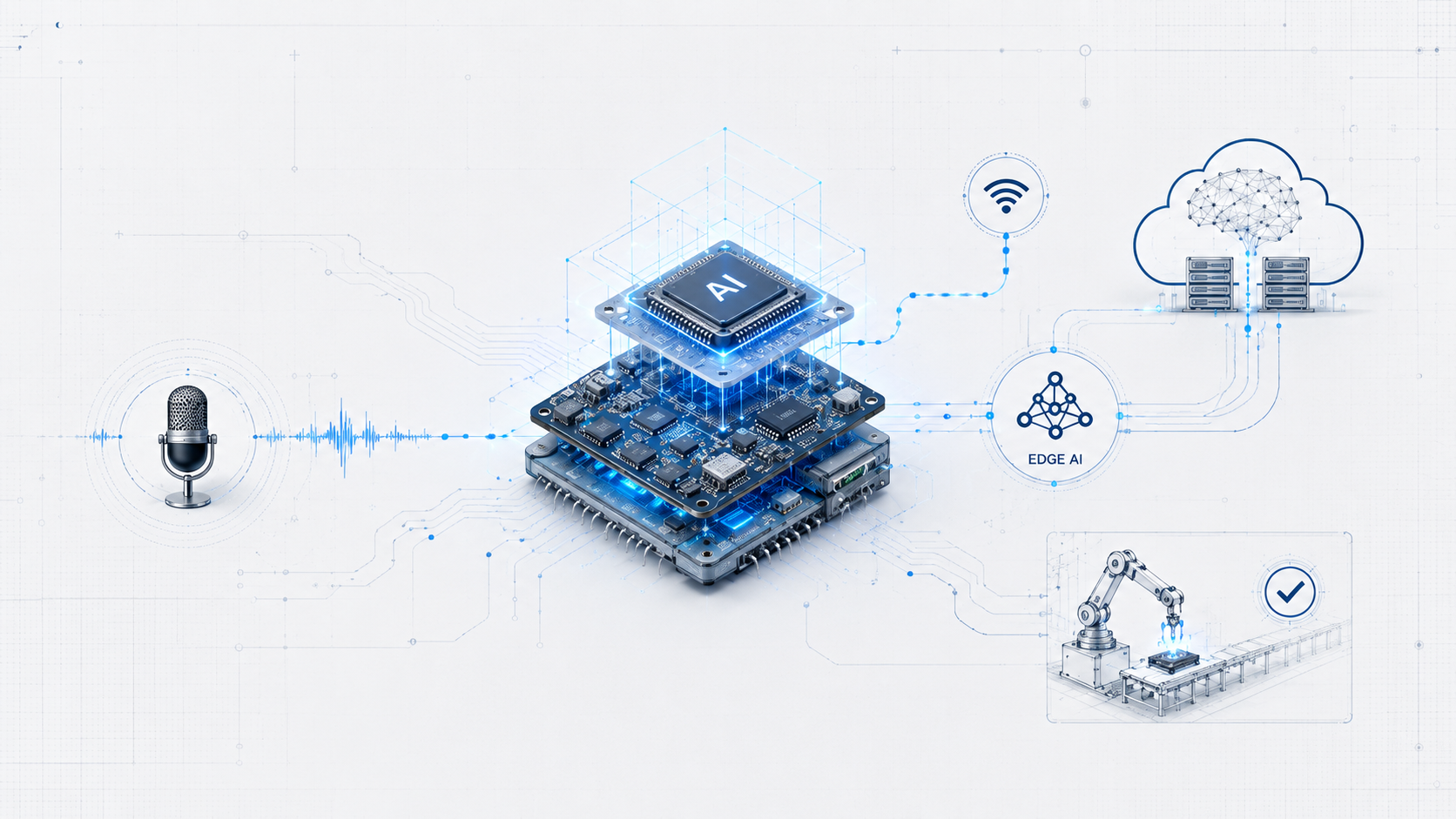
Artificial intelligence has become dramatically more capable over the past few years, but even the most advanced AI models depend on one thing to interact with the real world: hardware.
Whether it’s an AI voice recorder capturing conversations in a noisy hospital, smart glasses assisting field technicians, or wearable devices supporting enterprise workflows, the quality of the user experience is determined long before the AI model generates its first response. It starts with the hardware architecture.
A well-designed AI hardware architecture is far more than selecting a processor or connecting a microphone. It defines how sensors collect data, how embedded systems process information, how firmware manages device behavior, how wireless communication transfers data, and how AI software ultimately delivers meaningful insights. Every architectural decision influences latency, battery life, reliability, scalability, and manufacturing readiness.
As organizations increasingly deploy AI beyond the cloud and into physical environments, demand for intelligent edge devices continues to accelerate. According to IDC, billions of edge endpoints are expected to process AI workloads locally over the coming years as enterprises seek lower latency, improved privacy, and greater operational efficiency. At the same time, Grand View Research projects the global AI hardware market to grow at a compound annual growth rate exceeding 20% throughout the next decade, driven by rapid adoption across healthcare, manufacturing, logistics, retail, and enterprise automation.
For AI companies, this creates a new challenge. Building a successful AI product is no longer just about developing better models—it requires designing hardware that can reliably capture, process, transmit, and secure data in real-world environments.
In this guide, we’ll explore the key layers of modern AI hardware architecture, explain how embedded systems, firmware, connectivity, and AI platforms work together, examine common architectural challenges, and share best practices for designing scalable AI devices—from early prototypes to production-ready products.
What Is AI Hardware Architecture?
AI hardware architecture refers to the overall system design that enables an intelligent device to collect, process, transmit, and utilize data efficiently. Rather than focusing on a single component such as a processor or sensor, architecture defines how every hardware and software layer interacts to deliver reliable AI performance.
Many people mistakenly assume that AI hardware architecture is simply choosing a more powerful chip. In reality, a successful architecture is a carefully balanced ecosystem of sensors, embedded processors, firmware, communication modules, cloud services, and applications. Each layer must be optimized to work together while meeting requirements for performance, battery life, latency, security, and scalability.
For example, an AI meeting recorder doesn’t simply capture audio. It continuously performs voice acquisition, digital signal processing (DSP), noise reduction, wireless communication, cloud synchronization, and AI transcription—often within a device small enough to fit in a pocket or clip onto clothing. A weakness in any layer can affect the overall user experience, regardless of how advanced the AI model may be.
As AI expands into healthcare, field services, logistics, retail, and industrial automation, architecture has become one of the most important factors determining whether a product can move successfully from prototype to mass production.
The Six Layers of Modern AI Hardware Architecture
Modern AI devices typically consist of six interconnected architectural layers. While implementations vary depending on the application, most successful products follow a similar system design.
1.Data Acquisition Layer
Every AI system begins by collecting high-quality data.
Depending on the application, this may include:
- MEMS microphone arrays
- Cameras and image sensors
- IMUs (Inertial Measurement Units)
- GPS modules
- Environmental sensors
- Temperature and humidity sensors
- Biometric sensors
The quality of input data directly affects AI accuracy. Poor microphone placement, inadequate camera calibration, or low-quality sensors cannot be fully compensated for by more advanced AI models.
For Voice AI applications, multi-microphone arrays combined with acoustic tuning and beamforming algorithms significantly improve speech recognition performance, particularly in noisy environments such as hospitals, construction sites, and retail stores.
Key Design Considerations
- Sensor placement
- Signal quality
- Environmental interference
- Sampling frequency
- Power consumption
2. Embedded Computing Layer
Once data has been captured, it must be processed locally before being transmitted or analyzed.
The embedded computing layer typically includes processors such as:
- ARM Cortex Microcontrollers (MCUs)
- Application Processors (CPUs)
- Digital Signal Processors (DSPs)
- Neural Processing Units (NPUs)
- AI Accelerators
Rather than sending every piece of raw data directly to the cloud, modern AI devices increasingly perform preprocessing at the edge. This reduces bandwidth requirements, lowers latency, and improves privacy.
For example, a wearable Voice AI device may locally perform:
- Voice Activity Detection (VAD)
- Echo Cancellation (AEC)
- Noise Suppression
- Audio Compression
before transmitting optimized audio to a cloud-based speech recognition engine.
This hybrid architecture allows devices to deliver faster responses while reducing network costs.
3. Firmware Layer
Firmware is often the least visible—but arguably the most critical—layer in AI hardware architecture.
It serves as the bridge between hardware components and higher-level software, ensuring that every subsystem operates reliably and efficiently.
Typical firmware responsibilities include:
- Device initialization
- Sensor management
- Audio pipeline control
- Bluetooth pairing
- Wi-Fi connectivity
- Battery management
- Power optimization
- Secure storage
- OTA (Over-the-Air) firmware updates
- Device security
A well-designed firmware architecture not only improves device stability but also enables future feature updates without requiring hardware redesigns. This is particularly important for AI products, where software capabilities evolve much faster than physical hardware.
4. Connectivity Layer
AI devices rarely operate in isolation. Reliable communication is essential for synchronizing data, updating software, and integrating with enterprise platforms.
Common communication technologies include:
- Bluetooth Low Energy (BLE)
- Wi-Fi
- LTE / 5G
- NFC
- USB-C
- Ethernet (industrial applications)
The appropriate connectivity strategy depends on the deployment environment.
For example:
- Wearable devices often prioritize BLE for low-power communication.
- Industrial AI systems may require Ethernet for stable, high-bandwidth connections.
- Healthcare solutions frequently rely on secure Wi-Fi networks integrated with hospital infrastructure.
When designing hardware architecture, engineers must balance speed, range, security, and power consumption rather than simply selecting the fastest available protocol.
5. AI Platform Layer
Once data has been processed locally, it enters the AI platform layer—the stage where raw information is transformed into actionable intelligence.
Depending on the application, this layer may include:
- Automatic Speech Recognition (ASR)
- Large Language Models (LLMs)
- Computer Vision Models
- AI Agents
- Natural Language Processing (NLP)
- Predictive Analytics
- Enterprise AI Platforms
This is where the true value of AI is created. A wearable device, for example, may capture a sales conversation, reduce background noise through embedded DSP, transmit the optimized audio to a cloud-based speech recognition engine, and then use a large language model to generate structured meeting notes, customer insights, and follow-up tasks.
Modern AI hardware should be designed to integrate with multiple AI platforms rather than a single software ecosystem. Supporting SDKs, APIs, and cloud services allows organizations to update AI capabilities over time without redesigning the underlying hardware.
A flexible architecture also makes it easier to support enterprise software such as CRM systems, EHR platforms, workflow automation tools, and proprietary AI applications.
6. Application Layer
The final layer is where users interact with the AI system.
Depending on the deployment scenario, applications may include:
- Mobile applications
- Desktop software
- Web dashboards
- Enterprise SaaS platforms
- Healthcare systems
- Field service management platforms
- Internal business tools
At this stage, the AI hardware becomes part of a larger workflow rather than functioning as a standalone device.
For example, a field technician wearing an AI-enabled voice recorder may simply press one button to begin recording. Behind the scenes, the hardware captures high-quality audio, firmware manages local processing and wireless communication, cloud AI generates a structured service report, and the completed record is automatically synchronized with the company’s CRM or field service platform.
When designed correctly, users experience a seamless workflow without needing to understand the complexity of the underlying hardware architecture.
Edge AI vs. Cloud AI: Choosing the Right Architecture
One of the most important architectural decisions is determining where AI inference should take place.
Some applications benefit from running AI models directly on the device, while others rely on cloud computing for greater processing power. Increasingly, modern AI products adopt a hybrid architecture that combines the strengths of both.
| Edge AI | Cloud AI |
|---|---|
| Low latency | High computing power |
| Offline operation | Access to larger AI models |
| Better privacy | Easier model updates |
| Lower bandwidth usage | Virtually unlimited scalability |
| Reduced cloud costs | Faster deployment of new AI features |
For enterprise AI applications, hybrid architectures often provide the best balance.
For example, a wearable voice device may perform wake-word detection, noise suppression, and voice activity detection locally while sending compressed audio to the cloud for transcription and language model processing. This approach minimizes latency, improves battery efficiency, and enables access to continually evolving AI models.
As edge processors continue to improve, more AI workloads will gradually shift from centralized cloud infrastructure to intelligent devices operating closer to the user.
A Real-World Voice AI Hardware Architecture
To better understand how these layers work together, consider the architecture of a modern enterprise Voice AI device.
Unlike a traditional voice recorder, enterprise AI hardware must reliably capture conversations in dynamic, real-world environments while maintaining low power consumption, secure data transmission, and seamless software integration.
A typical Voice AI architecture follows this workflow:
Multi-Microphone Array
Captures clear voice signals while minimizing environmental noise.
↓
Digital Signal Processing (DSP)
Applies beamforming, echo cancellation, automatic gain control, and noise suppression to improve audio quality before AI processing.
↓
Embedded Processor
Manages device operations, local preprocessing, power optimization, and communication between hardware modules.
↓
Firmware Layer
Controls Bluetooth, Wi-Fi, storage management, encryption, OTA updates, and system stability.
↓
Wireless Connectivity
Securely transfers optimized data to mobile devices or cloud infrastructure using Bluetooth Low Energy or Wi-Fi.
↓
AI Platform
Speech recognition converts audio into text, while large language models generate summaries, action items, CRM notes, or workflow recommendations.
↓
Enterprise Applications
Processed information is delivered directly to business systems such as CRM platforms, healthcare documentation software, field service management tools, or internal AI assistants.
This layered architecture illustrates why successful AI products require close collaboration between hardware engineering, embedded software, cloud infrastructure, and AI application development. Optimizing only one layer rarely produces the best overall user experience.
Common Challenges in AI Hardware Architecture
Even well-funded AI companies often underestimate the complexity of hardware system design. Building an intelligent device requires balancing multiple engineering trade-offs rather than optimizing a single performance metric.
Some of the most common architectural challenges include:
Balancing Performance and Battery Life
Higher processing power typically increases energy consumption. Engineers must carefully allocate workloads between embedded processors and cloud services to maximize battery life without sacrificing responsiveness.
Managing Thermal Performance
Compact AI devices generate heat during continuous processing. Effective enclosure design, component placement, and thermal management become increasingly important as AI workloads grow more demanding.
Ensuring Reliable Connectivity
Wireless communication should remain stable across offices, hospitals, factories, and outdoor environments. Robust Bluetooth and Wi-Fi architecture directly affects user experience.
Designing for Manufacturing
A prototype that performs well in the lab may still fail during mass production if component selection, PCB layout, testing procedures, and manufacturing tolerances are not considered early in the design process.
Supporting Long-Term Software Evolution
AI software evolves rapidly. A flexible hardware architecture should support future firmware updates, API changes, and new AI capabilities without requiring a complete hardware redesign.
Best Practices for Designing AI Hardware Architecture
While every AI device has unique technical requirements, successful products often follow the same architectural principles. Designing for real-world deployment—not just laboratory performance—is what separates commercially successful AI hardware from prototypes that never reach production.
Start with the Use Case, Not the Chip
One of the most common mistakes in AI hardware development is selecting processors before defining the product requirements.
Instead, begin by answering practical questions:
- Where will the device be used?
- Will it operate indoors or outdoors?
- Is continuous recording required?
- Will the device rely on cloud connectivity or offline processing?
- What battery life is expected?
A wearable AI recorder designed for healthcare environments has very different architectural requirements than an industrial inspection camera or an AI-enabled smart speaker. Understanding the workflow first allows engineers to select the right combination of sensors, processors, firmware, and communication technologies.
Design Hardware and Software Together
AI hardware should never be developed independently from the software platform.
The best-performing products are built with hardware engineers, embedded software developers, and AI software teams working together from the earliest stages of development.
For example, decisions about microphone placement directly affect speech recognition accuracy. Firmware architecture influences latency, while wireless communication protocols impact how quickly AI-generated insights can be delivered to users.
Considering hardware and software as one integrated system reduces redesign cycles and improves overall product performance.
Build a Modular Architecture
Technology evolves quickly, especially in AI.
A modular hardware architecture makes it easier to upgrade processors, replace sensors, or integrate new AI models without redesigning the entire product.
Common modular design practices include:
- Standardized communication interfaces
- Replaceable wireless modules
- Independent firmware components
- API-first software integration
- Expandable sensor configurations
This flexibility helps extend product life cycles while reducing future development costs.
Design for Manufacturing from Day One
Many AI devices perform well as prototypes but encounter unexpected challenges during mass production.
Designing for manufacturability means considering production requirements early, including:
- Component availability
- PCB manufacturability
- Mechanical tolerances
- Assembly efficiency
- Automated testing
- Regulatory compliance
A structured development process typically includes multiple validation stages before production:
- Prototype Development – Validate core functionality and product concepts.
- EVT (Engineering Validation Test) – Verify hardware design and engineering feasibility.
- DVT (Design Validation Test) – Confirm mechanical reliability, industrial design, and product performance.
- PVT (Production Validation Test) – Validate manufacturing processes and production consistency before mass production.
Each stage reduces technical risk while ensuring the final product can scale efficiently.
Plan for Long-Term Product Support
Launching hardware is only the beginning of a product’s lifecycle.
Modern AI devices should support:
- Over-the-air (OTA) firmware updates
- Remote diagnostics
- Security patch deployment
- API compatibility
- Future AI model integration
Planning for maintainability from the beginning enables products to continue improving after deployment without requiring hardware replacement.
Conclusion
AI hardware architecture is much more than selecting processors or connecting sensors. It defines how every layer of an intelligent device—from data acquisition and embedded computing to firmware, connectivity, AI platforms, and enterprise applications—works together as a unified system.
As AI continues moving beyond cloud software into physical products, architecture has become a critical competitive advantage. Devices with well-designed architectures deliver lower latency, longer battery life, better reliability, and greater scalability while simplifying future software updates and manufacturing.
Whether developing AI-powered voice recorders, smart wearables, industrial edge devices, or healthcare solutions, investing in a robust hardware architecture early in the development process significantly reduces technical risk and accelerates time to market.
Ultimately, successful AI products are built on architectures that balance performance, usability, manufacturability, and long-term flexibility—creating intelligent devices that can evolve alongside rapidly advancing AI technologies.
Frequently Asked Questions
What is AI hardware architecture?
AI hardware architecture is the overall system design of an AI device, including sensors, embedded processors, firmware, communication modules, AI platforms, and applications that work together to perform intelligent tasks.
What are the core layers of AI hardware architecture?
Most AI devices include six primary layers:
- Data acquisition
- Embedded computing
- Firmware
- Connectivity
- AI platform
- Application layer
Each layer contributes to overall system performance and reliability.
What is the difference between AI hardware architecture and AI hardware integration?
AI hardware architecture focuses on designing the structure of an intelligent device, while AI hardware integration focuses on connecting hardware, firmware, software, and cloud services into a fully functional product.
Why is firmware important in AI hardware?
Firmware manages communication between hardware components, controls power consumption, enables wireless connectivity, supports OTA updates, and ensures stable device operation.
Should AI processing happen on the edge or in the cloud?
The answer depends on the application. Edge AI offers lower latency, better privacy, and offline capabilities, while cloud AI provides greater computing power and easier model updates. Many modern AI products use a hybrid architecture that combines both.
How does hardware architecture affect AI performance?
Hardware architecture directly influences data quality, processing speed, battery life, wireless reliability, and the overall user experience. Even advanced AI models cannot compensate for poor hardware design.
What industries benefit from AI hardware architecture?
AI hardware architecture is widely used across healthcare, field services, manufacturing, logistics, retail, enterprise productivity, public safety, and smart consumer devices.
How long does it take to develop an AI hardware product?
Development timelines vary depending on product complexity, but a typical commercial project progresses through prototype development, engineering validation, design validation, production validation, and mass production over several months to more than a year.
References
- Grand View Research. AI Hardware Market Size, Share & Trends Report.
- IDC. Worldwide Edge Spending Guide.
- McKinsey & Company. The State of AI.
- Arm. Edge AI and Embedded Systems Resources.