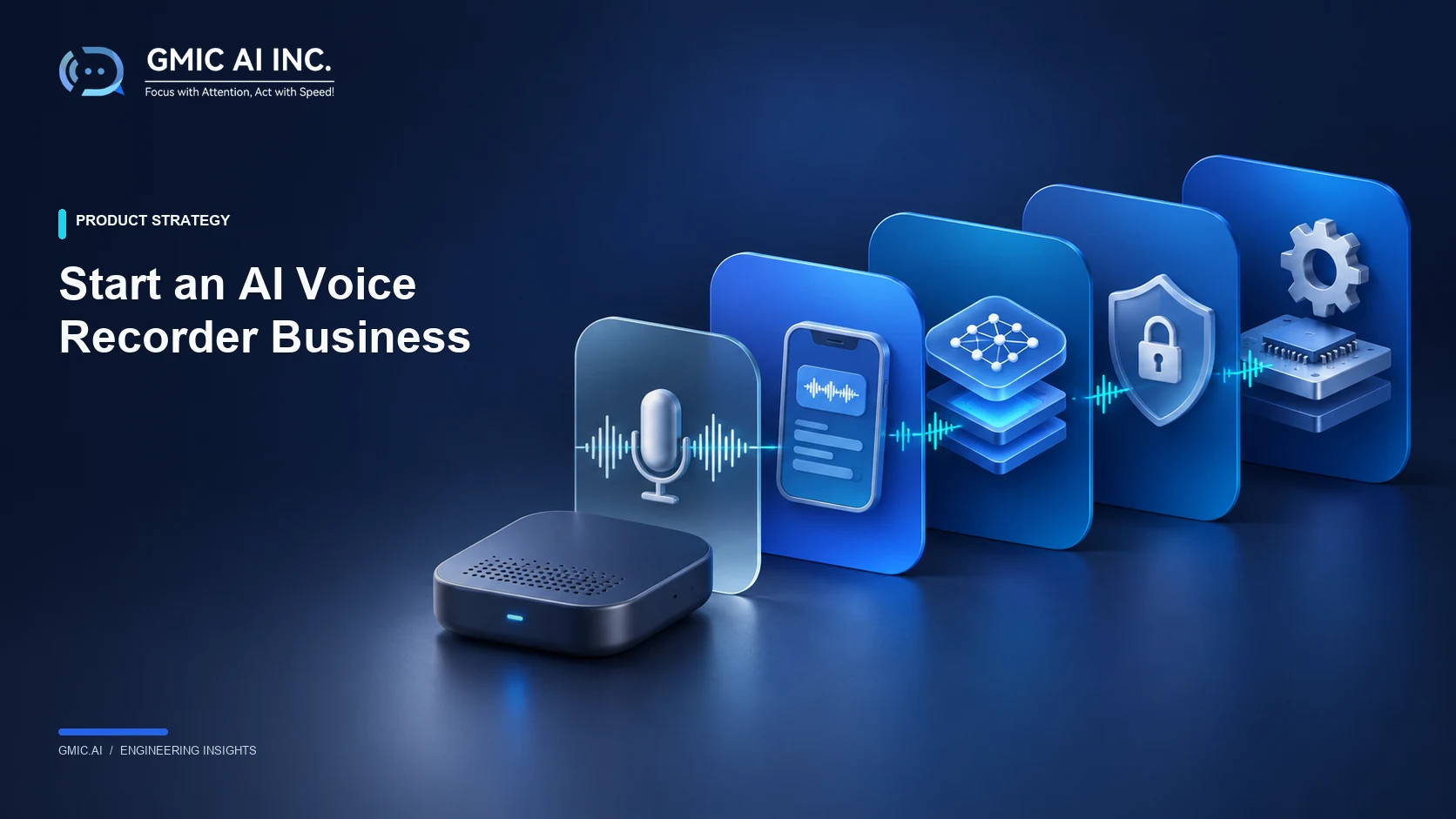
Starting an AI voice recorder business is not mainly a microphone project. It is a system-design business that combines a capture workflow, hardware, firmware, mobile or desktop software, AI services, privacy controls, manufacturing, and a recurring support model.
The first strategic question is not “Which recorder should we private-label?” It is: Which spoken-workflow problem is valuable enough that people will carry, charge, trust, and pay for dedicated hardware? This guide gives founders and product teams a practical path from market hypothesis to validated product and production plan—without assuming that every voice app needs a device.
The short answer: how do you start an AI voice recorder business?
- Choose one high-value recording workflow and user.
- Prove why dedicated hardware performs better than a phone or app.
- Define what happens to audio, transcripts, summaries, and identifiers.
- Choose the product boundary: recorder, interface, wearable, dock, or room device.
- Prototype the complete workflow before customizing production hardware.
- Select a business model that funds AI, storage, support, and updates.
- Validate hardware through EVT, DVT, and PVT before scaling.
- Launch with clear recording indicators, privacy controls, and support commitments.
The ordering matters. Starting with an attractive enclosure and adding “AI transcription” later usually creates a commodity recorder with an expensive cloud dependency. Starting with a painful workflow reveals what the hardware must do differently.
1. Choose a workflow, not a generic audience
“People who attend meetings” is too broad. A useful starting segment has a repeatable moment of capture, a clear cost of missed information, a defined output, and an identifiable buyer. Examples include sales representatives logging field conversations, clinicians creating reviewed notes, technicians documenting site work, researchers conducting interviews, or executives turning meetings into assigned actions.
| Question | What a strong answer contains |
|---|---|
| Who records? | A specific role, environment, and frequency |
| What is captured? | Meeting, call, field note, consultation, interview, or personal memo |
| What is the output? | Reviewed note, task, CRM record, report, searchable memory, or evidence file |
| What fails today? | Phone restrictions, friction, poor audio, missed context, delayed entry, or disconnected tools |
| Who pays? | Individual, team, employer, platform, distributor, or enterprise buyer |
| What creates trust? | Visible capture, user control, reliable deletion, data boundaries, and predictable support |
Interview users about the current process, not their enthusiasm for an AI gadget. Ask them to reconstruct the last real recording event: what they carried, how capture started, who else was present, where the file went, when it was reviewed, and what broke.
2. Prove that the product needs hardware
A phone already has microphones, storage, connectivity, a display, and an app ecosystem. Dedicated hardware must earn its place. It may offer faster physical capture, better microphone placement, visible recording state, longer sessions, offline continuity, phone-call interfacing, hands-free wearability, managed deployment, or separation from a user’s personal device.
- Use an app first when the phone can already capture the required audio and the main differentiation is software.
- Use a hardware interface when the product needs to capture from a phone, headset, room system, or specialized sensor path.
- Use a wearable recorder when immediate, hands-free, or consistent microphone placement is central to the workflow.
- Use a room device when multi-speaker coverage, shared visibility, power, and managed networking matter more than mobility.
Test the software and workflow on existing hardware before committing to tooling. A custom device should solve a problem that the prototype has already made visible. GMIC’s module-versus-finished-product guide explains how to choose the right delivery level.
3. Define the value chain beyond transcription
Transcription is increasingly an input, not the complete product. The business value often appears after speech becomes structured work: a reviewed note, follow-up task, searchable decision, CRM update, service report, compliance archive, or team memory.
Map the product as a sequence:
Capture → transfer → transcription → speaker handling → summarization → review → action → retention or deletion
For each step, name the owner, infrastructure, failure behavior, and cost driver. The recorder may work offline while transcription waits for connectivity. A summary may be useful only after a human confirms the transcript. An automated action may require explicit approval. These are product choices, not implementation details.
4. Set the data boundary before the hardware architecture
Voice recordings can contain personal, confidential, or regulated information. Recording and consent rules vary by jurisdiction and context, so qualified legal advice is necessary for the markets and workflows you serve. From an engineering standpoint, the business should still answer several questions before choosing storage and compute:
- Does raw audio remain on the recorder, move to a phone, or upload to a service?
- Can the user record without an account or internet connection?
- Which data is required for the core service, and which telemetry is optional?
- Are transcripts, summaries, embeddings, and speaker profiles retained separately?
- How can a user inspect, export, correct, and delete data?
- What happens after device loss, reassignment, repair, or factory reset?
- Which providers can access content, and is it used to improve their models?
The NIST Privacy Framework provides a risk-based structure for identifying and managing privacy risk. For product planning, convert that governance work into concrete requirements for capture, retention, access, deletion, telemetry, and supplier responsibilities. Our on-device AI privacy-by-design checklist covers the hardware implications.
5. Choose the processing architecture
| Architecture | Advantages | Main trade-offs |
|---|---|---|
| Recorder + cloud AI | Broad model choice and easier service updates | Connectivity, transfer, cloud cost, latency, and data-governance burden |
| Recorder + phone processing | Uses phone compute, display, network, and account security | OS restrictions, background behavior, phone compatibility, and battery impact |
| On-device transcription | Offline operation and reduced raw-audio transfer | Compute, memory, thermal, battery, model size, and update complexity |
| Hybrid edge/cloud | Local capture or redaction plus cloud intelligence | More states, interfaces, synchronization, and test coverage |
Do not choose the architecture from AI benchmark headlines alone. Test the actual model, audio conditions, session length, power state, network conditions, languages, and output quality. An offline design can improve resilience, but “local” does not automatically mean secure or compliant.
6. Turn the workflow into hardware requirements
The hardware brief should follow the user journey. A pocket recorder, wearable badge, phone accessory, and meeting-room endpoint need different microphone geometry, controls, power, antennas, storage, mechanical strength, and indicators.
- Audio: speaker distance, number of talkers, noise, directionality, sample format, automatic gain, echo, and clipping.
- Controls: start, stop, pause, bookmark, mute, lock, and error recovery.
- Indicators: unmistakable recording, muted, uploading, offline, storage-full, and battery states.
- Connectivity: USB, BLE, Bluetooth audio, Wi-Fi, cellular, or delayed transfer.
- Storage: capacity, encryption, buffering, file integrity, deletion, and repair access.
- Power: session duration, standby, charging time, battery ageing, thermal limits, and safe shutdown.
- Mechanical: wear position, buttons, microphone ports, antennas, drop, ingress, cleaning, and accessories.
- Security: secure boot, signed updates, key storage, debug policy, authentication, and factory reset.
For voice quality, validate the complete path rather than specifying only a microphone. The enclosure, port, DSP, gain, wireless transport, codec, and model input all affect the result. See our AI DSP guide for voice devices.
7. Design a business model that funds the full lifecycle
Hardware revenue arrives at purchase, while AI inference, storage, customer support, security work, mobile-app maintenance, and firmware updates continue. Model those costs before choosing “free AI forever” or an unlimited plan.
| Model | Works when | Watch for |
|---|---|---|
| Hardware margin only | Most processing is local or ongoing service cost is minimal | Underfunded updates, apps, support, and warranty |
| Hardware + subscription | Cloud AI, storage, team tools, or integrations deliver recurring value | Churn, usage variability, model-provider cost, and customer resistance |
| Usage-based AI | Minutes or workloads vary widely across customers | Unpredictable bills and confusing value communication |
| Enterprise licence | Administration, security, integrations, support, or deployment matter | Long sales cycles, procurement, onboarding, and service commitments |
| Platform or SDK | Other brands or apps use the device infrastructure | Developer support, versioning, partner dependency, and channel conflict |
Build a unit-economics worksheet using your own supplier quotes and service contracts. Separate hardware BOM, conversion cost, packaging, logistics, channel margin, returns, warranty reserve, payment fees, transcription, model inference, storage, support, and update operations. Do not copy headline margins from another recorder whose channel, volume, or service architecture is unknown.
8. Choose a development and manufacturing path
There are three common starting paths:
- Private label: adapt an existing recorder with branding, packaging, and limited configuration. Fastest for validating distribution, but differentiation and platform control may be limited.
- ODM platform customization: start from a proven electronics or product base and customize firmware, audio, enclosure, accessories, app integration, or AI service.
- Fully custom development: create the electronics, mechanical system, firmware, fixtures, and manufacturing package around unique requirements. Highest control, but also the most validation and investment.
Ask who owns the schematics, PCB layout, source code, mechanical CAD, tooling, test fixtures, signing keys, mobile applications, cloud accounts, and production data. Also define rights to modify the product, move production, receive component-change notices, and support devices after the original platform reaches end of life.
9. Validate in phases before ordering scale
A credible program moves from evidence to evidence:
- Workflow prototype: prove capture, AI output, review, and downstream action with existing hardware.
- Engineering prototype: test the target audio, power, compute, storage, wireless, and mechanical architecture.
- EVT: demonstrate that the engineering design works and close core technical risks.
- DVT: verify the production-representative design against requirements, reliability, and compliance plans.
- PVT: prove the factory process, programming, calibration, test coverage, assembly instructions, and traceability.
- Pilot launch: measure activation, successful capture, transcript review, workflow completion, returns, support load, and retention before a larger commitment.
Use explicit exit criteria at every phase. A working demonstration is not the same as a manufacturable product. Our EVT, DVT, and PVT checklist provides the stage-gate structure.
10. Plan security, certification, and updates as product features
Connected recorders need a repeatable software-release and vulnerability-response process. The NIST Secure Software Development Framework offers practices for preparing, protecting, producing, and responding to vulnerabilities. Translate those practices into source control, dependency management, build protection, signed releases, update support, and incident ownership.
Certification depends on the actual product and sales markets. For radio-frequency devices sold in the United States, review the official FCC equipment authorization program. Battery transport, electrical safety, EMC, radio, environmental materials, and cybersecurity obligations may also apply. A module report or prior product certificate does not automatically cover a changed finished device.
Metrics that matter before and after launch
- Percentage of target events successfully captured.
- Time from capture to a useful reviewed output.
- Recording failures by environment, device state, and software version.
- Audio quality and transcription outcome across real distances, speakers, accents, and noise.
- Activation, repeated use, and completed downstream workflows.
- Cloud cost per active user or completed workflow.
- Return, repair, battery, connectivity, and support-contact rates.
- Percentage of users who understand recording state and data controls.
A recorder can show high transcription accuracy and still fail as a business because users forget it, do not trust it, cannot move the output into work, or create support costs the revenue model cannot carry.
Common mistakes to avoid
- Building hardware before proving the workflow.
- Competing only on transcription accuracy or the latest model name.
- Assuming users understand when the device records or uploads.
- Treating the mobile app as a simple accessory instead of part of the product.
- Promising unlimited AI without modelling recurring cost.
- Using prototype performance as a promise for the final enclosure.
- Leaving firmware ownership, signing keys, or update responsibility undefined.
- Ordering scale before validating manufacturing test and field support.
A founder-ready brief for an AI voice recorder ODM
Before contacting a hardware partner, prepare a concise brief covering:
- Target user, workflow, environment, and buyer.
- Why dedicated hardware is required.
- Capture distance, speakers, session length, noise, and phone relationship.
- Data flow, retention, offline behavior, privacy controls, and target markets.
- App, AI, API, model, cloud, and enterprise-integration responsibilities.
- Preferred form factor and non-negotiable user controls.
- Prototype evidence already collected and risks still open.
- Expected launch channel, support model, and planning volume—not an unsupported forecast.
- Required ownership, documentation, certification support, and lifecycle commitments.
GMIC supports private-label, ODM-platform, and custom AI voice hardware programs across audio engineering, firmware, enclosure design, app and SDK integration, validation, certification support, and manufacturing preparation. Start with the workflow and evidence boundary, then select the lightest hardware path that can deliver it. Explore our AI hardware ODM/OEM services.
Frequently asked questions
Do I need custom hardware to start an AI voice recorder business?
No. Start by validating the workflow with an app, development kit, or existing recorder. Move to custom hardware when physical capture, audio quality, controls, privacy boundaries, deployment, or user experience create a defensible advantage.
Can I private-label an existing AI voice recorder?
Potentially. Confirm what can actually be changed, who controls the firmware and app, which certifications apply, what minimum order and support obligations exist, and whether the platform can support your data and AI architecture.
Should transcription run on the recorder, phone, or cloud?
The answer depends on latency, privacy, connectivity, model requirements, battery, cost, and update strategy. Many products use a hybrid design: reliable local capture with phone or cloud processing under defined controls.
How should an AI recorder business make money?
Possible models include hardware margin, subscription, usage-based AI, enterprise licensing, or an SDK/platform model. Choose based on the recurring value and ongoing costs of inference, storage, integrations, support, security, and updates.
What is the biggest early risk?
Building an attractive device before proving that dedicated hardware improves a valuable workflow. Validate user behavior and the complete capture-to-action loop before committing to custom tooling and large production orders.
Last reviewed: November 2026. This article provides product and engineering guidance, not legal, financial, or regulatory advice. Requirements vary by product, market, and use case.