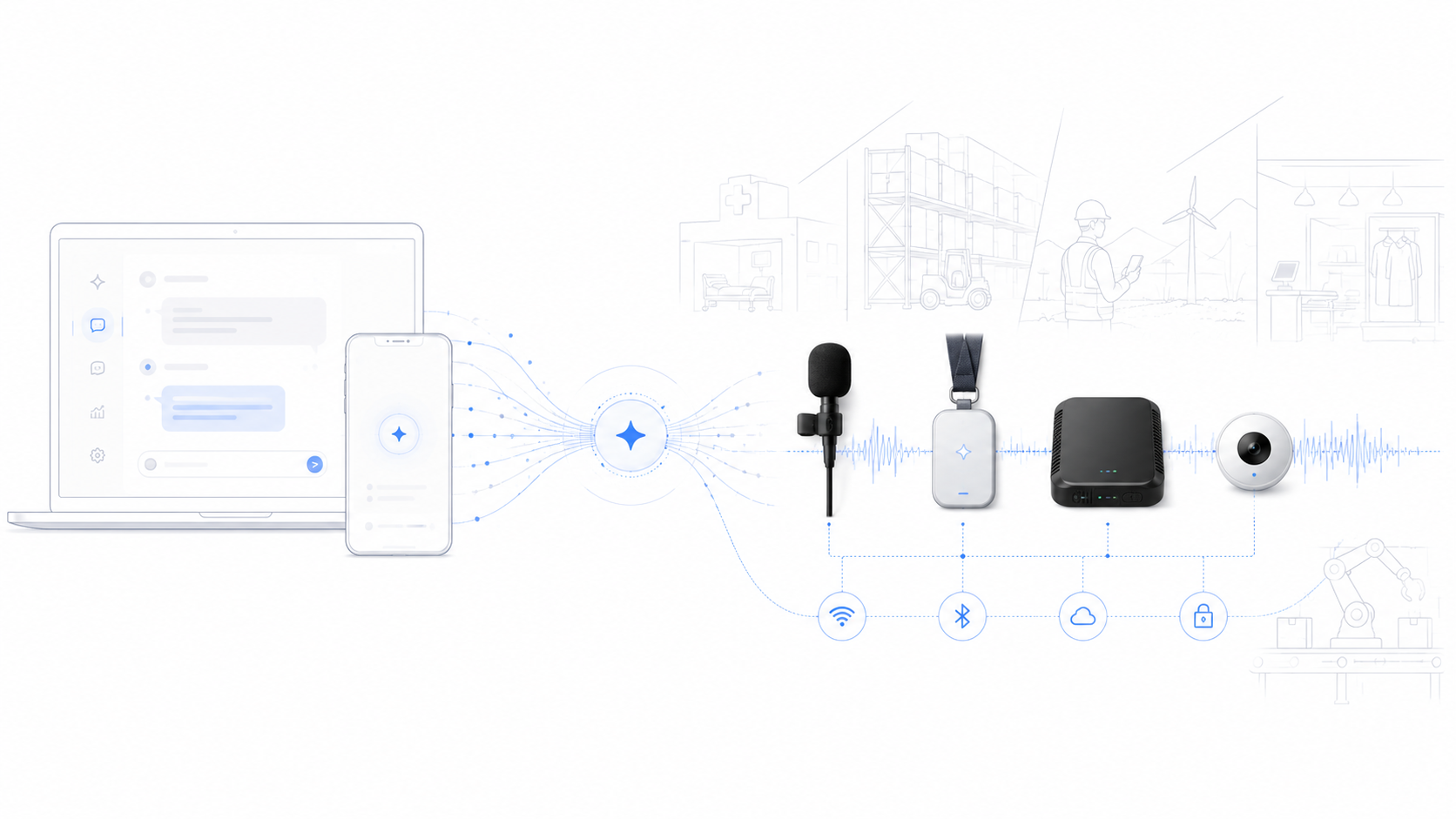
For most of the personal-computing era, every major technology shift has introduced another screen.
Desktop computers placed screens on desks. Smartphones put them in our pockets. Smartwatches moved them onto our wrists. Smart glasses are now attempting to place digital information directly in front of our eyes.
The next major AI device may move in the opposite direction.
On July 14, 2026, Bloomberg reported that OpenAI’s first consumer hardware product is being developed as a portable, screenless speaker intended to function as a humanlike AI companion in the home. Reuters subsequently reported that the device remains under development and may include a camera, environmental sensors, smart-home controls, messaging, media playback and access to ChatGPT capabilities. OpenAI had not publicly confirmed the final product specifications at the time of reporting.
The most important part of this story is not that OpenAI may be building another smart speaker.
It is that one of the world’s leading AI companies appears to believe the next computing interface may not require a traditional display. Instead, the interface could be built around voice, environmental awareness, memory and continuous contextual intelligence.
That shift has major implications for how a modern screenless AI device must be designed, engineered and manufactured.
What Is an AI Device?
An AI device is a physical product that uses artificial intelligence to interpret input, understand context, generate responses or perform actions.
Examples include:
- AI voice recorders
- Smart badges
- AI earbuds
- AI glasses
- Healthcare monitoring devices
- AI cameras
- Industrial inspection systems
- Home AI companions
- Educational AI products
- Field-service voice capture devices
What distinguishes an AI device from a conventional connected device is not simply the inclusion of a microphone, mobile app or internet connection.
A traditional smart device usually responds to predefined instructions. It may turn on a light, play music, transmit sensor data or complete another action that was designed in advance.
An AI-powered device can potentially go further by interpreting natural language, combining multiple types of sensor data, remembering earlier interactions and selecting an appropriate response based on the situation.
How an AI Device Differs From a Smart Device
The difference can be summarized as follows:
A smart device primarily executes commands.
An AI device attempts to understand the user’s intent.
Depending on its hardware and software architecture, an AI device may be able to:
- Understand conversational speech
- Interpret audio, images and sensor data
- Recognize relevant environmental context
- Generate original responses
- Retain selected user preferences
- Adapt to recurring workflows
- Coordinate actions across multiple services
- Complete limited tasks without step-by-step instructions
This does not mean every connected product needs generative AI. It means that products designed around AI interaction require a different relationship between hardware, firmware, models and cloud services.
Internal link: AI Hardware Architecture: A Complete Guide to Designing Intelligent Devices.
Why the Screenless AI Device Is Emerging Now
Screenless products are not new. Smart speakers, voice recorders and connected sensors have existed for years.
What is changing is the intelligence behind the interface.
A screenless AI device does not necessarily lack every form of visual feedback. It may still use LEDs, projected indicators or a companion application. However, it does not rely on a conventional graphical interface as the primary method of interaction.
The user may speak, gesture, move through an environment or allow the device to recognize a relevant event.
Several developments are making this type of product more practical.
Voice Is Becoming the Interface for AI Devices
Earlier voice assistants were generally built around a rigid interaction flow:
- Detect a wake word.
- Record a short command.
- Convert the speech into text.
- Match the command to a supported action.
- Return a predefined response.
Newer real-time voice models are designed for more natural, continuous interaction.
OpenAI announced GPT-Live on July 8, 2026, describing it as a new generation of voice models built to make human-AI conversation feel more natural. OpenAI has also introduced API models that can reason, translate and transcribe while a user is speaking.
As voice models become more conversational, users may no longer need to open an application, locate a feature and type a detailed request.
The interaction can begin with speech.
However, the quality of that experience still depends on whether the hardware can capture speech clearly, process it quickly and return a response with acceptable latency.
Context Makes a Screenless AI Device More Useful
Voice alone does not create an intelligent companion.
A useful screenless product also needs enough context to understand what is happening around the user.
Microphones can detect speech and environmental sound. Cameras can provide visual information. Motion sensors can determine whether the product is stationary or moving. Proximity sensors can identify whether a user is nearby.
Depending on the application, additional sensors can measure location, temperature, light, orientation or other environmental conditions.
These inputs allow an AI system to move beyond isolated commands.
For example:
- A meeting device may recognize that a conversation has started and prepare to capture notes.
- A field-service device may detect that a technician has arrived at a job site.
- A healthcare device may initiate an approved patient workflow.
- A home companion may adjust its response based on who is present.
- A wearable may distinguish between a direct request and background conversation.
The opportunity is not simply to remove the screen. It is to reduce the steps required to complete a real-world task.
What Makes an AI Companion Device Different From a Smart Speaker?
The phrase AI companion device is increasingly used to describe hardware intended to maintain an ongoing, context-aware relationship with a user.
A traditional smart speaker is primarily transactional. It waits for a command, completes a supported task and returns to an idle state.
An AI companion is expected to maintain more continuity.
It may remember selected preferences, understand relationships between conversations, recognize recurring activities and adjust its responses over time.
That experience requires more than a language model.
Memory in an AI Companion Device
A reliable memory system must determine:
- What information should be remembered
- What information should be discarded
- How long data should be retained
- Whether memory is stored locally or in the cloud
- How users can view or delete stored information
- How the device distinguishes between different users
- Which information may be used in future interactions
Persistent memory can make an AI companion more useful, but it also increases privacy and security risk.
A product should not remember everything simply because it can.
Memory must be designed around the use case, user permission and applicable privacy requirements.
Presence Is Part of the AI Companion Experience
An AI companion device also needs to communicate its state without depending on a large display.
Users should be able to understand:
- Whether the device is listening
- Whether it is recording
- Whether it is processing a request
- Whether its camera is active
- Whether data is being uploaded
- Whether the microphone is muted
- Whether the device has encountered an error
That feedback may be delivered through indicator lights, audio tones, mechanical movement, haptics or a companion application.
The goal is not to make the hardware appear human. The goal is to make its behavior understandable and predictable.
AI Device Hardware Architecture: What Happens Behind the Interface?
The intelligence of an AI device may come from an AI model, but the quality of the user experience is often determined by the hardware surrounding that model.
A practical architecture can include:
Microphones / Camera / Sensors
              ↓
       Signal Processing
              ↓
      MCU / Main Processor
              ↓
 Local or Cloud AI Processing
              ↓
     Decision and Response
              ↓
Speaker / LED / App / Connected System
Each layer affects product performance.
Audio Design for a Screenless AI Device
For a voice-first product, audio is not just another feature. It is the primary user interface.
The audio system may require:
- Multiple digital microphones
- Far-field voice capture
- Microphone beamforming
- Acoustic echo cancellation
- Noise suppression
- Automatic gain control
- Voice activity detection
- Speaker diarization
- Audio codecs
- Amplifiers and speakers
An AI model cannot correctly interpret speech it never receives clearly.
A prototype may perform well in a quiet meeting room and fail in a kitchen, vehicle, warehouse, clinic or field-service environment.
In GMIC’s work supporting voice AI and embedded hardware projects, several problems repeatedly appear during development:
- Microphones are selected before the acoustic environment is understood.
- The enclosure is designed without considering microphone placement.
- Speaker output leaks back into the microphone path.
- Noise-reduction expectations are defined too late.
- Cloud-model accuracy is evaluated separately from hardware audio quality.
- Battery estimates do not account for continuous microphone and wireless activity.
These issues cannot always be corrected through software alone.
Microphone location, enclosure openings, internal component placement, acoustic isolation, speaker position and DSP tuning must be evaluated as one system.
Internal link: Audio DSP for Voice AI Hardware.
Cloud and Edge Processing in an AI Device
Not every function should be sent to the cloud.
Many AI devices use a hybrid architecture in which basic operations happen locally while more computationally intensive reasoning is performed remotely.
Local functions may include:
- Wake-word detection
- Voice activity detection
- Button and sensor processing
- Device control
- Audio buffering
- Basic keyword recognition
- Selected privacy-sensitive processing
- Connectivity management
Cloud functions may include:
- Large-language-model reasoning
- Advanced speech recognition
- Multimodal analysis
- Long-term memory retrieval
- Cross-platform integrations
- Complex task execution
Local processing can reduce latency, limit bandwidth use and preserve basic functionality during network interruptions.
Cloud processing provides access to more powerful models but introduces dependencies on connectivity, infrastructure cost and data transmission.
The correct architecture depends on the product.
A home AI companion, clinical voice recorder and industrial monitoring device should not automatically use the same balance of local and cloud processing.
Offline Behavior Must Be Defined Early
Every team developing an AI device should answer several questions:
- What happens when Wi-Fi is unavailable?
- Can the user complete a basic workflow offline?
- Is audio stored locally?
- How much storage is required?
- Are interrupted uploads resumed automatically?
- Is stored data encrypted?
- When is local data deleted?
- Can firmware updates fail safely?
These are product decisions, not only engineering details.
Power Management in an AI Companion Device
Screenless does not automatically mean low-power.
Always-ready microphones, cameras, sensors, speakers, wireless connectivity and application processors can consume significant energy.
The product team must balance:
- Battery capacity
- Physical size
- Active operating time
- Standby time
- Charging speed
- Processor performance
- Wireless activity
- Sensor duty cycles
- Surface temperature
- Battery lifespan
An impressive demonstration that works for two hours may not be a commercially viable device.
Power requirements should be calculated from the real workflow.
A product that listens intermittently will behave differently from one that records continuously. A Wi-Fi product will have different power characteristics from an LTE-connected device. A cloud-dependent companion will behave differently from a mostly local edge device.
Thermal performance must also be considered, especially in small wearables and sealed enclosures.
Privacy and Security Will Determine Whether AI Devices Are Trusted
A screenless AI device may be placed inside a home, vehicle, clinic or workplace. It may include microphones, cameras, persistent memory and access to messages, calendars or connected services.
Privacy therefore cannot be treated as a policy-page issue.
It must be built into the product architecture.
The Federal Trade Commission warns that voice assistants may begin recording after mishearing a wake word and advises consumers to look for physical controls that stop the device from listening, as well as clear indicators showing when recording is active.
The FTC has also taken action involving the handling of highly private voice and in-home video data, demonstrating that recordings from connected devices carry significant privacy obligations.
NIST recommends managing the cybersecurity and privacy risks of connected products throughout the device lifecycle rather than addressing security only after deployment. Its guidance also encourages organizations to define the security capabilities expected from both a device and its manufacturer.
NIST IoT cybersecurity and privacy guidance.
Security and privacy features may include:
- Physical microphone mute controls
- Camera shutters
- Clear recording indicators
- Secure boot
- Signed firmware
- Device authentication
- Encrypted local storage
- Encrypted data transmission
- User-controlled deletion
- Configurable retention periods
- Role-based access
- Over-the-air security updates
- Local or private-cloud deployment options
The more humanlike an AI companion feels, the more clearly it must communicate what it is doing.
How Companies Develop an AI Companion Device
An AI hardware program should not begin by selecting components from a catalog.
It should begin with the workflow.
Step 1: Define the AI Device Use Case
The development team should identify:
- Who will use the device
- Where it will be used
- What task it performs
- Why a phone or existing product is insufficient
- Whether the device listens continuously
- Whether the product needs a camera
- What response time is acceptable
- What data must be stored
- What connectivity is available
- How long the battery must last
A clear use case prevents the project from becoming a collection of disconnected AI features.
Step 2: Define the System Architecture
The architecture should map the complete data flow:
User or Environment
        ↓
Audio / Image / Sensor Input
        ↓
Local Signal Processing
        ↓
Firmware and Device Logic
        ↓
Edge Model or Cloud Model
        ↓
Application / API / Database
        ↓
Response or Automated Action
This stage determines processor requirements, interfaces, storage, connectivity and power targets.
Step 3: Build and Test the Prototype
A prototype should validate more than whether the electronics turn on.
Testing should include:
- Speech capture distance
- Performance in realistic noise
- Echo behavior during two-way audio
- Network interruption recovery
- Upload reliability
- Battery life
- Charging behavior
- Surface temperature
- Data security
- Firmware stability
- API and SDK integration
- User understanding of device status
Testing in the intended environment is critical.
A healthcare voice device should be tested in clinical conditions. A field-service recorder should be evaluated near machinery, traffic and wind. A home companion should be tested with television audio, multiple speakers and normal household noise.
Step 4: Move From Prototype to Production
Once the concept is validated, the product moves through engineering validation, design validation and production validation.
This process may include:
- PCB and PCBA refinement
- Component sourcing
- Firmware stabilization
- Audio DSP tuning
- Sensor calibration
- Antenna testing
- Battery and charging validation
- Reliability testing
- Regulatory preparation
- Manufacturing test development
- Quality-control planning
- Packaging and logistics
At GMIC, our co-development scope focuses on the internal hardware and embedded system: PCB and PCBA engineering, electronic modules, sensor integration, firmware, connectivity, power management, prototyping, DFM, testing and mass-production support.
Internal link: AI Hardware ODM: From Prototype to Mass Production.
What OpenAI’s Reported AI Device Means for the Market
OpenAI’s reported product specifications may still change before launch.
However, the broader direction is already visible.
AI is moving beyond websites, applications and chat windows. Companies are exploring hardware that can hear, observe, remember and respond within real-world environments.
The next wave of AI products may include:
- Screenless home companions
- Wearable AI memory devices
- AI meeting hardware
- Clinical documentation devices
- Field-service assistants
- Smart badges
- AI earbuds
- Context-aware cameras
- Educational companions
- Elder-care devices
- Specialized enterprise AI hardware
Not every AI device will replace the smartphone.
Many of the strongest opportunities will come from workflows in which phones are inconvenient, distracting, insecure or unable to capture the required data.
The winning products will not be the ones that simply connect a language model to a microphone.
They will be the ones that solve a clearly defined problem through reliable audio, appropriate sensors, secure data handling, usable battery life and carefully integrated hardware and software.
The Future of the Screenless AI Device
The future of AI hardware is unlikely to be completely screenless.
Visual interfaces remain essential for video, complex editing, detailed navigation and many productivity tasks.
However, a growing category of interactions does not require users to stop what they are doing, open an application and look at a display.
In those situations, a screenless AI device can become an ambient layer between the user and the digital world.
The transition from AI software to physical AI products will create opportunities for companies building voice platforms, healthcare applications, enterprise agents and specialized workflow software.
It will also expose a new challenge:
A strong AI model does not automatically become a strong physical product.
The next generation of AI companion devices will depend on the quality of the complete system—from microphones, sensors and power management to firmware, connectivity, privacy controls and manufacturing.
AI may be leaving the screen.
But making it work reliably in the physical world will require much more than removing the display.
Frequently Asked Questions About AI Devices
What is an AI device?
An AI device is a physical product that uses artificial intelligence to understand input, interpret context, generate responses or perform actions. Examples include AI voice recorders, smart badges, AI earbuds, AI cameras, healthcare devices and home AI companions.
What is a screenless AI device?
A screenless AI device is an AI-powered product that does not depend on a conventional display as its primary interface. Users may interact with it through voice, sound, gestures, sensors, physical controls or contextual automation.
What is an AI companion device?
An AI companion device is hardware designed to maintain an ongoing, context-aware interaction with a user. It may use voice, memory, sensors and personalized behavior to provide assistance across multiple conversations or activities.
Is an AI companion device the same as a smart speaker?
Not necessarily. A smart speaker generally responds to predefined commands. An AI companion device may maintain context, remember selected information, interpret multiple sensor inputs and perform more complex tasks.
Does a screenless AI device need an internet connection?
Some functions may require cloud connectivity, while others can run locally. Many products use a hybrid architecture that combines edge processing with cloud AI. Offline behavior should be defined during the architecture stage.
What hardware is required to build an AI device?
Requirements depend on the use case but may include microphones, speakers, cameras, environmental sensors, an MCU or application processor, local storage, wireless connectivity, power-management components and a secure firmware platform.
How long does it take to develop an AI companion device?
The timeline depends on product complexity, customization, certification, firmware requirements and manufacturing readiness. A modified existing platform can generally be developed faster than a fully custom device requiring a new PCB, enclosure, acoustic design and production tooling.
Can an AI software company build a custom AI device without an internal hardware team?
Yes. An experienced AI hardware ODM or co-development partner can support PCB and PCBA engineering, module integration, audio systems, firmware, connectivity, power management, prototyping, testing, DFM and mass-production preparation.
Author and Review Information
Author: GMIC AI Hardware Team
Technical review: Embedded hardware and voice-device engineering team
Last updated: July 16, 2026
GMIC supports AI software companies developing custom voice and embedded AI devices. Our engineering scope includes PCB and PCBA development, microphone and sensor integration, firmware, Bluetooth and Wi-Fi connectivity, power management, prototyping, design for manufacturing, testing and mass-production support.
Editorial note: Information about OpenAI’s reported consumer device is based on media reporting available as of July 16, 2026. OpenAI had not publicly confirmed the final specifications, commercial name or launch configuration at the time of publication.