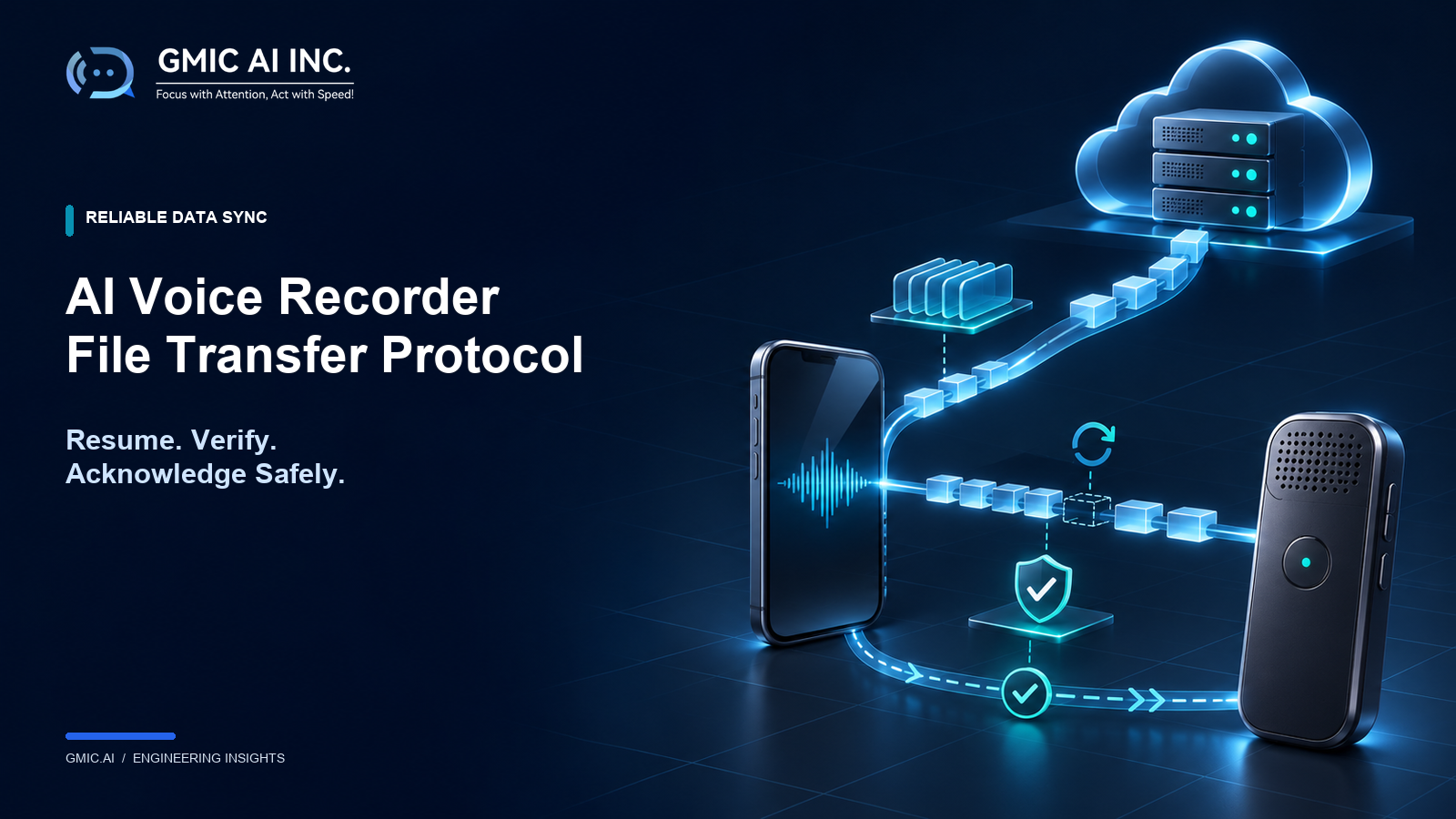
A reliable AI voice recorder file transfer protocol must do more than move bytes from a device to an app or server. It must identify every recording, resume after interruption, detect corruption, prevent duplicate uploads, distinguish “received” from “durably stored,” and delete the local original only after an authoritative acknowledgement. These behaviors should be defined before an OEM or ODM project freezes its firmware and mobile SDK.
This engineering guide explains the protocol decisions, state model and acceptance tests that product teams should review when building a connected recorder. It focuses on file reliability rather than choosing between Bluetooth and Wi-Fi, and it does not claim that one frame format fits every product.
Why file transfer becomes a product risk
Recent anonymized buyer questions reviewed by GMIC repeatedly asked about SDK access, BLE and Wi-Fi transfer, transfer speed, interrupted uploads, local retention, automatic deletion and integration with a customer-controlled backend. These are not merely app features. They determine whether a recording survives common failures such as a phone leaving range, an app being suspended, a battery loss or a server response disappearing.
SERP research shows that many available resources document one implementation: a GATT characteristic, an AT command, a packet layout or a sample SDK. Those references are useful, but a buyer still needs to decide what counts as completion across the device, phone and backend. A transfer can reach 100% in the UI while the final file is incomplete, unverified, duplicated or not durably committed.
Start with one recording identity
Every completed recording should receive a stable identifier that survives reconnection, app restart and backend retry. Do not use a filename alone as the identity. Filenames can collide after factory reset, clock loss or device replacement.
A practical recording manifest can include:
| Field | Purpose | Acceptance question |
|---|---|---|
| Recording ID | Stable end-to-end identity | Does it remain unchanged through every retry? |
| Device ID | Identifies the source within the product owner’s registry | Can two devices create the same recording ID? |
| Sequence number | Detects gaps and supports ordered listing | What happens after reset or rollover? |
| Capture timestamps | Supports user display and timeline reconstruction | How is an invalid device clock represented? |
| File size | Detects truncation and supports progress | Is it the finalized size or an estimate? |
| Audio format and parameters | Tells the receiver how to validate and process the file | Are codec, sample rate and channels explicit? |
| Integrity value | Verifies the completed object | Which algorithm and byte range are covered? |
| Firmware/protocol version | Enables compatibility decisions | Can an app reject an unsupported version safely? |
The manifest should be finalized only when the recorder closes the audio file. If the product uploads while recording, define a stream identity plus independently addressable chunks and an explicit end-of-stream event.
Separate control messages from file data
An SDK is easier to maintain when control and bulk data have distinct responsibilities.
The control plane may handle pairing, authentication, file listing, metadata, transfer requests, cancellation, status and deletion authorization. The data plane carries the audio bytes. BLE implementations often use a command/response characteristic plus a notification characteristic for file frames; Wi-Fi implementations may expose an HTTPS or local-socket transfer path.
This separation does not require separate radios. It prevents large transfers from making device control ambiguous and gives the protocol clear error responses. The specification should say which commands are allowed while recording, transferring, charging, updating firmware or formatting storage.
For transport selection, see Bluetooth vs Wi-Fi for AI voice recorders. The protocol in this guide sits above that decision and should preserve the same recording identity and completion rules on every supported transport.
Design chunks around recovery, not a marketing speed
Breaking a recording into chunks allows bounded memory use, progress reporting and retransmission. The optimum payload depends on the negotiated BLE MTU, stack overhead, storage write behavior, phone platform and radio conditions. Therefore, a fixed packet size copied from a development kit should not become a product requirement without testing.
Each data unit normally needs enough context to reject stale or misplaced bytes:
- protocol and message type;
- transfer session ID;
- recording ID or file index;
- offset or sequence number;
- payload length;
- payload;
- optional per-frame error-detection value.
Sequence numbers can detect missing or reordered frames. Explicit byte offsets make recovery easier because the receiver can state the last committed position. A sliding window may improve throughput, but the sender must not exceed the receiver’s available buffers and storage path.
Per-frame CRC can detect accidental transmission errors. It is not a substitute for endpoint authentication or a cryptographic integrity design. If the product’s threat model requires tamper detection, use an authenticated channel and an approved message-authentication or digital-signature design. NIST’s Secure Hash Standard defines SHA algorithms that can produce a digest for integrity verification; the surrounding protocol still has to authenticate who supplied that digest.
Make resume state durable on both sides
“Resume supported” is incomplete unless the specification defines the restart point after different failures.
The receiver should acknowledge only data that it can recover after its own restart. Bytes accepted into a volatile buffer are not necessarily committed bytes. After reconnection, the two sides can compare the recording ID, expected size, committed offset and a digest over the retained prefix. If the prefix does not match, restart the affected file instead of appending to unknown data.
A robust resume exchange answers:
- Is this the same recording and protocol version?
- Does a partial object already exist?
- How many bytes are durably committed?
- Does the retained prefix match the sender’s bytes?
- From which aligned offset may transfer continue?
- Has the entire object already been verified?
Open technical implementations demonstrate useful patterns. Seeed Studio’s reSpeaker Clip protocol documentation documents file frames, CRC32 verification and session/file resume behavior. The value of such a reference is the concrete state handling—not a requirement to copy its UUIDs or frame layout.
Treat the mobile operating system as a failure source
A recorder protocol should assume that the companion app can be paused, terminated or disconnected. Mobile operating systems control background execution; the device firmware cannot assume that a connected phone will keep consuming notifications indefinitely.
Apple explains that foreground-only apps normally cannot continue Bluetooth work while suspended, and even apps declaring Core Bluetooth background modes do not run forever. Apple also provides state-preservation and restoration mechanisms for longer-lived Bluetooth actions. Review Core Bluetooth background processing for the current platform model.
Android’s official guidance similarly notes that a BLE connection closes if the app process is killed and describes WorkManager, companion-device APIs and foreground-service options for background communication. See Android BLE background communication.
The product implication is straightforward: progress must be reconstructable from device and app storage after relaunch. A screen showing 63% is not the source of truth.
Verify the whole recording before marking it complete
Packet acknowledgement means that a particular unit arrived. It does not prove that the assembled file is complete and correct.
At file end, compare at least:
- recording ID;
- expected and received byte counts;
- expected final sequence or offset;
- whole-file digest or integrity value;
- codec/container parse result where appropriate;
- required manifest fields.
The receiver should write to a temporary or private partial object and publish the final object only after verification. This avoids exposing a truncated recording to transcription or downstream users. If the final completion response is lost, the sender should be able to ask whether the same recording and digest already completed rather than upload the entire file again.
Make server upload idempotent
When the phone or recorder uploads to a backend, a timeout creates an important ambiguity: the server may have stored the file even though the client never received the response. Blindly repeating a non-idempotent create request can produce duplicates.
Use a stable recording ID or explicit idempotency key and define the outcome for repeated requests:
- same identity and same size/digest: return the existing result or continue the existing upload;
- same identity but different content: reject as a conflict and preserve evidence;
- unknown identity: create a new transfer session;
- verified complete identity: return the durable receipt.
RFC 9110 defines an idempotent request as one whose intended server effect is the same after multiple identical requests as after one. It also explains why idempotent operations can be retried after a connection failure. An API can implement equivalent application-level semantics for a recording upload even when its workflow uses more than one HTTP request.
Distinguish four acknowledgements
Many integration failures come from calling every positive response “success.” Define separate events:
- Frame ACK: a packet or window was accepted by the immediate receiver.
- File verified: the complete byte count and digest match on the phone or gateway.
- Server receipt: the backend has durably stored the object and manifest under the recording ID.
- Processing result: transcription or another downstream operation succeeded or failed.
Only the third event normally makes the device copy eligible for policy-controlled deletion. The fourth may occur much later and should not be confused with upload integrity. Some products intentionally retain audio until processing finishes; if so, state that as a retention rule rather than an accidental dependency.
Never delete on “upload attempted”
Safe deletion should be an explicit state transition authorized by the product owner’s workflow. A practical sequence is:
`finalized locally → queued → transferring → file verified → server receipt recorded → deletion authorized → deleted`
The receipt should bind the recording ID to the accepted size and digest. If the app tells the recorder to delete, authenticate that command and make it replay-safe. A repeated delete request should return a clear “already deleted” result rather than an unrelated error.
Also specify what factory reset, user deletion, storage pressure and retention expiry do to recordings in every state. For private infrastructure and ownership boundaries, see Private-Cloud AI Voice Recorder Architecture.
Define error codes that support recovery
“Transfer failed” is not enough for an app, a support team or an automated test. Use stable machine-readable reason codes for conditions such as:
- unsupported protocol version;
- unauthenticated or unauthorized device;
- recording not found;
- recording still open;
- invalid offset or sequence;
- prefix mismatch;
- per-frame integrity failure;
- whole-file integrity failure;
- insufficient storage;
- transfer already active;
- incompatible firmware or SDK version;
- server rejection or expired credential;
- cancellation by user, device or operating system.
Do not put audio content, credentials or sensitive user data into routine diagnostic logs. Record identifiers may also require protection depending on how they are generated and used.
Measure throughput in real workflows
Headline radio rates do not predict the user’s sync time. Measure finalized recordings using representative codecs, phone models, operating-system versions, interference, distances and device states.
Report at least:
- useful payload throughput, not only link rate;
- connection and service-discovery time;
- time to first byte;
- total transfer plus verification time;
- retry and reconnect rate;
- energy used by the recorder and phone;
- performance while recording continues;
- behavior when the app moves to the background;
- recovery time after app or device restart.
Tests should include a short memo, a typical meeting and a near-capacity recording set. A design optimized only for one small laboratory file can fail when users sync hours of audio.
OEM acceptance test matrix
Before approving production firmware and SDKs, run the same tests on the actual commercial hardware:
| Test | Fault introduced | Passing evidence |
|---|---|---|
| Baseline transfer | None | Size and digest match; one final object exists |
| Radio interruption | Move out of range during several transfer stages | Resume begins from a verified committed position |
| App suspension | Background the mobile app | State remains recoverable and UI explains next action |
| App termination | Kill the app process | Relaunch reconstructs the session without duplicate data |
| Device reboot | Remove power during transfer | Finalized source remains intact; resume or restart is deterministic |
| Phone reboot | Restart the receiver | Partial state is validated before reuse |
| Full device storage | Fill recorder storage | Recording and sync behavior follow the documented policy |
| Full phone storage | Exhaust destination storage | Device copy remains; error is actionable |
| Lost final response | Drop the completion response | Repeated completion returns the same verified result |
| Duplicate upload | Retry a completed recording | Server returns the existing receipt, not a second object |
| Content conflict | Reuse an ID with different bytes | Request is rejected and logged as a conflict |
| Corrupted frame/file | Modify test data | Integrity failure prevents publication and deletion |
| Credential expiry | Expire app or device credentials | Reauthentication does not lose the recording state |
| Firmware/SDK mismatch | Pair incompatible versions | Compatibility error is explicit and safe |
Save packet traces, app logs, device logs, backend receipts and final digests as project evidence. The objective is not a perfect demo; it is deterministic recovery.
What to request from an OEM or ODM
A production-ready voice recorder SDK package should include more than library binaries:
- protocol specification with version history;
- GATT, socket or HTTP interface definitions;
- recording manifest and error-code schemas;
- transfer and deletion state diagrams;
- iOS and Android lifecycle behavior;
- reference app or test client;
- compatibility matrix across firmware and SDK versions;
- throughput and power test methodology;
- automated interruption and corruption tests;
- a maintenance, security update and support policy.
For the broader interface evaluation, review AI SDK integration for voice devices and AI hardware ODM services.
Frequently asked questions
Is CRC32 enough for voice recorder file transfer?
CRC32 is useful for detecting accidental corruption, but it is not designed to authenticate a sender or resist intentional modification. Use authenticated transport and a security design appropriate to the threat model; use a whole-file digest or authenticated integrity mechanism where required.
Should a BLE recorder resume by packet number or byte offset?
Either can work, but an explicit committed byte offset is easier to compare with a retained partial file. The protocol should also verify that the retained prefix belongs to the same recording before appending.
When can the recorder delete the local audio file?
Normally only after the receiving backend has durably stored and verified the complete recording and returned a receipt bound to its identity, size and digest. The exact retention rule should be defined by the product owner.
Can a phone app reliably transfer large recordings in the background?
It depends on the operating system, permissions, app architecture and transfer duration. Both iOS and Android impose lifecycle constraints, so the protocol must support interruption and state restoration instead of assuming an uninterrupted connection.
Does Wi-Fi remove the need for resumable transfer?
No. Wi-Fi can provide higher throughput, but networks, credentials, servers, power and device processes still fail. Recording identity, integrity verification, idempotent retry and safe deletion remain necessary.
What is the difference between an SDK and a protocol specification?
An SDK provides code that implements part of the integration for a platform. A protocol specification defines the interoperable messages, states, errors and compatibility rules. Product teams generally need both so they are not dependent on undocumented library behavior.
Engineering note: this article uses anonymized patterns from buyer integration questions and public technical references. It does not disclose customer identities or commercial terms, and it does not present unverified project requirements as shipped GMIC capabilities. Last reviewed: November 2026.