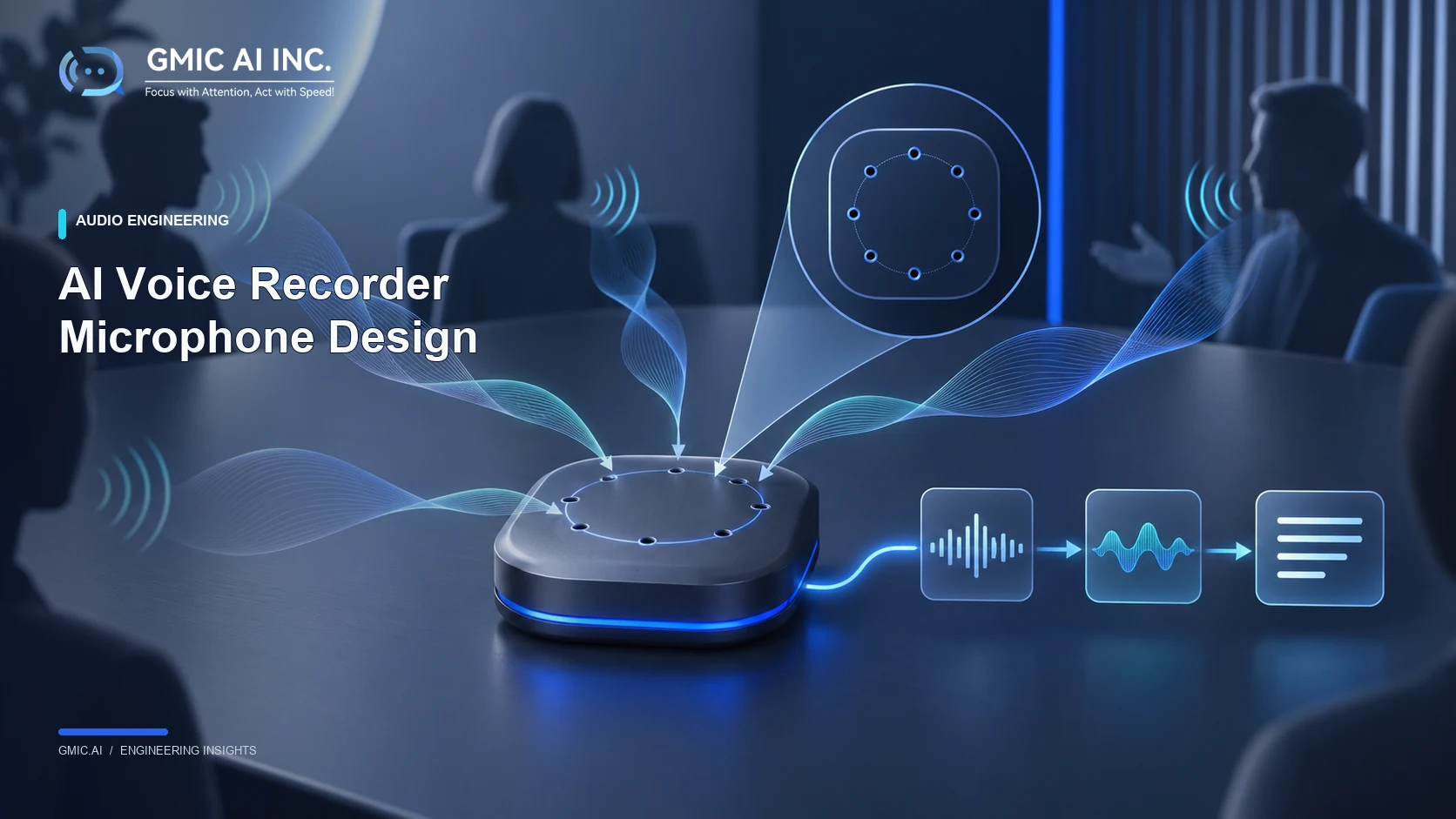
Short answer: A reliable AI voice recorder is not defined by microphone count alone. Speech capture quality depends on the complete audio path: the intended speaking distance, room noise and reverberation, microphone sensitivity and signal-to-noise ratio (SNR), enclosure acoustics, channel synchronization, gain control, noise reduction, and the speech model used downstream. For an ODM project, these variables should be converted into measurable use cases before the microphone or processor is selected.
This guide explains how to make those decisions without relying on vague claims such as “360-degree pickup” or “AI noise cancellation.” It is written for product teams designing meeting recorders, interview tools, lecture capture devices, and other compact speech-first hardware.
Why microphone design matters more for an AI recorder
A conventional recorder only needs to create an audio file that sounds acceptable to a listener. An AI voice recorder usually has a harder job: the captured waveform may also feed automatic speech recognition (ASR), speaker diarization, translation, summarization, and keyword extraction. A recording can sound pleasant after aggressive processing while still losing consonants or spatial cues that a model needs.
The useful design question is therefore not “How many microphones should we use?” It is:
Under which acoustic conditions must the device produce speech that is intelligible enough for both human review and the intended AI pipeline?
That requirement should identify the speaker distance, number and position of speakers, expected background noise, room type, device orientation, and whether people may overlap. Only then can the team choose a microphone topology and processing strategy.
Start with the recording scene, not the component list
Three products described as “AI voice recorders” can require very different audio front ends:
| Use case | Typical acoustic challenge | Design priority |
|---|---|---|
| Personal dictation | One nearby speaker; changing device angle | Low self-noise, wind/plosive control, consistent gain |
| Two-person interview | Speakers on opposite sides; unequal distance | Balanced coverage, orientation tolerance, clear channel strategy |
| Small meeting | Several distant speakers; table noise and reverberation | Far-field SNR, array geometry, echo/reverberation handling |
| Lecture capture | One distant primary speaker; audience noise | Directional pickup, placement guidance, long-session stability |
| Mobile field notes | Wind, handling vibration, traffic and abrupt level changes | Mechanical isolation, headroom, robust gain control |
A single default mode may not satisfy every row. If a product is expected to cover multiple scenes, consider explicit recording modes, orientation guidance, or a processing profile selected by the application. The interface should explain what changes rather than presenting an unexplained “AI mode.”
Near-field and far-field capture are different engineering problems
As the speaker moves away, direct speech becomes weaker relative to room noise and reverberation. Analog Devices notes that higher microphone sensitivity can help in far-field applications, but also explains why sensitivity alone is not a quality score: designers must balance noise, clipping, distortion, sensitivity, and the gain applied before conversion. See its technical explanation of microphone sensitivity.
For a close speaker, the system may have abundant signal and instead need protection against overload, breath noise, and handling vibration. For a distant speaker, the system must preserve weak speech without amplifying the recorder’s own noise or every sound in the room. This is why a pickup-distance claim without a defined voice level, noise condition, room, orientation, and intelligibility criterion is not very useful.
A practical way to specify distance
Do not ask the factory to validate “up to five meters” as a standalone statement. Define test points such as:
- one speaker at 0.3 m in a quiet office;
- two speakers at 0.8 m on opposite sides of a table;
- four speakers at 1.5 m with representative HVAC noise;
- a presenter at the target lecture distance with audience noise;
- the device flat on a table and held in the hand.
At every point, retain the raw recording, processed recording, transcript, firmware version, device configuration, and room notes. This creates evidence that can be compared after a mechanical, component, or algorithm change.
The specifications that actually influence speech capture
Signal-to-noise ratio and self-noise
SNR describes how far the desired signal sits above noise. For an individual microphone, the data-sheet SNR helps characterize its internal noise under a defined test method. At product level, however, effective SNR is also shaped by the enclosure, power rails, PCB layout, acoustic leakage, processor noise, room, distance, and gain strategy.
A higher component SNR can be valuable for weak, distant speech, but it does not rescue poor placement or a noisy mechanical design. Compare candidates under the same acoustic scene and with production-representative electronics.
Sensitivity
Sensitivity indicates the electrical output produced for a defined sound pressure. It helps match the microphone to the rest of the signal chain. It should not be read as “more sensitive means better.” A system with excessive gain or insufficient headroom can clip when a nearby speaker becomes loud.
Acoustic overload point and headroom
The acoustic overload point helps determine whether loud speech or environmental sounds can be captured without unacceptable distortion. A dictation device held near the mouth and a recorder sitting in the middle of a conference table may need different compromises. Evaluate sudden laughter, table impacts, and close speech—not only a steady test tone.
Frequency response
Speech-focused products do not necessarily need a response optimized for music. What matters is preserving the bands that support intelligibility without introducing enclosure resonances or over-processing artifacts. The complete device response is more relevant than the bare microphone response.
Channel matching and synchronization
Multi-microphone processing depends on predictable timing and level relationships between channels. Component tolerance, clocking, routing, and calibration can affect beamforming or direction-of-arrival estimates. If the product uses an array, channel behavior should be tested across production units and operating conditions.
Does an AI voice recorder need a microphone array?
Not always. A well-placed single microphone may outperform a poorly implemented array. Multiple microphones become useful when the product needs spatial information or wants to combine channels to improve a target direction, estimate where speech is coming from, or provide coverage for different orientations.
Microsoft Research has demonstrated that multi-device microphone inputs, alignment, beamforming, speech recognition, and diarization can work as a coordinated meeting-transcription system. Its research on virtual microphone arrays for meeting transcription also illustrates an important principle: the value comes from the full signal-processing system, not from microphone count in isolation.
Array geometry must match the enclosure
The distance and orientation between microphones determine what spatial cues are available at different frequencies. Industrial design constraints—device thickness, openings, screens, batteries, buttons, and waterproof membranes—can alter the acoustic path. The array layout should therefore be developed with mechanical and audio engineering together, not added after the enclosure is locked.
Beamforming has limits
Beamforming is spatial filtering. It can emphasize or suppress sound based on direction when the array, calibration, and acoustic conditions support that operation. It cannot perfectly separate every overlapping speaker, remove all reverberation, or recover speech that was clipped or never captured.
Small portable devices also have limited spacing between microphones. Product teams should ask for measured results in representative rooms rather than assuming that more channels guarantee a longer pickup range.
Noise reduction is not the same as better source audio
Noise reduction can suppress stationary noise, handling sounds, or other interference, depending on the algorithm. Automatic gain control can make levels more consistent. Voice activity detection can help determine when speech is present. Acoustic echo cancellation matters when a device plays audio while listening. Each tool solves a different problem.
Aggressive processing can also create risks:
- soft consonants may be removed with noise;
- speech can sound watery or gated;
- overlapping voices may be distorted;
- gain pumping can make room noise rise between phrases;
- processing latency or power use may increase;
- a pleasant-sounding output may perform worse in ASR.
For development, keep access to raw or minimally processed audio whenever privacy and storage requirements allow. Compare that source with each processing stage. Espressif’s microphone design guidance also highlights practical physical issues such as separating microphones from vibration and other noise sources.
The enclosure is part of the microphone system
An excellent microphone can underperform behind a poorly designed acoustic port. Common causes include:
- a port that is partially blocked by the hand or table;
- unequal acoustic paths across array channels;
- vibration from buttons, motors, haptic elements, or the housing;
- air leakage or resonance around the microphone cavity;
- adhesive or mesh variation during assembly;
- electromagnetic or power noise entering the audio path;
- speaker-to-microphone coupling in devices with playback.
Validate early with production-like plastics, gaskets, mesh, adhesives, PCB, and battery—not only an open evaluation board. Acoustic performance can shift when the industrial design changes between prototype stages.
Design for transcription, diarization, and summaries separately
These downstream functions do not have identical requirements.
- Transcription needs intelligible speech with limited clipping, noise, and reverberation.
- Speaker diarization must determine who spoke when; overlapping speech and weak spatial or voice cues increase difficulty.
- Summarization depends on the transcript and language model, so acoustic omissions can become confident but incomplete summaries.
- Translation can magnify recognition errors, especially for names, technical terms, and numbers.
Test the complete pipeline with domain-relevant vocabulary. A low word error rate on generic speech does not prove that the system will correctly capture product names, accented speakers, or specialized terminology.
A practical ODM validation plan
1. Write an acoustic use-case matrix
For each recording mode, define speaker count, distance, angle, room, noise, orientation, duration, language, and success criteria. Rank the scenes: a compact device may not optimize every use case equally.
2. Create a fixed reference corpus
Use consented, non-sensitive speech samples and repeatable playback levels. Include quiet and noisy conditions, near and far speakers, accents relevant to the market, overlapping speech, and key domain terms. Do not use confidential customer meetings as an uncontrolled benchmark.
3. Save both acoustic and AI outputs
Archive representative raw audio, processed audio, transcripts, speaker labels, and summaries. Record the hardware revision, microphone lot, firmware, processing settings, and model version. This makes regression analysis possible.
4. Measure more than one outcome
Useful metrics can include clipping rate, level consistency, noise floor, objective or expert listening scores, ASR word error rate on a controlled reference, speaker-attribution errors, power consumption, thermal behavior, and storage use. The exact acceptance thresholds must come from the product requirement—not from a generic internet benchmark.
5. Repeat across EVT, DVT, and PVT
Audio risk changes as the enclosure, PCB, suppliers, and assembly process mature. Use the staged approach described in our guide to EVT, DVT, and PVT. A microphone result from an engineering sample should not automatically be treated as production evidence.
Questions to ask an AI voice recorder ODM
- Which acoustic scenes were used to choose the microphone and array layout?
- Can the team provide raw and processed recordings from defined distances?
- How are microphone ports, mesh, gaskets, and vibration isolation controlled in production?
- Which functions run on-device and which depend on a phone or cloud service?
- Can noise reduction, AGC, and recording profiles be tuned for our use case?
- How are channel matching and synchronization checked for an array?
- What changes to the enclosure or PCB require acoustic revalidation?
- How is transcript quality evaluated for our target languages and terminology?
- Can firmware and model versions be traced to each validation result?
- What privacy controls apply to stored audio and uploaded recordings?
For teams deciding how much of the product stack to own, see our comparison of an AI voice recorder module versus a finished product. Connectivity choices also affect upload time, power, and workflow; our guide to Bluetooth versus Wi-Fi for AI voice recorders covers that layer.
How GMIC can support the hardware platform
GMIC’s MIC06 AI Voice Recorder is a reference point for brands exploring compact voice-first hardware. Its published platform features include local NAND storage, Wi-Fi, Bluetooth 5.3, NFC, firmware encryption, slide-touch interaction, motion sensing, and multi-sensory feedback. These features can support product workflows, but they do not by themselves prove a particular pickup range, transcription score, security certification, or acoustic performance.
For a custom program, the responsible next step is to define the target acoustic scenes and validate a production-representative configuration. GMIC can discuss enclosure, electronics, firmware, connectivity, storage, and manufacturing requirements as part of that broader ODM process.
FAQ
How many microphones does an AI voice recorder need?
There is no universal number. One microphone can be appropriate for close dictation. Multiple microphones can provide spatial information for orientation handling, beamforming, or meeting capture, but only when geometry, channel synchronization, processing, and enclosure acoustics are designed together.
Does a microphone array guarantee better transcription?
No. An array can improve the input to speech processing under suitable conditions, but transcription also depends on distance, room acoustics, noise, channel quality, processing, language, and the ASR model. Compare complete-system results using the same test corpus.
What is the difference between sensitivity and SNR?
Sensitivity describes the microphone output for a defined sound pressure. SNR compares desired signal with noise under a defined condition. Neither specification alone predicts finished-device performance.
Can AI noise reduction recover speech that was not captured clearly?
It may suppress some interference, but it cannot reliably reconstruct clipped audio or speech buried beyond the information preserved in the recording. Strong source capture should come before enhancement.
How should pickup range be tested?
Specify the speaker level, distance, angle, room, background noise, device orientation, processing mode, and success metric. Test several production-representative units and retain the audio plus AI outputs for comparison.
Should the device store raw or processed audio?
During development, retaining both can make tuning and regression analysis more reliable, subject to consent, privacy, and storage requirements. The commercial product may expose only the formats appropriate for its workflow and privacy policy.
Conclusion
The best microphone architecture for an AI voice recorder begins with a measurable acoustic requirement. Define the scene, select components and geometry for that scene, treat the enclosure as part of the audio system, and evaluate both the waveform and downstream AI outputs. That approach creates defensible product evidence—and gives an ODM team a specification it can actually build and verify.