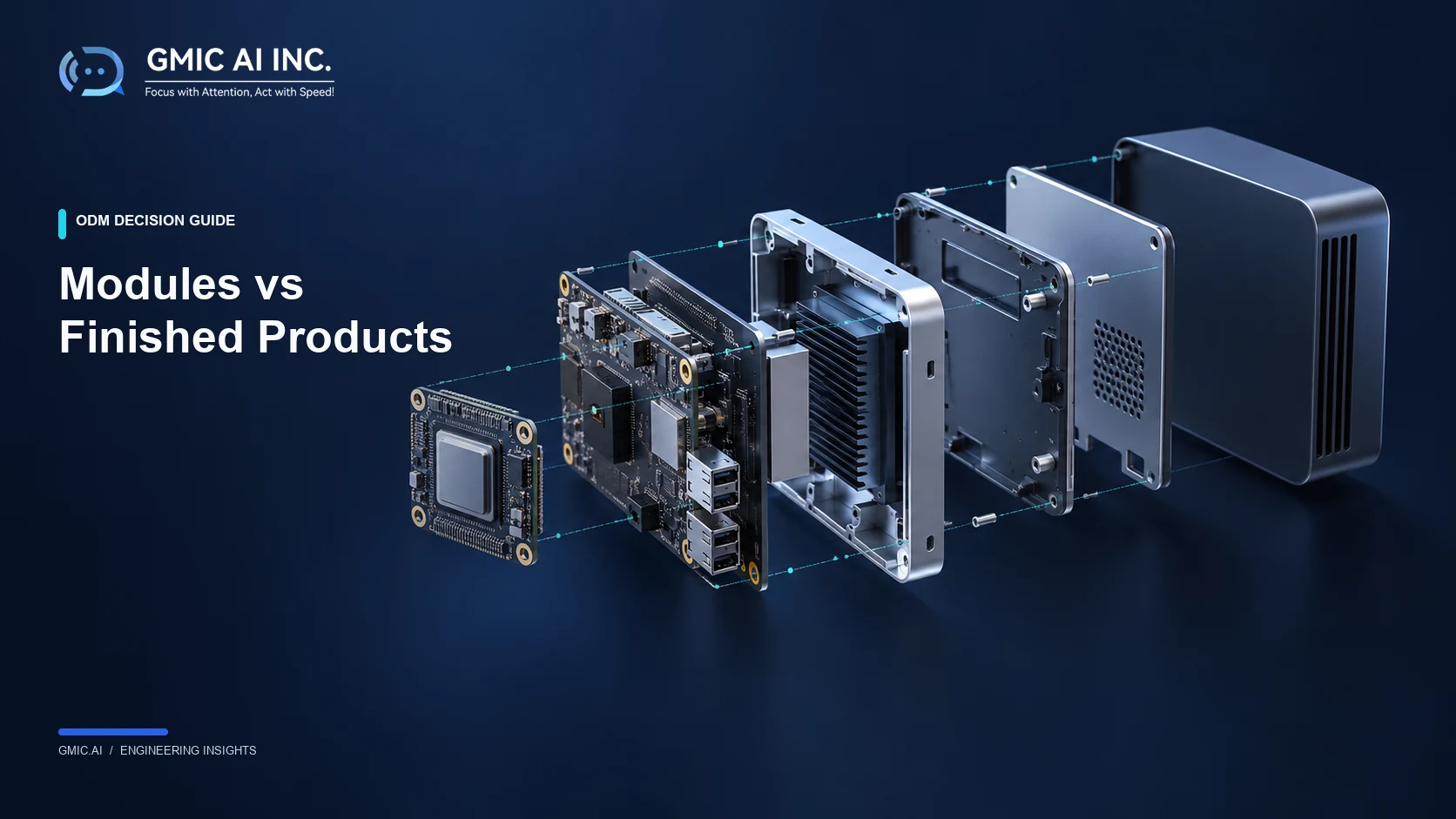
A custom AI hardware module and a finished AI product solve different parts of the same problem. A module can accelerate compute, audio, sensing, or connectivity integration. A finished product must also prove the carrier board, power system, enclosure, thermal design, antennas, firmware, user controls, manufacturing tests, certification path, packaging, and field support.
For software companies and product teams, the most important sourcing decision is not simply “Which AI hardware manufacturer should we use?” It is: Where should the supplier’s responsibility begin and end? This guide compares modules, PCBAs, development kits, semi-finished assemblies, and market-ready devices so you can define an ODM scope that matches your team.
The short answer
Choose a module-led program when your team owns the system design and needs a reusable subsystem. Choose a finished-product ODM program when you need one partner to coordinate electronics, firmware, mechanical design, validation, certification support, production test, and manufacturing introduction. Choose a hybrid when your core IP belongs in a controlled module but the surrounding product still needs ODM engineering.
| Delivery level | What it usually includes | What it does not prove |
|---|---|---|
| AI module / SoM | Processor, memory, power rails, selected interfaces, basic BSP | Final I/O, enclosure, antennas, acoustics, certification or mass-production yield |
| Custom PCBA | Module or SoC plus product-specific interfaces, power and connectors | Complete mechanical, environmental and user-workflow performance |
| Development kit | Evaluation board, debug access, reference software and documentation | Production size, battery life, thermal limits, cost or regulatory readiness |
| Semi-finished assembly | PCBA plus selected antennas, battery, microphones, speakers or housing | Retail-ready system, packaging, final certification and field lifecycle |
| Finished product | Integrated hardware, firmware, enclosure, test process and production package | Your market-specific legal approval, service operation or business success |
Why “module” is often misunderstood
A module is a bounded subsystem. It may combine a processor, memory, power management, wireless radio, audio front end, sensor, accelerator, or embedded software. The value is concentrated complexity: your carrier board can use a defined footprint and interface instead of reproducing every high-risk circuit.
But a module does not remove system engineering. The finished device still determines signal integrity, grounding, electromagnetic compatibility, antenna placement, microphone openings, acoustic echo, heat paths, battery safety, connector stress, ingress protection, and user-visible behaviour. Even a pre-certified radio module may only simplify part of the final product’s approval path; the host configuration, antenna and market requirements still have to be evaluated.
This is why module selection belongs inside the wider AI hardware architecture, not as a purchasing shortcut made after the enclosure is designed.
Five questions that define the right scope
1. What engineering capability already exists in-house?
A software team with an embedded engineer may integrate a documented module but still need help with RF, acoustics, mechanical design, certification, and production test. A mature hardware company may want only a specialized audio or AI compute subsystem. Inventory skills by discipline rather than saying “we have engineering.”
2. Where does the product differentiate?
If differentiation is mostly in software, workflow, or cloud service, a proven hardware platform may reduce unnecessary risk. If differentiation depends on size, sensor placement, battery life, far-field audio, haptics, or a proprietary accessory, the physical architecture needs deeper customization.
3. Which assets must your company control?
Define ownership and access separately for schematics, PCB layout, source code, bootloader, factory firmware, mechanical CAD, tooling, test fixtures, calibration data, signing keys, mobile apps, cloud accounts, model files, and manufacturing records. “You own the product” is too vague to manage a supplier transition.
4. Who will carry lifecycle risk?
Modules create dependencies on vendor BSPs, security patches, component availability, and end-of-life notices. Finished-product programs add responsibility for replacement components, firmware regression, manufacturing quality, warranty analysis, and repair or replacement policy. Put each responsibility into the scope before quotation.
5. What must be demonstrated before the next investment gate?
An early module prototype may only need to prove model latency and audio input. A design-validation unit must be representative enough to test enclosure acoustics, thermal behaviour, radio performance and reliability. A production-validation build must prove assembly, programming, calibration, traceability and test coverage. Use the required evidence—not the appearance of the prototype—to define the delivery level.
Module-led development: when it works best
- Your team owns the carrier board and full product architecture.
- The subsystem will be reused across several products.
- You need a replaceable compute, audio, wireless, or sensor block.
- The module vendor provides stable documentation, reference software, lifecycle notices and update support.
- Your organization can validate the completed host system.
The module specification should cover more than peak AI performance. Request operating temperature, real power profiles, thermal limits, boot time, sleep states, interfaces, clocking, audio paths, supported memory, security functions, BSP versions, update mechanism, production programming, test points, change-notification policy, and product-lifecycle status.
Finished-product ODM development: when it works best
- You have a product concept or software platform but not a complete hardware team.
- The market requires coordinated industrial, mechanical, electrical and firmware design.
- Audio, RF, thermal, battery and enclosure choices interact strongly.
- You need one owner for prototype builds, design verification and manufacturing introduction.
- Your commercial plan requires packaging, traceability, production testing and repeatable quality.
A capable ODM does not merely assemble parts. It turns requirements into a controlled design, validates the design through progressively representative builds, creates manufacturing data, qualifies the production process, and manages changes. For a complete overview, see GMIC’s AI hardware ODM process guide.
The hybrid architecture: controlled core plus ODM integration
Many AI products use a hybrid scope. The brand or technology company controls a module containing its model, security boundary, or proprietary processing. The ODM develops the carrier board, microphones, wireless system, power architecture, enclosure, fixtures, firmware integration, and final assembly around it.
This can protect a reusable technical core while avoiding the burden of building every physical product discipline internally. It also creates interface risk. The parties need a stable hardware and software contract covering power, clocks, buses, audio formats, boot order, error states, diagnostic access, update responsibility, security keys, manufacturing tests, and module replacement.
What to put in the ODM statement of work
| Scope area | Define explicitly |
|---|---|
| Inputs | Product requirements, target markets, use environment, volume assumptions, industrial design and software |
| Hardware | Module, carrier board, sensors, microphones, speakers, battery, antennas, connectors and accessories |
| Firmware | BSP, drivers, audio pipeline, BLE/Wi-Fi, power management, OTA, logging and factory mode |
| Mechanical | ID/MD ownership, materials, finish, tooling, sealing, drop and cleaning requirements |
| Verification | Test plan, sample quantity logic, pass criteria, reports, issue closure and regression |
| Manufacturing | DFM, programming, calibration, fixtures, end-of-line test, golden samples and traceability |
| Compliance support | Target standards, responsible party, test lab, pre-scan, samples and technical documentation |
| IP and access | Ownership, licences, source access, escrow, keys, tooling, data and supplier-transition rights |
| Lifecycle | Change notice, component substitution, vulnerability response, updates and end-of-support |
Do not treat a development kit as a product prototype
A development kit is intentionally generous: exposed connectors, debug access, large power supplies, open airflow, standard antennas, and reference firmware make experimentation easier. Those conditions hide constraints that appear after miniaturization.
- Thermal throttling may appear inside the final enclosure.
- Battery and regulator limits may reduce sustained AI performance.
- Antenna efficiency can change near batteries, displays, metal and the user’s body.
- Microphone response changes with port geometry, membranes and assembly tolerance.
- Boot, update and recovery behaviour must work without engineering tools.
- The final BOM may require different memory, storage or component grades.
Use a kit to retire specific technical risks, then move to a production-representative design through controlled EVT, DVT and PVT phase gates.
Security and regulatory responsibilities follow the finished system
Software security should be planned throughout development. The U.S. National Institute of Standards and Technology’s Secure Software Development Framework provides practices for preparing, protecting, producing and responding to vulnerabilities. In an ODM project, translate these into ownership for source control, dependency tracking, signing, release approval, vulnerability handling and update support.
Likewise, a component approval does not automatically approve the finished product. In the United States, the FCC equipment authorization program applies to radio-frequency devices under specific rules and procedures. In the EU, cybersecurity obligations for products with digital elements are addressed by the Cyber Resilience Act. The applicable path depends on the product, market, radio configuration, intended use, and your legal role; obtain qualified compliance advice for the actual design.
Red flags when selecting a module or finished-product supplier
- The supplier cannot explain which design files, source code and tools are included.
- A development kit demonstration is presented as evidence of final battery, acoustic or thermal performance.
- The quotation excludes firmware integration, production test or certification samples without saying so.
- Module lifecycle, security updates and component-change notices are undocumented.
- Production debug access or shared credentials remain enabled by default.
- Pass criteria are replaced with phrases such as “industrial grade” or “AI ready.”
- The commercial proposal assumes a production volume but the technical design has not been validated at that level.
A practical decision sequence
- Define the user workflow, environment, data boundary and target markets.
- List the engineering and operations capabilities your team truly owns.
- Separate differentiating IP from commodity functions.
- Choose the delivery level required for the next evidence gate.
- Map every interface and responsibility between your team, module vendor and ODM.
- Contract for deliverables, ownership, verification and lifecycle support.
- Validate progressively with production-representative hardware before committing to scale.
GMIC supports module adaptation, custom PCBAs, firmware integration, enclosure development, audio engineering, prototype validation and finished-product ODM manufacturing. The right engagement can begin with one subsystem or cover the complete product, but the boundary should always be explicit. Explore our custom AI hardware development paths.
Frequently asked questions
What is the difference between an AI hardware module and a finished product?
A module is a subsystem designed for integration into a larger device. A finished product includes the complete electronics, mechanical system, firmware, user interface, manufacturing process and product-level validation needed for its intended market.
Can an ODM build only a custom AI module?
Yes. The scope may be limited to a compute, audio, wireless or sensor module plus its firmware and documentation. Your team or another integrator then owns the carrier board and finished system.
Does using a certified wireless module certify the final device?
Not automatically. A module authorization may simplify part of the process, but the final host, antenna, installation conditions, labelling and market rules still require review.
Who should own the firmware in an ODM project?
Ownership and licensing depend on the commercial model. The contract should separately address pre-existing platform code, project-specific code, third-party components, source access, build tools, signing keys and rights needed for long-term support.
Last reviewed: October 2026. Technical and regulatory requirements vary by product and market; verify them against the actual design and current official guidance.