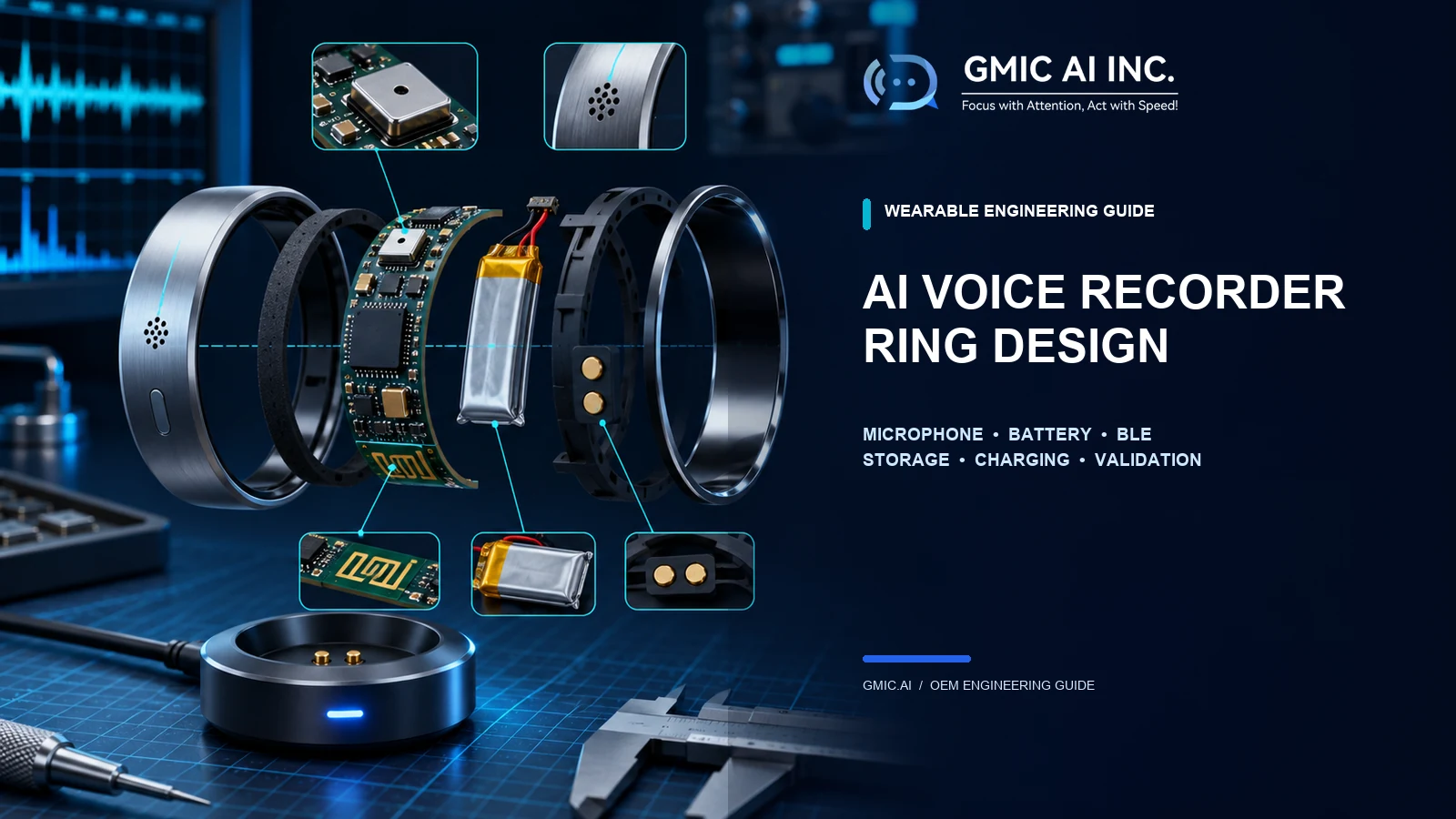
An AI voice recorder ring design is technically possible, but it should not be treated as a normal voice recorder made smaller. The ring cross-section, microphone opening, battery volume, on-body antenna performance, local storage, controls and charging method constrain one another. A credible OEM proposal therefore begins with a measurable use case and a feasibility build–not a promised thickness or runtime based on a component datasheet.
This guide turns recurring, anonymized buyer questions into an engineering framework. It is intended for product teams evaluating a press-to-record ring that can capture audio locally, synchronize through Bluetooth Low Energy (BLE), and hand recordings to a customer-owned app or AI service.
What buyers are actually asking for
Recent project inquiries repeatedly combine the following requirements:
- a thin ring with no display or speaker;
- one-button or press-and-hold recording;
- offline audio capture when a phone is absent;
- BLE synchronization to a mobile app later;
- enough local storage for short notes or meetings;
- multi-day light-duty use rather than continuous recording;
- a compact contact or magnetic charging case;
- an SDK or documented GATT interface for a customer-owned app;
- OTA firmware updates, battery status and storage status; and
- certification and IP ownership suitable for commercial launch.
Some briefs also propose band widths around 6 mm and radial thickness near 3 mm. Those numbers are useful as industrial-design targets, but they are not proof of feasibility. Finger size, internal curvature, wall thickness, seals, component height, battery swelling allowance and assembly tolerances all consume the same small volume.
The first useful engineering answer is therefore: define what the ring must do, how often it must do it, and which requirement may move when the geometry does not close.
Start with a requirement budget, not a render
Before selecting a chipset, divide the product brief into seven linked budgets.
| Budget | Questions to freeze before EVT |
|---|---|
| Mechanical | Ring sizes, maximum width/thickness, material, water/sweat target, serviceability |
| Acoustic | Voice distance, direction, noise environment, clothing/hand occlusion, sample rate |
| Energy | Record minutes per day, standby duration, transfer frequency, charge time |
| RF | Phone positions, worn/unworn range, transfer throughput, coexistence |
| Storage | Codec, bitrate, retained hours, deletion policy, corruption recovery |
| UX | Press-and-hold or toggle, state feedback, accidental activation prevention |
| Software | Mobile platforms, BLE services, file transfer, OTA, security, cloud ownership |
These budgets prevent a common failure mode: the industrial design is approved before the battery, antenna and acoustic path are tested in the real enclosure.
1. Ring geometry is the first feasibility gate
A ring is harder to package than a flat wearable. The electronics must follow a curved body or occupy a localized “top” module. A fully curved PCB can improve distribution but complicates component placement and assembly. A segmented rigid-flex or small rigid board is often easier to prototype, but it can create a thicker local section.
The mechanical stack must include more than the nominal component dimensions:
- PCB and solder-joint height;
- battery pouch, tabs and protection circuit;
- microphone acoustic gasket and port path;
- antenna keep-out and nearby metal clearance;
- charging contacts and ESD protection;
- enclosure wall, adhesive or weld land;
- manufacturing tolerance and battery expansion allowance.
Create cross-sections for the smallest, middle and largest ring sizes. A design that closes only at one diameter is not a product family. Before electronics, print or machine non-functional ergonomic samples and test comfort during typing, gripping and hand washing.
2. Microphone placement determines whether the recording is useful
The microphone is not just a component choice. Its port, cavity and exposure to the speaker determine the captured signal. TDK’s MEMS microphone mounting guidance recommends aligning the acoustic opening, keeping the acoustic path short and avoiding cavities that can create unwanted resonances. Those principles become more important when the enclosure is only a few millimeters thick.
For a ring recorder, validate at least these conditions:
- hand resting on a table;
- hand holding a phone, bag or steering wheel;
- port partly blocked by a neighboring finger;
- ring rotated away from the speaker;
- speech at near-field note-taking distance and at meeting distance;
- fabric rub, taps and hand movement.
A single microphone may be sufficient for short, close-range voice notes. It cannot create the same spatial processing options as a well-spaced microphone array. If the brief prioritizes size and power, one microphone plus a deliberate speaking gesture can be a better product decision than claiming far-field performance that the geometry cannot support.
For component and port tradeoffs, see our AI voice recorder microphone design guide.
3. Push-to-record is an engineering advantage
Press-and-hold recording is not merely a user-interface choice. It can reduce standby power, accidental recordings, privacy ambiguity and storage demand. The firmware can move from deep sleep to capture only while the control is intentionally held.
However, a ring without a display, LED, speaker or vibration motor has no obvious way to confirm recording state. The product team must choose a feedback path:
- tactile button travel and a defined hold threshold;
- a low-power indicator on the charging case;
- phone notification when connected;
- a very small haptic pulse, if the energy and volume budgets allow it; or
- a clear interaction contract, such as “hold to record, release to save.”
The firmware should debounce the control, reject very short accidental presses, finalize the file after power interruption and expose a stable recording ID to the app. The state machine should be tested before industrial-design tooling begins.
4. Battery life must be calculated from a duty cycle
“Three to five days” is not a complete battery requirement. It could mean five minutes of recording per day with no transfer, or hours of recording plus daily BLE synchronization. Those products have different cells, thermal behavior and charging intervals.
Build an energy model using measured current for:
- deep sleep;
- button sensing and wake-up;
- microphone plus audio capture;
- codec or compression processing;
- flash writes;
- BLE advertising and connection;
- file transfer; and
- battery protection and regulator losses.
Then calculate a representative day. Include cell derating, low-temperature behavior, battery aging and a shutdown reserve. Do not quote runtime from nominal milliamp-hours divided by one “average” current taken from a development board.
Texas Instruments publishes small-form wearable power-management reference designs, illustrating how charging, regulation and power-path decisions belong in the system architecture. They do not, however, establish runtime for a finished ring. Runtime must be measured in the final hardware and firmware duty cycle.
Our AI voice recorder battery-life calculation guide provides a validation method and acceptance-test template.
5. BLE performance changes when the ring is worn
Bluetooth Low Energy operates in the 2.4 GHz band. At that frequency, the finger, hand, metal enclosure and nearby battery can detune or shield a very small antenna. Bluetooth SIG guidance notes that antenna location, package size, antenna gain and obstacles all affect achievable range.
For that reason, an antenna that works on an open evaluation board is not evidence that the ring will transfer files reliably. RF validation should compare:
- ring worn and unworn;
- different ring sizes and hand positions;
- phone in the same hand, opposite hand, pocket and on a table;
- recording active versus idle;
- charging dock connected versus disconnected; and
- representative iOS and Android phones.
Tune the antenna in the intended enclosure and on a representative hand fixture, then confirm with real users. Record RSSI, connection loss, usable throughput, retry rate and energy per transferred megabyte. The goal is not an impressive open-air range; it is a repeatable user workflow.
6. Local storage depends on codec and recovery rules
A request such as “at least 30 minutes of recording” is easy to misunderstand. Storage capacity depends on sample rate, bit depth, channel count, codec and container overhead. Raw PCM is simple and robust but consumes more space. Compressed audio saves flash and BLE energy per minute, but adds codec complexity and may increase processing current.
Define the storage contract in minutes at the chosen audio profile, not just in megabytes. Also specify:
- maximum file duration and automatic segmentation;
- what happens when storage is full;
- file finalization after brownout or reset;
- checksum or integrity verification;
- stable recording IDs and timestamps;
- deletion only after an acknowledged transfer; and
- factory-reset and secure-erasure behavior.
For robust synchronization, use resumable chunks rather than restarting a large file after every disconnect. The AI voice recorder file-transfer protocol explains chunk IDs, checksums, resume behavior and idempotent completion.
7. The SDK should expose a product contract, not raw BLE trivia
A customer-owned app normally needs more than a list of GATT characteristics. The integration package should define the lifecycle of a recording and the error behavior around every command.
A practical ring SDK or protocol specification should cover:
- pairing, bonding and device identity;
- battery, charging and storage status;
- recording list and metadata;
- start, stop, finalize and delete commands;
- resumable file transfer and progress;
- time synchronization;
- firmware and hardware version reporting;
- signed OTA update flow;
- error codes, timeouts and retry rules; and
- a versioning and backward-compatibility policy.
The app should confirm receipt and integrity before requesting deletion from the ring. If cloud upload is used, local-to-phone transfer and phone-to-cloud upload should remain separate states. This prevents the device from deleting the only copy when the phone has received a file but the cloud has not.
Use the AI voice recorder SDK evaluation checklist to review source access, licensing, sample applications and maintenance responsibilities.
8. A charging dock is part of the product, not an accessory
For very small wearables, external charging contacts can be more volume-efficient than putting USB-C directly on the ring. A magnetic or keyed dock can simplify alignment, but the contacts must tolerate sweat, skin oils, cleaning and repeated cycles.
Validate:
- incorrect orientation and short-circuit protection;
- contact resistance after contamination and wear;
- charge current versus cell limits and temperature;
- ESD at exposed contacts;
- mechanical retention and removal force;
- dock-to-ring alignment across every size; and
- behavior when the ring is repeatedly reseated.
Wireless charging removes exposed contacts but adds coils, shielding, alignment constraints and conversion losses. In a thin ring, it should be compared with contact charging through measured prototypes rather than selected for appearance alone.
Can the ring work while a Bluetooth headset is connected?
Potentially, but the system architecture must be explicit. A ring that records from its own microphone and a headset that handles phone audio are separate Bluetooth roles and audio paths. The phone operating system decides how live call audio is routed and what third-party apps may capture.
Do not promise universal call recording based only on BLE connectivity. Validate each supported mobile platform, headset scenario and jurisdiction. A safer, testable product definition is often: the ring records its own microphone locally, while the phone and headset continue their normal audio session.
Recommended prototype and validation path
Phase 1: requirement and ergonomic model
Freeze target users, ring sizes, use gesture, record minutes per day, sync frequency and environmental conditions. Produce non-functional size models and verify comfort.
Phase 2: acoustic and RF mule
Use a larger engineering enclosure if necessary. Prove the microphone orientation, codec, antenna concept, BLE throughput and file-transfer flow before forcing everything into the final ring.
Phase 3: EVT ring prototypes
Build several mechanical and antenna variants. Measure current in every state, audio quality in defined scenes, storage recovery and worn-body RF performance.
Phase 4: DVT and certification preparation
Lock materials and assembly, then run environmental, sweat, drop, charging-cycle, ESD, battery-safety, RF and software regression tests. Certification scope depends on the target markets and final radio implementation. Products using Bluetooth technology must also follow the applicable Bluetooth qualification path; radio products may require market-specific equipment authorization.
Phase 5: PVT and production controls
Define microphone acoustic tests, RF production tests, current-leakage limits, charging-contact checks, firmware traceability and serialization. A golden sample should include both hardware and approved firmware.
Acceptance criteria to put in the OEM brief
Avoid adjectives such as “clear audio,” “long battery life” and “stable Bluetooth.” Replace them with testable criteria:
- speech intelligibility or a chosen objective audio metric in named scenes;
- maximum input level without unacceptable clipping;
- record minutes and standby hours for a defined daily duty cycle;
- minimum retained recording time at the selected codec;
- transfer completion rate and time for a known file size;
- maximum recovery time after connection loss;
- worn-body RF test positions and phone models;
- button force, hold duration and accidental activation rate;
- charge time, contact-cycle target and temperature limits; and
- successful recovery from power loss during recording, transfer and OTA.
This converts a concept into a quotation and validation basis that engineering teams can review honestly.
FAQ
Can an AI voice recorder ring work without a phone?
Yes, if it contains its own microphone, controller, local storage and battery. The phone can be used later for synchronization, transcription or AI processing. The exact offline duration depends on codec, flash capacity and the power budget.
How much audio can a recording ring store?
There is no single answer. Storage time is calculated from the selected audio format and bitrate, then reduced by file-system overhead and a safety reserve. State the requirement in minutes at a defined codec profile.
Can a 3 mm-thick ring contain a recorder and battery?
Treat 3 mm as a feasibility target, not a guaranteed specification. Ring diameter, wall thickness, local top-module geometry, component height, battery construction, antenna clearance and sealing must be modeled together. A physical stack-up and prototype are required.
Is one microphone enough?
One microphone can be appropriate for intentional, close-range voice notes. Meeting-room or far-field capture may require a different form factor, speaking behavior or multiple microphones. Test the real gesture and distance rather than relying on microphone sensitivity alone.
Does the ring need Wi-Fi?
Not necessarily. BLE can control the device and transfer short recordings to a phone. Large or frequent transfers may take longer and consume significant energy, so throughput and duty cycle should be measured. The phone can provide internet connectivity.
Can it record phone calls while a headset is connected?
The ring can record its own microphone, but phone-call capture depends on operating-system routing, app permissions, headset behavior and local law. It should not be promised as a universal feature without platform-specific validation.
Engineering conclusion
The strongest AI voice recorder ring design is not the one with the most features. It is the one whose geometry, acoustic path, duty cycle, antenna, storage rules and app workflow have been verified together. Start with anonymized user scenarios, turn every promise into a test condition, and allow the prototype data to decide whether thickness, runtime, range or recording distance must change.
For an OEM feasibility review, prepare the target ring sizes, maximum cross-section, record minutes per day, voice distance, sync frequency, mobile platforms, charging preference and launch markets. GMIC can use that input to structure an architecture review and staged prototype plan without exposing customer-specific information.
Authoritative engineering references
- Bluetooth Core Specification: Low Energy RF PHY
- Bluetooth SIG: Understanding Bluetooth Range
- Bluetooth SIG: Bluetooth Low Energy Primer
- TDK InvenSense: Recommendations for Mounting MEMS Microphones
- Texas Instruments: Small-Form Wearable Power Management Reference Design
- Texas Instruments: Wearable Wireless Power Reference Design
- FCC Equipment Authorization Data