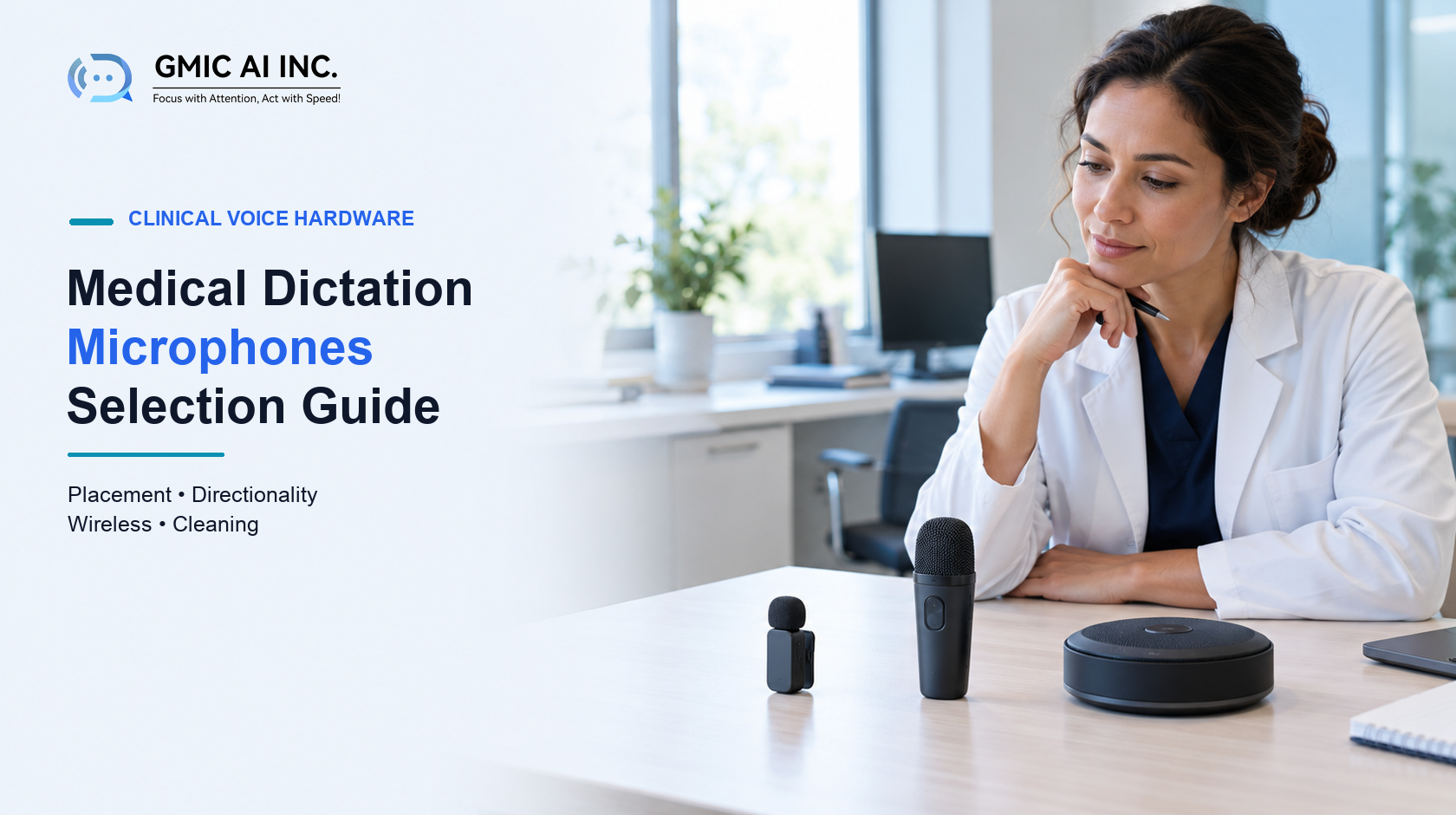
A medical dictation microphone should be selected for the clinical workflow, not only for its microphone specification. Placement, talker distance, movement, background speech, enclosure, audio processing, wireless reliability and cleaning all affect the signal that reaches an AI scribe.
There is no universally best microphone for every doctor or care setting. A close-talk headset can provide consistent distance but may interrupt normal interaction. A wearable can keep hands free but changes orientation as the clinician moves. A room array can capture multiple speakers but must manage distance, reverberation and privacy boundaries.
In brief: Define the users, environment and documentation workflow first. Then compare form factor, microphone geometry, audio path, controls, connectivity and cleanability. Validate the complete hardware-and-software system with representative clinicians and clinical vocabulary.
Explore microphones for AI scribes or discuss a clinical voice hardware project.
What Makes a Medical Dictation Microphone Different?
Clinical voice capture combines ordinary acoustic problems with workflow and data-integrity requirements. The device may need to capture speech while a clinician walks, turns away, examines a patient, handles equipment or speaks near other conversations.
Selection criteria can include:
- Consistent speech capture at the intended distance.
- Resistance to clothing, handling and airflow noise.
- Ability to distinguish the target speaker from nearby voices.
- Simple start, pause, cancel and confirmation interactions.
- Reliable association with the correct user, patient and encounter.
- Local buffering or recovery when connectivity fails.
- Materials and geometry compatible with the approved cleaning process.
- Battery life and comfort for the expected shift.
- Integration with the selected ASR, diarization and note workflow.
The microphone is one subsystem in a larger documentation path. An excellent acoustic signal can still fail if the recording is incomplete, attached to the wrong encounter or transformed into an inaccurate draft.
Compare the Main Microphone Form Factors
| Form factor | Strengths | Main trade-offs | Suitable evaluation scenarios |
|---|---|---|---|
| Headset or boom | Stable mouth distance, strong near-field speech | Wearability, hygiene, visible interaction | Structured dictation, noisy work areas |
| Handheld dictation mic | Intentional control, close speech, familiar workflow | Occupies a hand, less ambient conversation | Post-visit dictation, workstation notes |
| Wearable badge or pendant | Hands-free, mobile, persistent placement | Clothing noise, orientation and consent workflow | Rounds, home visits, mobile documentation |
| Lapel or collar mic | Short speech distance, lightweight | Placement varies; fabric contact | Individual clinician capture |
| Desktop microphone | Simple workstation use | Distance changes and desk noise | Office dictation and review |
| Room microphone array | Multi-speaker coverage and spatial processing | Reverberation, privacy boundary, cost and complexity | Consultation rooms and team discussions |
| Phone microphone | No extra device | Shared platform, placement, battery and interruptions | Low-friction pilots where phone use is acceptable |
Choose the form factor that reduces workflow variation. A better laboratory microphone may perform worse if users place it inconsistently or avoid wearing it.
Placement and Distance Come First
Sound level falls as distance increases, while room reflections and competing voices become relatively stronger. In practice, placement often matters more than a small difference between microphone component specifications.
Evaluate:
- Typical and maximum mouth-to-microphone distance.
- Orientation when the clinician looks at the patient, screen or equipment.
- Approved wearing locations and plausible misplacement.
- Whether coats, scrubs, lanyards or hair can cover the port.
- Movement between sitting, standing, walking and bending.
- Whether the patient’s speech is in or out of scope.
For a wearable, test the device as worn—not only mounted on a stand. For a room device, map useful coverage and failure zones rather than quoting one maximum range.
Omnidirectional, Directional or Beamforming?
An omnidirectional microphone captures sound from all directions. It can be forgiving of orientation but also collects more surrounding speech and room noise.
A directional microphone favors some angles. It may improve target-to-background ratio when orientation is predictable, but performance can drop when the wearer turns or the device rotates.
A microphone array uses synchronized channels for spatial processing such as beamforming. Arrays can support directionality, echo control and speaker localization, but results depend on microphone spacing, enclosure geometry, calibration and DSP.
More microphones do not automatically mean better dictation. A well-positioned single microphone can outperform an untuned array in a near-field wearable. Review GMIC’s microphone array and beamforming hardware guide for the system-level trade-offs.
Microphone Specifications That Matter
Datasheet values help screen components, but they do not predict the complete device by themselves.
Sensitivity
Sensitivity describes the electrical output for a defined sound pressure. The useful value must be considered with preamplifier gain, ADC range and intended distance.
Signal-to-noise ratio and self-noise
These affect quiet-speech capture, but enclosure noise, power noise and processing may dominate the final system.
Acoustic overload point
Adequate headroom helps prevent clipping from loud speech, handling or nearby transients.
Frequency response
A response appropriate for intelligible speech is more useful than an unnecessarily wide audio bandwidth. The port, membrane and enclosure modify the final response.
Digital interface and synchronization
PDM, I²S, TDM or codec interfaces affect routing and processor requirements. Arrays require stable channel timing and known channel order.
Environmental and production tolerance
Temperature, humidity, membrane choice, assembly and component variation can shift behavior. Validate production-intent units, not only a golden prototype.
The Audio Front End and DSP
The microphone output may pass through gain, filtering, noise reduction, automatic gain control, beamforming, echo cancellation and encoding before reaching speech recognition.
Google’s official WebRTC Audio Processing Module documents a speech-enhancement pipeline that includes echo cancellation, noise suppression and automatic gain control. It is a useful architectural reference, not proof that one configuration fits every clinical device.
Aggressive suppression can remove quiet consonants or create artifacts that harm ASR. Gain control can amplify background conversations during pauses. Beamforming can attenuate the target when the device moves. Evaluate raw and processed recordings plus downstream transcription.
See GMIC’s audio DSP tuning for voice AI and AI audio front-end guide.
Wireless and Offline Behavior
Bluetooth or Wi-Fi can improve mobility, but the design must define what happens when the link is weak or unavailable.
Test:
- Pairing, reconnection and ownership transfer.
- Range in the intended building or home environment.
- Coexistence with busy Wi-Fi and other Bluetooth devices.
- Packet loss, latency and audio gaps.
- Phone backgrounding, operating-system interruption and permission changes.
- Local buffering and upload resume.
- Duplicate prevention and segment ordering.
- Correct user, patient and encounter metadata.
- Battery behavior during capture and transfer.
A transcript cannot recover audio that was never recorded or transferred. Separate acoustic accuracy from transport completeness in the evaluation report.
For disconnected workflows, review offline voice AI hardware and wearable clinical dictation for home visits.
Controls, Feedback and Human Factors
The user needs to know whether the device is ready, recording, paused, failed or synchronizing. Feedback can use light, sound, vibration or a companion application, depending on the workflow and privacy requirements.
FDA’s Human Factors Considerations identifies intended users, use environments and user interfaces as connected parts of a device-user system. The guidance concerns medical devices; citing it does not mean every dictation microphone is regulated as one. It provides a useful discipline for healthcare hardware design.
Evaluate controls with representative users wearing gloves where applicable, moving between tasks and working under distraction. Include error recovery: accidental start, wrong encounter, low battery, lost connection and incomplete upload.
Cleaning and Material Compatibility
Clinical procurement should involve the facility’s infection-prevention and environmental-services stakeholders. Cleaning requirements depend on where and how the device is used.
The CDC recommends that noncritical patient-care devices follow appropriate cleaning and disinfection procedures and that materials be compatible with the selected agents; see its healthcare disinfection recommendations.
For a microphone device, review:
- Seam, button, clip and port geometry.
- Resistance of plastics, coatings, adhesives and printed marks.
- Whether a membrane blocks liquid without harming acoustics.
- Approved agents, concentration, contact time and wipe method.
- Replaceable covers, windscreens or clips.
- Charging contacts and connector protection.
- Written cleaning responsibility and inspection frequency.
Do not claim disinfectant compatibility until the production materials and acoustic performance have been tested after the intended exposure cycles.
Privacy and Recording Boundaries
Microphone directionality does not create a reliable legal privacy boundary. Nearby speech may still be captured, and processing can change audibility.
Define:
- When recording is allowed and how consent is handled.
- Visible or audible capture indication.
- Who can start, stop, review and delete recordings.
- Local retention and deletion conditions.
- Encryption and device identity.
- Which backend receives audio and metadata.
- How failed or abandoned recordings are handled.
- Logs needed for troubleshooting without exposing unnecessary content.
Legal, privacy, security and clinical stakeholders should review the intended workflow and jurisdiction-specific requirements.
How to Test Medical Dictation Microphones
Build a matrix around realistic use rather than one quiet-room sample.
| Dimension | Conditions to include | Measures |
|---|---|---|
| Placement | Approved positions and plausible misplacement | Level, clipping, intelligibility, ASR result |
| Movement | Sitting, walking, bending, head turns | Handling artifacts and missing speech |
| Clothing | Scrubs, coat, lanyard and outer layers | Fabric noise and port blockage |
| Noise | HVAC, speech babble, carts, TV and target workplace sounds | Error rate and critical-term preservation |
| Speakers | Representative voices, accents, rates and approved languages | Distribution, not only average |
| Vocabulary | Medications, names, numbers, negations and specialty terms | Critical substitutions and omissions |
| Connectivity | Normal, degraded, disconnected and recovery | Missing, duplicate or delayed segments |
| Duration | Short dictation, full encounter and repeated shift use | Battery, thermal and completion rate |
| Cleaning | Intended agents and exposure cycles | Material damage and acoustic drift |
Measure word error rate alongside clinically important errors, speaker attribution, recording completion and clinician correction time. GMIC’s wearable transcription accuracy framework provides a deeper test method.
A Buyer’s Checklist
Before selecting a microphone, confirm:
- Intended users, locations and languages.
- Dictation versus ambient conversation workflow.
- Target speaker distance and orientation.
- Whether patient or caregiver speech is required.
- Required controls and recording feedback.
- Microphone count, placement and processing path.
- Wireless, local storage and recovery behavior.
- Battery and charging workflow.
- Approved cleaning process and material evidence.
- Privacy, consent, identity and data boundaries.
- Integration with ASR, note generation and clinical systems.
- Test matrix and acceptance criteria.
- Manufacturing variation and end-of-line acoustic testing.
- Firmware update and lifecycle support.
Frequently Asked Questions
What is the best microphone for an AI medical scribe?
There is no universal best microphone. The strongest option is the one that meets the intended workflow’s placement, noise, mobility, cleaning, connectivity and review requirements in representative testing.
Is a wearable microphone better than a phone?
A wearable may provide more consistent hands-free placement and dedicated controls. A phone may simplify deployment. Compare complete workflow reliability rather than form factor alone.
Does a microphone array improve medical transcription?
It can help in far-field or multi-speaker situations, but only with suitable geometry, synchronization, enclosure design and DSP. Near-field wearables may not benefit from a complex array.
Should the microphone store audio locally?
Local buffering can protect against connection loss, but it introduces storage, security, deletion and synchronization requirements. The decision should follow the approved data architecture.
Can a medical dictation microphone be disinfected?
Only according to validated material and product instructions. Confirm compatibility with the facility’s approved process; do not assume that a consumer-electronics cleaning claim is sufficient.
Choose the Complete Capture System
Medical dictation accuracy is a property of the complete capture and documentation system. Microphone placement, enclosure, DSP, network, firmware, ASR and user workflow all contribute to the result.
Start with representative clinical conditions, compare configurations on the same corpus and preserve failed recordings for diagnosis. Select the design that reduces correction work and workflow failure without creating unacceptable usability, privacy or cleaning burdens.
Contact GMIC to evaluate a medical dictation microphone platform, or explore healthcare AI scribe hardware.