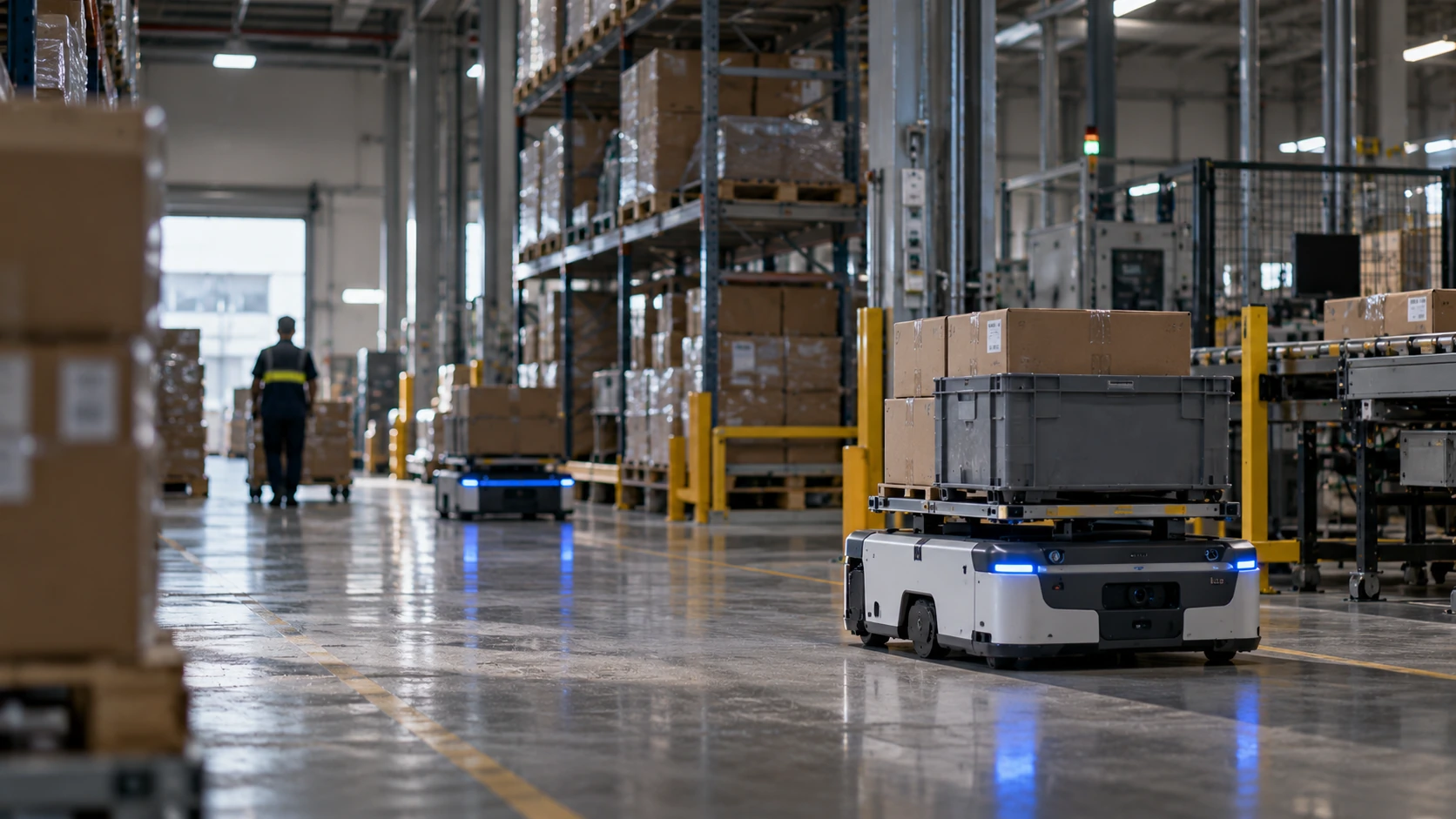
Develop reliable embedded hardware for AMRs, warehouse robots, inspection systems and industrial robotics — with edge compute, sensing, connectivity, firmware, custom electronics and production support.
Industrial robots operate around variable networks, electrical noise, dust, vibration, long duty cycles and continuous data flows. The embedded system has to be designed for reliability, diagnostics and repeatable manufacturing — not just for a successful demo.
GMIC helps productize the electronics around the customer's robotics, autonomy and fleet software.
Integrate MCU, SoC and edge-computing platforms for local processing, low-latency response and reliable offline operation.
Connect cameras, proximity sensors, IMUs, environmental inputs and industrial sensing interfaces.
Architect Wi-Fi, BLE, Ethernet, USB or cellular connections between robots, fleet systems, cloud platforms and facility networks.
Microphones, speakers, DSP and audio capture for environments where voice interaction or acoustic sensing is required.
Connect device firmware, APIs, SDKs, OTA updates and AI pipelines with the existing robotics software stack.
Move from development boards to production-intent PCB and PCBA designed around power, interfaces, reliability and manufacturing.
Embedded compute, sensing interfaces, connectivity and device electronics for autonomous mobile platforms and fleet-connected systems.
Hardware for robots supporting material movement, inventory workflows and warehouse automation.
Sensor, camera, edge-compute and network interfaces around picking, scanning and inventory workflows.
Connected sensing and embedded hardware for robots collecting visual, acoustic or environmental data in industrial sites.
Embedded interfaces, sensing and connected electronics supporting industrial robot applications and collaborative environments.
Edge-ready electronics and connectivity for robots operating outside a controlled office or lab network.
Industrial systems cannot assume a perfect cloud connection. Edge processing can reduce latency, preserve local operation and limit the amount of raw data that has to leave the machine.
The architecture should answer what must continue offline, what data needs real-time response, what should be buffered locally, and what can be sent to cloud services later.
GMIC can support the electronics, firmware and manufacturing path while your team continues to own autonomy, navigation, fleet software and robotics IP.
Already have a working industrial robotics prototype?
Discuss Your PrototypeDesign for manufacturing and assembly.
Balance performance, availability, and cost.
Sourcing and alternates planning.
Production-intent electronics.
Assembly sequence and setup.
Test strategy and procedures.
Quality controls for production.
Documentation and sustaining support.
An autonomous mobile robot is a mobile robotic system that can navigate its operating environment using onboard sensing and software rather than relying only on a fixed physical guide path. The final architecture varies by use case and safety requirements.
Yes. GMIC can focus on embedded compute, sensor interfaces, connectivity, firmware, custom PCB/PCBA and production readiness while the customer retains the autonomy, navigation and fleet-management software.
Yes, when the architecture is designed for it. Local processing, storage or buffering can keep defined functions available, with data synchronized when connectivity returns.
Those are not the default scope of this page. The standard focus is embedded electronics, sensing interfaces, compute, connectivity, firmware, integration and manufacturing support.
Bring us your current prototype, interface requirements and target operating environment. We can help define the embedded hardware path from architecture through validation and production.
Discuss Your Robotics Hardware