Build connected hardware around your companion AI, home assistant or consumer robotics software — with voice, sensing, embedded compute, connectivity, firmware, custom electronics and production support.
An AI companion or home robotics product has to operate in a much messier environment than a software demo. It has to hear people across a room, handle household noise, stay connected, manage power, recover from interruptions and make device state understandable to non-technical users.
GMIC helps build the embedded hardware layer around that experience.
Microphones, speakers, arrays, AEC, noise reduction and DSP for two-way conversation in real household environments.
Integrate camera, motion, touch, IMU, proximity and environmental sensors based on the product experience.
Select MCU, SoC and edge compute based on latency, privacy, local processing and cost requirements.
Connect the product to apps, home networks, cloud services and accessories with the appropriate wireless and wired interfaces.
Implement device state, pairing, recording/streaming behavior, retries, updates, authentication and power-management logic.
Move from modules and dev boards to integrated electronics designed around enclosure size, BOM, power and production.
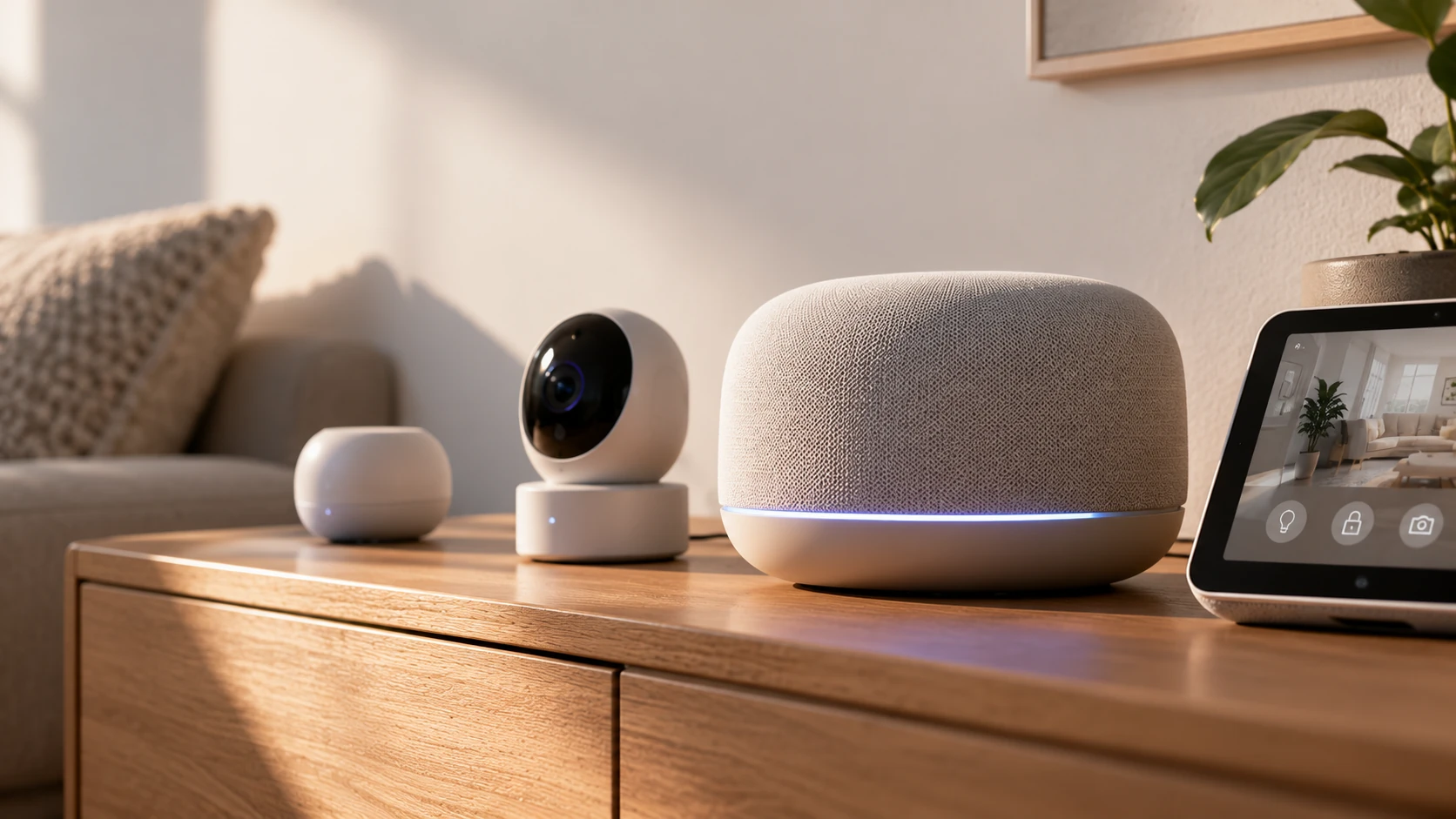
TV audio, kitchen noise, multiple speakers, music, reflective rooms and the product's own speaker can all degrade voice capture. The audio architecture has to be designed around the enclosure and target listening distance, not added after industrial design is complete.
Low-latency device functions, wake word, simple local inference, privacy-sensitive processing and offline behavior.
Large models, fast model updates and compute-heavy reasoning when network access is available.
Local capture/control plus cloud intelligence, with buffering and retry behavior designed into firmware.
GMIC helps implement the device hardware and firmware around the architecture your AI product requires.
Home products have to balance experience with practical constraints such as cost, thermal behavior, battery life, enclosure size, wireless performance, assembly, testing and certification. Those trade-offs need to be resolved before scale.
Design for manufacturing and assembly.
Balance performance, availability, and cost.
Manage sourcing and supply-chain planning.
Integrated production electronics.
Assembly planning and production setup.
Define test procedures and criteria.
Quality controls for pilot and production.
Packaging and shipment support.
Yes. The typical engagement keeps the customer's model, cloud service and application logic while GMIC develops or adapts the embedded hardware, firmware, connectivity and device interfaces around that software.
An app can remain entirely software-based. A companion robot or physical companion device adds microphones, speakers, sensors, compute, connectivity, power and embedded firmware so the AI can interact through a dedicated physical product.
Yes. Many products use a hybrid architecture in which latency-sensitive or privacy-sensitive functions run locally while larger models and heavier reasoning run in the cloud.
Yes. When speed matters, an existing hardware platform can be used for early validation. If the product proves demand, the architecture can move toward deeper customization and production-intent electronics.
The standard scope is embedded electronics, audio, sensing interfaces, connectivity, firmware, integration and manufacturing support. Motion systems should be scoped separately if required.
Tell us what the AI already does, how users should interact with the device and where it will operate. We can help define the embedded hardware path from prototype through production.
Discuss Your Product