
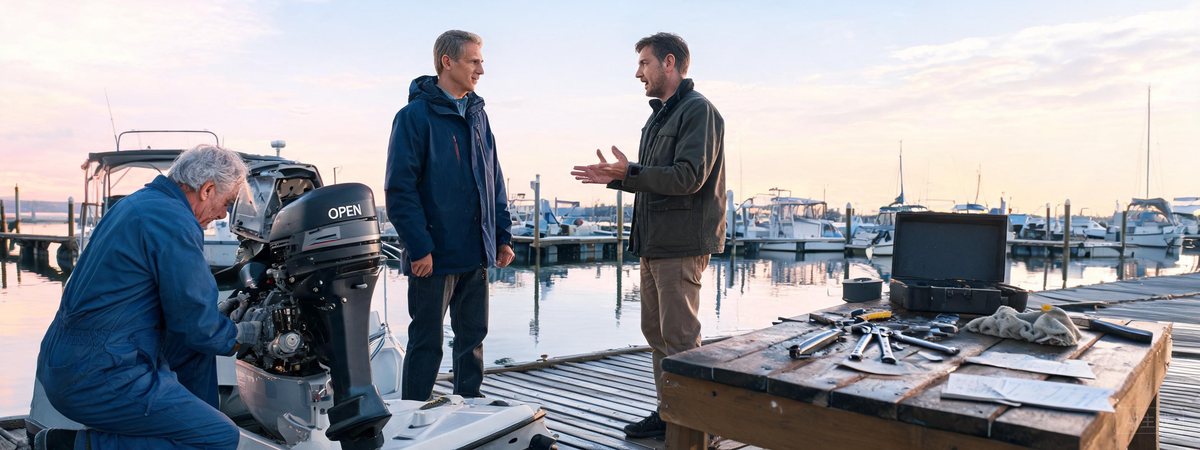
You know the moment. A customer walks back in on Thursday, points at the same noise they described last week, and your best tech pauses for half a second too long.
He remembers the face. Maybe the vehicle. Maybe that there was something about cold starts or a rattle after turning left. But the actual words are gone, and the work order says: “customer states noise.”
The AI receptionist wave is only the first page
AutomateNexus Voice showing up on Yahoo Finance with an AI-powered virtual receptionist is part of a real industry shift. Small businesses are realizing the front desk is no longer just a person, a phone, and a notepad.
That matters. But if we stop at answering and routing, we will build a faster version of the same forgetful company.
The real breakthrough is not that AI can talk. It is that the business can finally remember what was said.
At GMIC AI, this is the line we keep coming back to: knowledge has a half-life, and that half-life is shortest when your hands are dirty.
A receptionist hears the urgency in a customer’s voice. A service advisor hears the weird detail that does not fit the form. A senior technician hears a pattern because he has heard the same failure 400 times before.
- Before: The conversation becomes a few rushed words in a field.
- After: The customer’s words become searchable memory, tied to the profile, the job, the asset, and the next visit.
Conversations are the richest database most companies never keep
The CRM is not the system of record for most small businesses. The conversation is.
The problem is that conversations disappear into air. A call ends. A walk-in customer leaves. A field technician climbs back into the truck. The intelligence existed, but only for a few minutes.
Pick the last return customer. Without checking the system, what did your tech say about their vehicle, machine, or job last visit?
Now check the work order. Listen to the gap between what the team knew and what the company remembered.
That gap is where management pain lives. Not in a dashboard. In the awkward handoff where context died.
This is also why the market is moving so quickly. Gartner has projected that roughly one in ten agent interactions will be automated by 2026, up from a very small share in 2022. Salesforce has reported that 73% of customers expect companies to understand their unique needs and expectations.
Answering is not the finish line
Look, I understand why AI receptionists are getting attention. They are easy to describe. They sit at the front door of the business.
But the front door is not where memory is won. Memory is won in the second and third interaction, when the customer realizes your team did not make them start over.
- The boat owner: Last time, he said the motor bogged down only after twenty minutes on the lake, not at idle.
- The auto customer: She described the vibration as coming through the seat, not the steering wheel.
- The equipment rental client: The operator mentioned the hydraulic issue happened only after the machine warmed up.
Those details change the work. They change the estimate. They change the next question your team asks.
Revenue is the aftereffect of remembered detail. You diagnose cleaner. You avoid paying for the same discovery twice. You make the customer feel known because the business actually knows.
Enterprise Memory is infrastructure, not a feature
This is why we built Telalive the way we did. An AI phone agent should not be judged only by whether it sounds polite. It should turn each customer call into structured customer memory: what they said, what they asked for, what changed, what needs follow-up, and what the team should know next time.
Then the work moves off the phone. It moves into the bay, the aisle, the service yard, the field visit.
The 11 minutes that evaporate between the wrench and the keyboard are often the most valuable 11 minutes in the business.
That is where MIC05 and MIC06 come in. Wearable voice capture means the diagnosis is captured at the moment of the work, not reconstructed later when the tech is tired, the next vehicle is waiting, and the original thought has collapsed into a generic phrase.
The Bureau of Labor Statistics reported median employee tenure in the U.S. at 3.9 years in January 2024. For an owner, that is not an HR statistic. It is the 30-year veteran whose pattern recognition may walk out at retirement with no clean way to pass it on.
What changes when every conversation becomes a profile
Before Enterprise Memory, the business runs on people remembering. After Enterprise Memory, people still matter, but they are supported by a company memory that does not get tired, distracted, or pulled into the next emergency.
The difference is concrete.
- Before: A customer repeats the whole story to three people. After: The next person starts with context.
- Before: A vague work order forces the tech to rediscover the complaint. After: The original description is attached in the customer’s words.
- Before: Shift handoff depends on who had time to explain. After: the handoff includes a structured summary of what happened and what matters.
- Before: Senior judgment lives in one person’s head. After: recurring patterns become part of the company’s operating memory.
This is the part of the AI receptionist conversation I think the market is still underestimating. The voice interface is not the product. The memory layer behind it is.
Businesses do not need another shiny AI tool sitting beside the real work. They need capture infrastructure that meets the work where it actually happens: under the car, at the counter, beside the machine, in the second the question forms.
The companies that win will not be the ones whose AI talks the most. They will be the ones whose teams remember the best.
“I’m Trigg — CEO at GMIC AI. We build AI solutions that actually ship, from phone agents to custom hardware.”
What Can GMIC AI Do for You?
From AI phone agents to custom hardware — we’ve got you covered.