
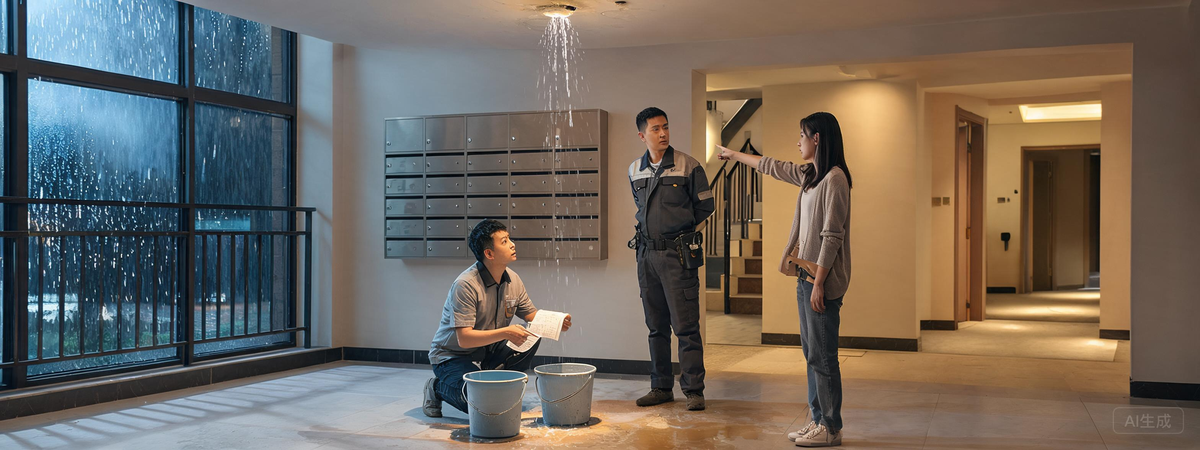
The leak was described clearly. The system remembered it badly.
It is 7:43 on a rainy Tuesday. A tenant calls the property office and says the ceiling is bubbling above the hallway closet, not the bedroom, and the water only appears when the upstairs neighbor runs the shower.
By 10:15, the work order says: “leak in unit.” The maintenance tech arrives with the wrong assumption, the tenant repeats the story, and your vendor asks a question your front desk already heard three hours ago.
This is the part owners and operators feel. Not some abstract dashboard number. The detail existed. Then it shrank.
That is why the recent Yahoo Finance coverage of Reinvent Telecom introducing MyCloud AI Receptionist matters. Telecom providers are moving AI reception into the mainstream. The market is no longer debating whether a machine can greet a caller, collect information, and route the next step.
The real question is not whether AI can answer. The real question is whether the conversation becomes company memory.
For property managers, that question has a very simple cost side. A full-time receptionist is expensive. An AI phone agent is not.
But cost alone is not the whole decision. The bigger issue is whether the exact tenant words, vendor details, showing questions, renewal concerns, and repair history survive the day.
The real cost of a human receptionist
Let’s be practical. A receptionist is not just an hourly wage. If you run a property office, you know the real number is salary, payroll tax, benefits, training, coverage, sick days, management time, and turnover.
The U.S. Bureau of Labor Statistics puts receptionist and information clerk pay in the mid-$30,000 range annually. BLS employer compensation data also shows benefits commonly adding roughly another 30% of wage cost in private industry. Even before you talk about hiring time, the math gets heavy.
- Base pay: $31,000 to $38,000 a year in many local markets, higher in competitive cities.
- Payroll taxes and insurance: often $2,500 to $4,000 on top of wages.
- Benefits: health coverage, PTO, retirement contributions, or cash equivalents can add several thousand dollars.
- Training: your manager spends hours teaching software, tenant rules, escalation paths, vendor contacts, and owner preferences.
- Sick days and coverage: someone else takes the desk, or your manager becomes the desk.
- Turnover: SHRM has reported average cost-per-hire at $4,700 across roles. Even if your number is lower, the disruption is real.
So the common $35,000 to $45,000 all-in annual receptionist cost is not dramatic. It is conservative. In some offices, it is low.
And that person works human hours. They need lunch. They take vacation. They have bad days. They are asked to be calm with an angry tenant, precise with a vendor, polite with an owner, and fast inside property management software at the same time.
What AI actually does for $200 a month
An AI phone agent usually costs $100 to $300 a month. Use $200 because it is easy math. That is $2,400 a year.
For that, it works 24/7, does not call in sick, and can handle 10x the call volume without turning the front desk into a pressure cooker. It can greet tenants, collect maintenance details, answer leasing questions, schedule showings, send summaries, and escalate the items that need a human.
- Maintenance intake: unit number, location, symptoms, urgency, photos requested, access instructions, pets inside, and tenant availability.
- Leasing questions: rent range, move-in date, parking, pet policy, tour scheduling, and follow-up notes.
- Owner communication: the reason for the call, property address, decision needed, and next action.
- Vendor handoff: what was already said, what was promised, and what must be checked on site.
Look, this is not magic. It is just a cheaper front layer for repeatable conversation work.
The mistake is stopping there. If the AI only behaves like a cheaper receptionist, you saved payroll but kept the same memory problem.
Pick the last maintenance request that became messy.
Before checking the system, what exactly did the tenant say? Now open the work order. Listen to the gap between the conversation and the record.
The math that makes the decision obvious
A human receptionist at $40,000 a year costs about $3,333 a month. An AI phone agent at $200 a month costs $2,400 a year.
That is a 16x difference in monthly cost before you count management time. And the AI layer can cover nights, weekends, lunch breaks, high-volume rent days, storm events, and the five-minute pileup when three tenants and one vendor all call at once.
- Human receptionist: $35,000 to $45,000 per year, human coverage limits, training burden, turnover risk.
- AI phone agent: $1,200 to $3,600 per year, always on, consistent intake, 10x volume capacity.
- Difference: roughly $32,000 to $42,000 a year that can go toward maintenance coordination, leasing, resident experience, or owner reporting.
But the best operators will not use that savings to pretend people no longer matter. They will move people toward judgment and let software handle repetition.
A good property manager should not spend the morning retyping tenant symptoms into short phrases. They should be deciding whether the leak requires emergency access, which vendor knows the building, and whether the owner needs approval documentation.
The receptionist is becoming infrastructure
This is where I separate AI reception from Enterprise Memory.
Telalive does not treat the call as a disposable event. It captures the conversation, turns it into searchable customer memory, and structures the details so the next tenant interaction starts with what was already said in their words.
In property management, the same principle applies in the field. A maintenance supervisor walking a unit can describe the stain pattern, the shutoff location, the tenant’s concern, and the likely source while standing in the hallway. With MIC05 or MIC06, that spoken diagnosis is captured at the moment of work instead of being reconstructed later at a keyboard.
Knowledge has a half-life, and that half-life is shortest when your hands are dirty.
That is true in an auto bay. It is true in a dental operatory. It is true in an apartment hallway with wet drywall and a tenant asking whether their closet is safe.
The 11 minutes between the walkthrough and the work order can erase the best part of the diagnosis. The exact words become “water damage.” The pattern becomes a generic note. The next person pays for the same thinking twice.
So what should a property office buy?
If your only question is cost, the answer is simple. A $200 monthly AI agent beats a $40,000 receptionist for repeatable intake work. The math is not close.
If your question is operations, the answer is more important. Buy the layer that remembers. The greeting matters for ten seconds. The record matters for the whole repair, the renewal conversation, the vendor invoice, and the next time that resident calls.
- Do not only ask: Did the phone get picked up?
- Ask: Did the tenant’s exact description survive?
- Ask: Can the field tech find it without bothering the office?
- Ask: Will the next manager understand the history six months from now?
The industry is moving toward AI reception because the payroll math is obvious. Reinvent Telecom’s announcement is another signal that this category is becoming normal.
But normal is not enough. The companies that get the most from AI will not be the ones with the fanciest greeting. They will be the ones whose conversations stop evaporating between the front desk, the hallway, the vendor, and the work order.
A receptionist answers for the moment. Enterprise Memory remembers for the business.
“I’m Trigg — CEO at GMIC AI. We build AI solutions that actually ship, from phone agents to custom hardware.”
What Can GMIC AI Do for You?
From AI phone agents to custom hardware — we’ve got you covered.