

Introduction
The global technology industry is entering a new structural phase driven by artificial intelligence. Over the past three years, the majority of attention has focused on large language models and generative AI systems developed by companies such as OpenAI, Google DeepMind, and Anthropic. These breakthroughs have transformed how software is built and how humans interact with machines.
However, a deeper structural shift is emerging beneath the surface. If we examine the long history of computing platforms—from personal computers to mobile operating systems and cloud computing—we observe a consistent pattern: the most valuable companies are rarely those that provide raw computing capability. Instead, the companies that control the operating layer—the orchestration layer that governs how software interacts with hardware and services—capture the majority of long-term economic value.
In the AI era, this orchestration layer may take the form of what many researchers and developers are beginning to call the AI Agent Operating System (Agent OS).
This article examines why the Agent OS layer may ultimately become more strategically valuable than the large language models themselves.
1. Lessons from the History of Computing
The technology industry has repeatedly demonstrated a structural hierarchy in value creation.
- Personal Computing — Core Computing Capability: Microprocessors — Operating Layer: Windows / MacOS — Dominant Value Capture: Microsoft / Apple
- Mobile Internet — Core Computing Capability: ARM processors — Operating Layer: iOS / Android — Dominant Value Capture: Apple / Google
- Cloud Computing — Core Computing Capability: Data Centers — Operating Layer: AWS / Azure — Dominant Value Capture: Amazon / Microsoft
In each era, hardware and raw computing capacity were necessary but not sufficient to capture the majority of economic value. Instead, the companies that controlled the operating environment—the platform through which software is built, distributed, and executed—became the most powerful.
The reason is simple: the operating layer governs access, coordination, and ecosystems.
The same structural logic is likely to appear in the AI industry.

2. The Current AI Stack
Today’s AI ecosystem can be broadly represented as a layered stack:
Compute Infrastructure (GPUs)
↓
Foundation Models
↓
Agent Systems
↓
Applications
Most industry attention has concentrated on the model layer—the creation of increasingly capable foundation models. Yet models alone do not complete tasks in the real world. They interpret information and generate responses, but they do not inherently manage workflows, data access, tool usage, or multi-step decision processes.
To transform intelligence into action, a coordinating layer is required. This is where AI agents and agent orchestration frameworks enter the picture.
3. The Commoditization of Models
Another structural factor shaping the future is the rapid commoditization of AI models.
The competitive landscape now includes:
- OpenAI
- Anthropic
- Meta
- xAI
- DeepSeek
- Mistral
- Alibaba
- and numerous emerging research labs
As competition intensifies and open-source models improve, model capabilities are likely to converge. Over time, access to high-quality models will resemble other utilities in computing—such as bandwidth, storage, or cloud infrastructure.
In other words, models may increasingly behave like commoditized intelligence infrastructure.
This does not diminish their importance. But it does suggest that the strategic leverage may shift to the systems that coordinate how intelligence is applied.
4. What an AI Agent Operating System Actually Does
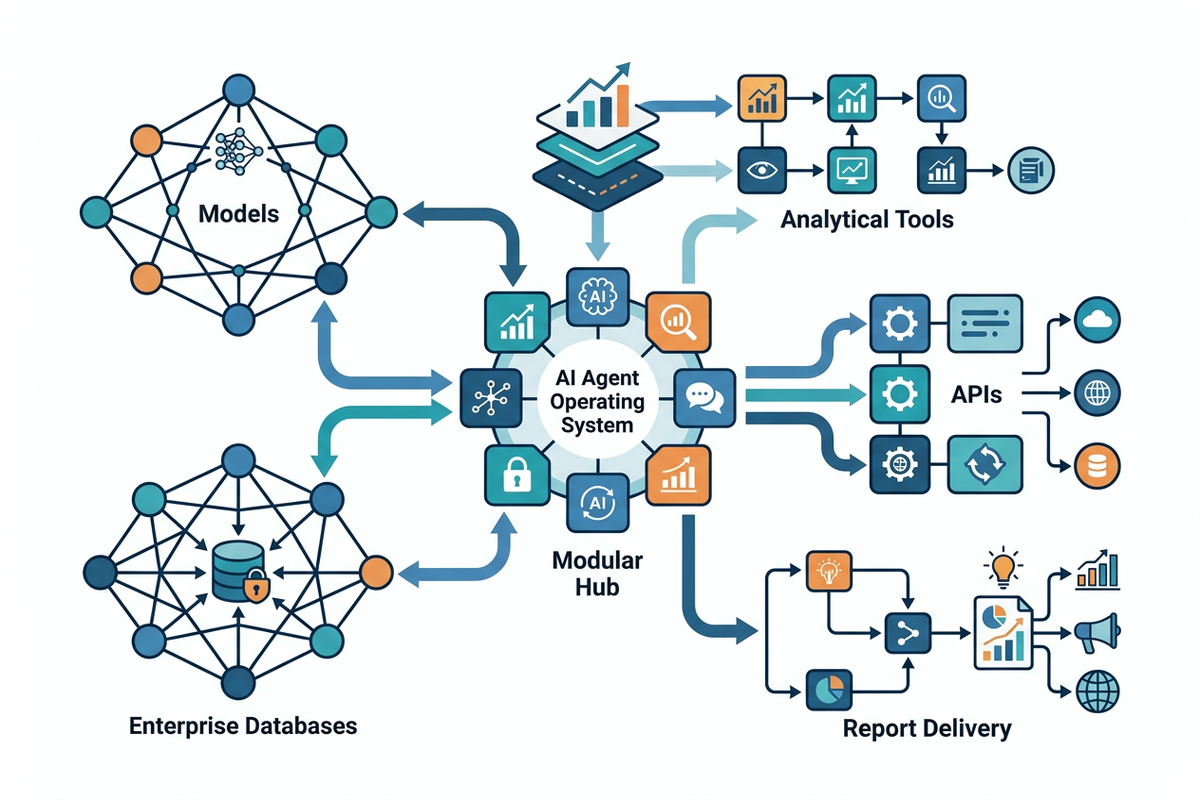
An AI Agent Operating System is not simply another application. It is an orchestration environment that manages how intelligent systems interact with software tools, data, and external systems.
For example, when a user requests:
“Analyze our customer data and generate a business report.”
A mature Agent OS might coordinate the following sequence:
- Interpret the user’s intent using a language model
- Access enterprise databases
- Retrieve relevant datasets
- Perform analysis through analytical tools
- Generate structured insights
- Deliver the final report through communication channels
In essence, the Agent OS becomes responsible for task orchestration, including:
- Memory and context management
- Tool selection and API orchestration
- Workflow execution
- Data access governance
- Security and permissions
Rather than a chatbot interface, the system becomes a digital operating environment for intelligent tasks.
💡 If models become increasingly interchangeable, where does durable strategic value move?
This article argues that the answer may lie in the orchestration layer—the systems that manage workflows, tools, permissions, and execution across real-world tasks.
5. Control of Workflows Equals Control of Value
In technology ecosystems, control over the orchestration layer often translates into economic leverage.
Consider the smartphone ecosystem. Hardware manufacturers initially appeared to be the dominant force. Yet over time, the most durable power emerged from platform ecosystems, particularly app distribution systems.
Similarly, an Agent OS would sit between foundation models and applications:
AI Models
↓
Agent Operating System
↓
Enterprise Applications
↓
End Users
By controlling the orchestration of tasks and data flows, the Agent OS can influence how models are used, which tools are invoked, and how services are delivered.
This positioning creates opportunities for value capture similar to those historically seen in operating systems and cloud platforms.
6. Enterprise Dependence on Agent Infrastructure
As AI systems mature, enterprises are likely to deploy multiple specialized agents for different functions:
- Sales agents
- Customer service agents
- Financial analysis agents
- Operations agents
- Knowledge management agents
Managing these agents individually would quickly become impractical. Instead, organizations will require infrastructure that provides:
- Centralized memory systems
- Agent scheduling and coordination
- Security and access management
- Observability and performance monitoring
- Integration with existing enterprise software
These requirements strongly resemble the role played by operating systems and cloud orchestration platforms in previous computing eras.
7. Stronger Business Models
Another important distinction lies in business models.
Foundation model providers typically monetize through:
- Token usage
- API calls
- compute-based pricing
Agent operating systems, however, can adopt business models closer to enterprise platforms:
- Per-seat subscriptions
- Per-workflow automation pricing
- Enterprise licensing
- Developer marketplaces
This opens the possibility for recurring revenue streams tied directly to organizational productivity, rather than purely computational usage.

8. The Emergence of Ecosystems
Historically, the most influential platforms build ecosystems.
Examples include:
- The Apple App Store
- AWS developer tools
- The Salesforce platform ecosystem
A mature Agent OS could support a similar structure:
Developers
↓
Agent Plugins
↓
Agent Marketplace
↓
Enterprise Users
In such an ecosystem, developers contribute specialized agents and integrations, expanding the platform’s capabilities and reinforcing network effects.
Once these ecosystems form, they can become extremely durable.
9. The Strategic Frontier of the AI Industry
Looking forward, the AI industry may organize around four major competitive layers:
- Compute Infrastructure — NVIDIA
- Foundation Models — OpenAI, Google, Anthropic
- Agent Operating Systems — Emerging contenders
- Applications — Thousands of startups
The Agent OS layer is still in its early stages, with no definitive global leader yet established. This makes it one of the most strategically important frontiers in the AI ecosystem.
10. The Role of Real-World Interfaces
One final dimension often overlooked in discussions about AI infrastructure is the importance of real-world interfaces.
Intelligent systems require continuous input from the physical environment—through audio, video, sensors, and other forms of data collection.
Devices capable of capturing real-world signals may therefore become essential components of the broader AI architecture, providing the sensory layer that connects human environments with intelligent software systems.
In this sense, the future AI stack may look like this:
Compute Infrastructure
↓
Foundation Models
↓
Agent Operating Systems
↓
Real-World Devices and Interfaces
Each layer plays a distinct role in enabling intelligent systems to perceive, reason, and act.
Conclusion
The rapid development of large language models has sparked enormous excitement and investment. Yet the long-term structure of the AI industry may ultimately resemble previous computing revolutions, where the orchestration layer captured the most durable strategic value.
AI Agent Operating Systems represent an emerging attempt to build that orchestration layer for the age of intelligent software. By coordinating models, tools, data, and workflows, these systems could become the foundational infrastructure that enables AI to operate reliably in complex real-world environments.
While the model race continues, the deeper question may be this:
Who will build the operating system for intelligent agents?
The answer to that question may define the next generation of technology platforms.
“I’m Trigg — I explore how structural shifts in AI infrastructure can reshape where long-term value is created across the industry.”
Explore More AI Industry Insights
Get broader perspective on AI platforms, orchestration layers, and emerging industry trends shaping the next generation of intelligent systems.
GMIC AI — from hardware to software to field deployment.