
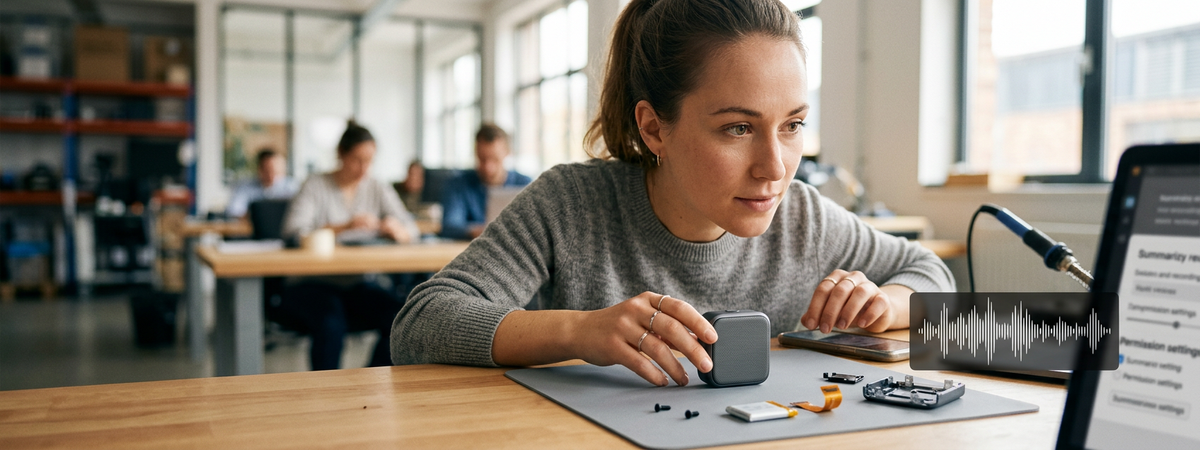
Most people still talk about AI recording gear as if the whole job is saving audio files. I think that misses the point for any wearable voice device business.
What matters over the next few years is whether a device can capture the messy middle of real life — conversations, pauses, handoffs, decisions — and turn that into memory a human can actually use later, without creeping people out in the process.
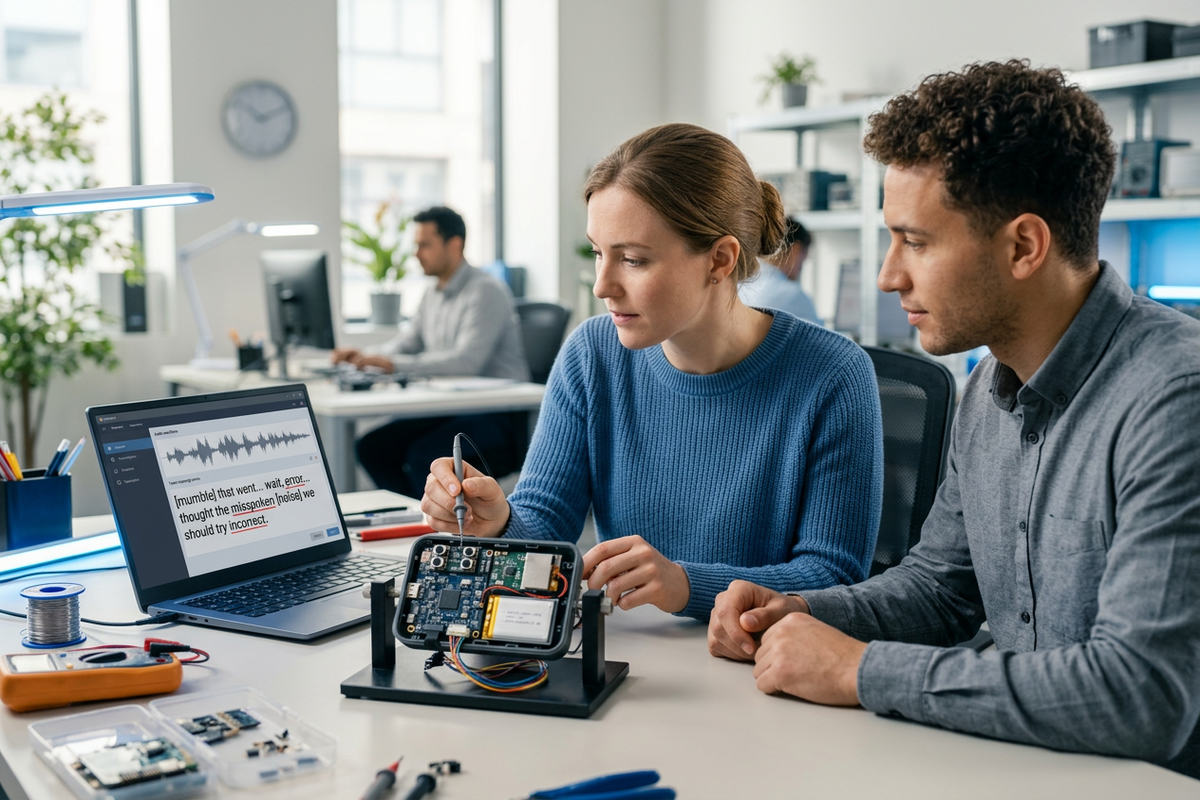
A prototype test changed how I see wearable voice device business products
A while back, we were reviewing a wearable voice prototype from the GMIC ODM side. On paper, it looked great: small body, solid battery life, clean industrial design, decent mic pickup. I remember thinking, honestly, “the phone is already good enough, so this thing needs to be almost invisible to justify existing.”
Then the field test got ugly. A user clipped it too low on a jacket zipper, fabric kept brushing the mic, and the transcript turned “call the supplier before 3” into “call the lawyer at 4.” Everyone laughed for about three seconds. Then nobody laughed, because that single line would have created the wrong follow-up task.
1 bad line
can send a team in the wrong direction for a whole day
That test changed my view. People aren’t buying a microphone. They’re buying fewer dropped details, fewer repeated explanations, and fewer “wait, who said that?” moments. Different thing.
And this is where the wearable expert in me gets stubborn: memory is embodied. Humans don’t think in isolated files. We think through situations. A useful AI recorder has to respect that. It has to know who captured the conversation, what kind of setting it came from, what should stay local, what can be summarized, and what should disappear after the task is done.
Why MIC05 voice capture and dedicated devices can beat the phone
I didn’t plan to write about this, but here’s the part founders often don’t want to admit: the phone is convenient, yet it’s a terrible default memory companion in many real environments. It gets buried in pockets. Permissions get changed. Battery anxiety kicks in. People forget to hit record.
A dedicated device like MIC05 or a custom GMIC-built wearable earns its place when it turns occasional capture into normal behavior. Not all day, not everywhere, and definitely not without boundaries. Just in the moments where forgetting is expensive.
💡 Here’s what I’d tell you if we were having coffee
Draw your data boundary before you build your next feature. Which audio must stay on the device? What gets turned into notes? Who can pull it up later? And who can delete it? If you can’t answer those four questions on one page, you’re not building memory yet. You’re just collecting risk.
Voice AI customer data only works when products know their limits
That’s the real shift. The interesting category isn’t “record everything forever.” I actually think that product shape is more likely to fail, even if it demos well.
The stronger products will be narrower and more opinionated. Capture this kind of conversation. Summarize it this way. Keep it for this long. Let these people see it. Delete the rest. Boring? Maybe. Useful? Very.
- In a factory pilot: a custom GMIC wearable caught shift-change notes that were usually lost between clipboards and hallway talk.
- In a field team setting: MIC05 voice capture made more sense than asking staff to type summaries in the parking lot after every visit.
- In both cases: the value came from what happened after the audio — summary, handoff, task creation — not from the recording itself.

There’s also a human reason for this. We don’t want perfect total recall. We want selective recall with permission. That may sound philosophical, but it’s really a product decision.
“Good memory tools don’t act like surveillance. They act like a careful assistant who knows what to write down, what to ignore, and when to leave the room.”
What I’d watch next in wearable voice device business
I’d be careful with big, chest-thumping predictions here. Still, a pattern is showing up.
The first solid wins will probably come from work settings where missed context costs real money: field service, team handoffs, sales follow-up, on-site inspections, distributed operations. Places where people are moving, talking, and forgetting. Not because the hardware is magical. Because the pain is obvious.
The products that struggle will likely be the ones that stay stuck as “smart recorders” with no clear answer for storage, retrieval, deletion, and action. That middle part matters more than founders think. I’ve watched teams obsess over beamforming and enclosure design, then hand-wave the question of who gets access to a summary two weeks later. That’s backwards.
For clarity: this article is industry observation only. It isn’t legal, medical, or investment advice. If you’re shipping into sensitive or tightly controlled environments, get professional review early. Don’t wing it.
“I’m Trigg — I work with teams building voice hardware and AI capture products, and I can help you map what should be recorded, summarized, stored, and deleted before you spend money on the wrong device design.”
Review your AI recording device concept with a real boundary map
If you’re a hardware brand, solution provider, or innovation team, we can walk through your wearable or recording product idea and pressure-test the capture flow, edge processing choices, and human use case.
Built for teams exploring AI audio devices and custom hardware.