
AI receptionists are the start. Memory is the real system.
vcita and PickMyCall launching an AI voice receptionist is a useful signal. The market is moving from simple call handling to real business capture. That matters. For years, small and mid-sized businesses treated phone coverage as the problem: missed calls, after-hours gaps, overloaded front desks. Now the industry is finally admitting the deeper issue. The problem is not just answering the phone. The problem is what happens to the conversation after it ends.
A receptionist, human or AI, can pick up every call. Great. But if the details from that call still disappear into a notebook, a half-written CRM entry, or somebody’s memory, the business is still leaking revenue. The same is true for walk-ins, site visits, estimate meetings, and internal handoffs. Most companies do not have an AI problem. They have a memory problem.
That is the shift I believe this latest launch points toward. Businesses do not need a pile of disconnected AI tools. They need infrastructure that captures conversations across every channel and turns them into execution: customer profiles, follow-up tasks, reminders, insights, and reusable content. If it’s not captured, it doesn’t exist.
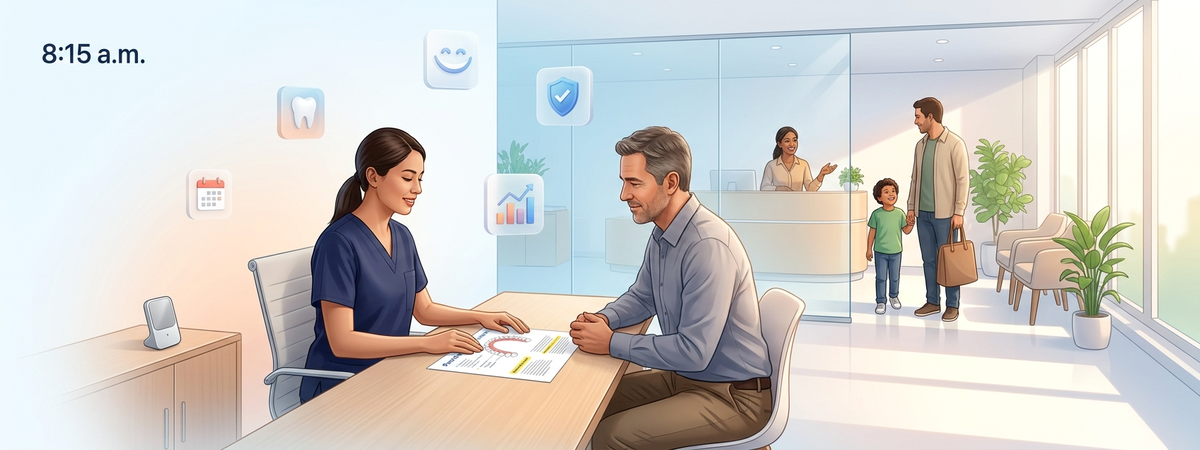
Let me make this practical. Take a dental group, a business type that lives and dies on scheduling, treatment acceptance, and patient trust. Every day, valuable information is spoken out loud: insurance questions, treatment concerns, family scheduling constraints, cosmetic goals, post-procedure issues, and reasons people delay care. Most of it vanishes. And that is expensive.
What you’re losing in a dental practice
A dental office looks organized on the surface. Phones are answered. Patients come in. Hygienists take notes. The practice management system has appointments and billing. But the most valuable layer is often missing: the conversation layer.
Here is what typically disappears in a week:
Phone inquiries that never become structured leads. A caller asks about Invisalign, implants, pediatric availability, sedation, or financing. The call gets handled, but the intent, objections, and urgency are not stored in a way the practice can act on later.
Front-desk walk-in conversations. A patient mentions they want whitening before a wedding, or that their spouse needs a new dentist, or that mornings are impossible because of school drop-off. Useful details. Usually gone by lunch.
Chairside conversations. Patients explain why they postponed treatment, what they are worried about, and what outcome they actually want. That is not small talk. That is sales intelligence and retention data.
Internal huddles and handoffs. The front desk says, “Mrs. Chen sounded nervous about cost.” The treatment coordinator says, “Follow up next Thursday after payday.” If nobody captures that, the office runs on memory and sticky notes.
Look, dental practices are not unique here. But they are a perfect example of how revenue gets lost in spoken detail. The U.S. healthcare system still struggles with no-show rates that commonly range from 5% to 30% depending on specialty and population. The Medical Group Management Association has repeatedly highlighted scheduling inefficiency and patient communication as major operational issues. And separate industry research from Salesforce has shown that 88% of customers say the experience a company provides is as important as its products or services. In dentistry, experience is often voice-first long before it becomes treatment-first.
So yes, an AI receptionist can help answer more calls. But if the business does not build memory around those conversations, it only solves the first 10% of the problem.
How to capture it
Start simple. You do not need to rebuild your practice stack. You need to stop letting conversations evaporate.
1. Capture every inbound and outbound call. This is your online voice layer. A system like Telalive should not just answer or route calls. It should capture intent, identify the patient, summarize the reason for contact, log objections, create follow-up tasks, and update the customer memory over time. If someone calls twice about implants and asks about payment options both times, that should become a structured profile, not two disconnected call notes.
2. Capture front-desk and consult conversations in the physical office. This is where most businesses are blind. In-person conversations shape conversion and retention, yet almost nobody records them in a usable way. A wearable or room-based capture layer like MIC06 can turn walk-in questions, consult discussions, and team handoffs into searchable memory. Not every sentence matters. But the moments that signal intent, concern, timing, and next action absolutely do.
3. Structure the output around execution. Raw transcripts are not the goal. The output should create assets the practice can use immediately: patient profiles, treatment-interest tags, unscheduled treatment reminders, financing follow-ups, no-show risk flags, FAQ content ideas, and coaching feedback for staff.
4. Connect memory across channels. The patient who called on Monday, walked in on Wednesday, and asked a hygienist a question on Friday should not appear as three separate events. One patient. One memory trail. One set of next actions.
5. Review patterns weekly. After a month, the practice should know what people are asking before they book, where treatment acceptance stalls, which insurance questions create friction, and what concerns show up repeatedly by location or provider. That is not just operations data. That is growth data.
What happens when you do
When a dental practice builds enterprise memory, three things happen fast.
First, conversion improves. Fewer inquiries die in the gap between conversation and follow-up. Implant leads get called back with context. Cosmetic patients receive the right reminder at the right time. Families who ask about scheduling are tagged and routed properly. The office stops restarting every conversation from zero.
Second, retention improves. Patients feel known. Not in a fake CRM way. In a real way. The office remembers they were nervous about pain, needed early appointments, or wanted to wait until their FSA reset. That memory changes how the next interaction feels.
Third, marketing gets smarter without extra work. The best content ideas are already sitting inside patient conversations. If 17 callers asked about same-day crowns this month, that should become a landing page, a short FAQ video, and a front-desk script. If parents keep asking about first pediatric visits, that becomes outreach content. Voice is not just support data. It is market demand in plain English.
And the ROI is not abstract. If a multi-location practice recovers even five treatment opportunities a week that would have been forgotten or mishandled, the annual value can be substantial. One accepted implant case or a handful of restorative treatment plans can pay for the system many times over. Add fewer no-shows, better staff handoffs, and stronger reactivation, and the economics get obvious.
But here is the bigger point. The market is going to keep shipping AI agents for narrow tasks: answering, scheduling, routing, summarizing. Fine. Useful. We build and ship too. But the winners will not be the businesses with the most AI tools. They will be the businesses with the best memory infrastructure.
That is why we built this as a system, not a widget. Telalive captures the phone layer. MIC06 captures the in-person layer. Together, they form enterprise memory: one layer that turns business conversations into structured, executable assets.
If you run a dental practice, start there. Capture what your team is already saying and hearing every day. Because right now, the most valuable part of your business is happening in conversations that disappear.
If you want to see how to turn those conversations into revenue, visit https://telalive.us or https://hearit.ai.