
Trend I keep hearing from owners
“Don’t sell me an AI tool. Sell me ‘the phones are handled’—with someone accountable when Friday goes sideways.”
Last Tuesday I was standing behind the counter at a buddy’s auto shop in Mississauga, and the phone would not stop. Not dramatic. Just relentless.
The packaging shift: software isn’t the product anymore
Jay runs a 6-bay shop. Between 8:10 and 9:05am he counted 23 calls: tow-ins, “do you have brake pads for a 2017 CR‑V?”, and the classic “can you squeeze me in today?” His service writer grabbed 9. The rest went to voicemail purgatory.
He tried a DIY AI receptionist before. It worked… until he opened a second location and calls started bouncing to the wrong place. That’s when he stopped shopping features and started shopping risk transfer: answer-within-3-rings, correct routing, and a real escalation path. In his case, Telalive wasn’t “an app”—it was the system that could prove what happened on each call (transcripts, timestamps, who got notified) when something broke.
Analogy I use with owners: DIY AI is buying kitchen equipment. A managed virtual receptionist service is buying a catering contract—with a head chef on call when the oven dies.
Why now: edge cases are eating everyone alive
A clinic in Tempe (Dr. Patel’s, family practice) had a Monday reschedule wave after a staff change—insurance questions, “can I come earlier?”, after-hours voicemail rules. One call almost created a double-book. Not because the AI was “dumb,” but because the policy was fuzzy and the day was noisy.
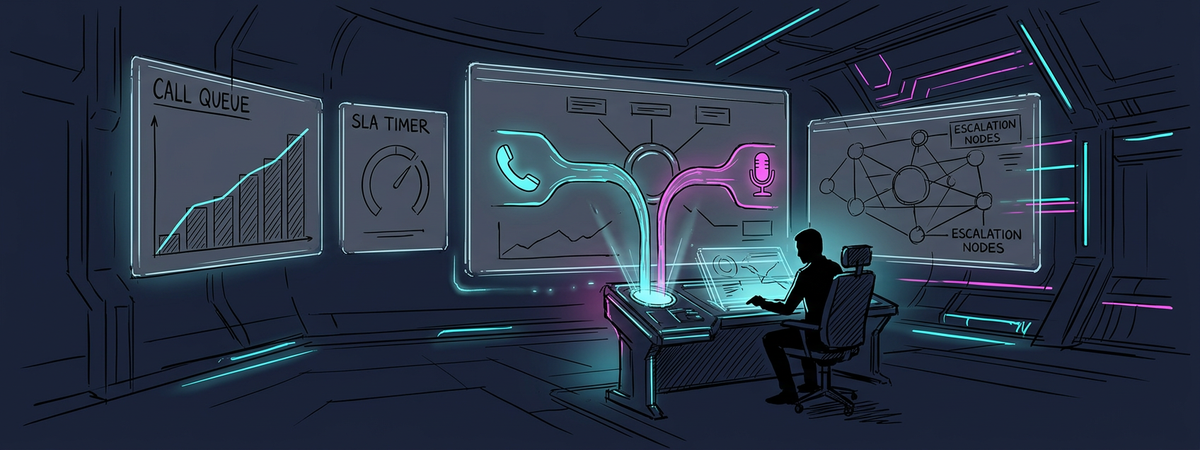
Managed service means someone owns the fuzz: they review 10–20 interactions a week, log failures, and update the call-flow like you’d update a playbook. Telalive makes that loop auditable: you can point to the escalation log, the changed rule, and the next week’s QA sample. I don’t actually know why we ever thought “set-and-forget voice” was realistic.
Download: “Managed Receptionist Contract Box”
SLA wording, escalation matrix, a weekly ops report layout, and a change-log example—built around the artifacts Telalive already generates. Grab it here →
What “managed” includes (the unsexy parts that build trust)
1) An escalation map: when to text the manager, when to warm-transfer, when to take a message.
2) A change log: “we changed after-hours routing on Feb 12 because cancellations spiked; here’s the impact.”
3) A weekly ops note: missed-call rate, abandonment, booking accuracy, escalation rate—messy, but visible.
And here’s the part most people skip: the offline reality. A showroom in Portland kept getting “but your staff said it was in stock” complaints. Telalive handled the phone perfectly, yet the floor promises were drifting. MIC05 (wearable offline capture → summaries → actions) gave the owner a clean feed of what was actually being said in-person, so the managed playbook matched both worlds.
Trust in high-stakes operations doesn’t come from “smart.” It comes from governance: clear ownership, measurable quality, and fast learning loops.
I used to think the goal was perfection. Now I think the goal is recovery.
Fast, documented, repeatable recovery.
Next step
See what “managed virtual receptionist” looks like when it’s auditable.
Book a demo of Telalive’s managed voice ops workflow (SLA behavior, escalations, weekly reports), and ask us when MIC05 makes sense to close the gap between phone promises and front-desk reality.
Book a Telalive demo →
Starter starts at $29.9/mo.