
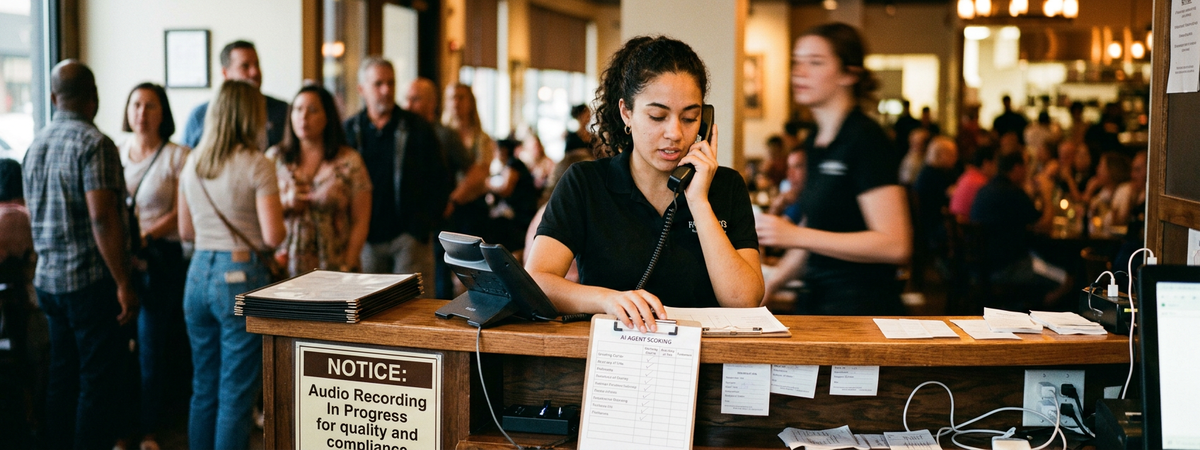
Key Takeaways
- Don’t buy the best demo—buy the system that survives Friday 6:30pm.
- Pass/fail beats “nice transcripts”: reservations, confirmations, and audit logs must actually happen.
- If you capture in-store voice, do it with clear notice + consent + tight data controls—or don’t do it.
Friday, 6:30pm. Jae’s 52-seat ramen spot in San Diego has a host juggling walk-ins, a printer spitting tickets, and a phone that won’t stop.
That night he missed 9 calls, and two callers who did get through were told “about 15 minutes” when the real wait was closer to 45. One left a review the next day: “Love the broth, but nobody knows what’s going on.”
The only buyer’s test that matters: 10 messy calls
When I’m vetting an AI phone answering service for restaurants, I give vendors 30 minutes to prove basics (pickup SLA, concurrency, real handoff). Then we do 10 live calls from three phones, with real noise.
On call #7 we had a caller with a thick accent ask, “table for fo’ at sev’n-fifteen,” while the kitchen hood roared in the background. The bot repeated “7:50,” the caller corrected it, and the transcript looked perfect—yet the reservation never wrote into the booking system. In the logs, the failure was simple: the “create reservation” step timed out and never retried. Pretty text. Zero outcome.
💡 If your restaurant is a system, what happens when the system gets stressed?
Grab a self-serve “10-call scorecard” (3 criteria preview: pickup time, parallel calls, reservation + confirmation created). Use it on any vendor—including Telalive—before you sign.
What to demand (procurement-grade, not vibes)
- Outcome logs: Not just transcripts—proof a reservation/order was created, a confirmation was sent, and an audit trail exists.
- Concurrency in writing: Test 3 simultaneous calls; fail if it drops intent or loops “please hold.”
- Clear limits: If your workflow needs complex refunds, disputes, or sensitive allergy liability, require a warm transfer or manager callback task (Telalive can auto-create these) instead of “AI improvisation.”
One more blind spot: what’s said at the host stand. Telalive catches the online voice (calls) and turns it into summaries and tasks; MIC05 can capture limited in-store service snippets for QA—but only in a compliance-first mode.
“Guests don’t experience your intentions. They experience your system—especially when it’s busy.”
Practically: use visible signage/voice notice, get staff consent where required, offer opt-out, and keep tight controls (pause switch, role-based access, encryption, short retention, delete/export workflow, and no capture of payment details). If you can’t do that cleanly, don’t record.
Ready to Stop Missing Calls?
Low-commitment: download the scorecard and run it in 5 minutes. High-commitment: book a 15-minute walkthrough and we’ll give you a one-page pass/fail verdict + 3 fixes for your rush hour.
Starting at $29.9/month. No contracts.