
A founder’s note from the front desk
Datatonic called it “productivity leakage”—when AI exists in isolation from the people who actually run the business. On paper, that sounds enterprise-y. In real life, it’s a missed call, an unlogged walk-in, a quote that never gets sent, and a customer who quietly goes elsewhere.
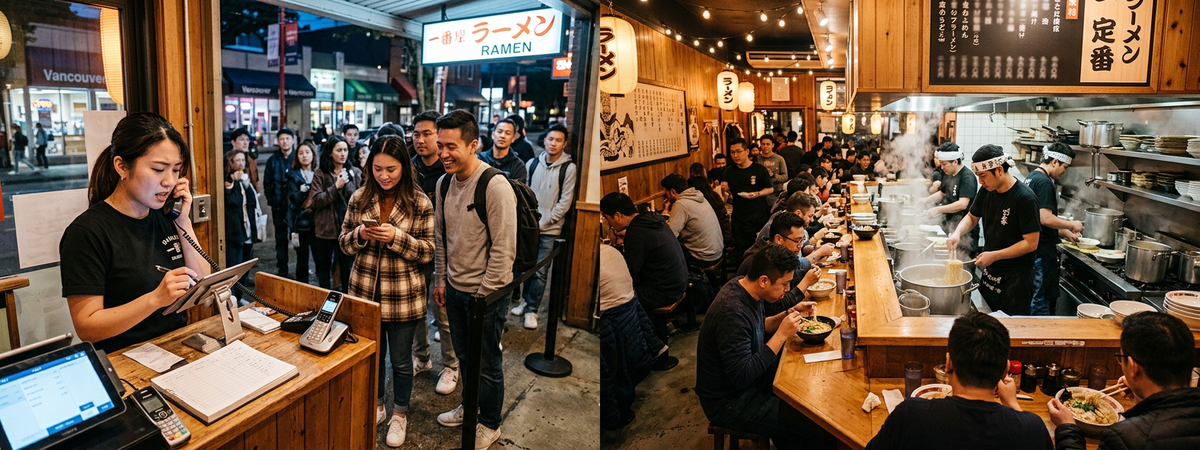
Friday, 6:41pm, Vancouver. I’m standing in the back of a small ramen shop (let’s call it Kenji Ramen) because the owner, Hana, asked me to “just listen for ten minutes.” The dining room is full. The phone is not stopping. Her hostess answers, puts someone on hold, then a walk-in asks about a 7-top, then another call comes in, then the delivery tablet pings, then the hostess looks at Hana like she’s about to cry.
Hana isn’t losing because she’s lazy. She’s losing because her business is a bucket with hairline cracks. Not dramatic enough to notice in one hour. Big enough to matter by month-end.
What I wrote down in 10 minutes:
- 8 calls rang through; 3 answered; 2 put on hold long enough to hang up
- 1 walk-in asked about a large party; no record of it anywhere
- 1 voicemail with a catering question—nobody had time to listen
That’s the “leak.” And Datatonic’s point lands: if your AI is sitting in a dashboard generating “insights,” while the front desk is drowning, you didn’t add intelligence—you added another tab nobody opens.
1) The real productivity leakage is conversational (and mostly invisible)
In SMBs, productivity isn’t a spreadsheet problem first. It’s a conversation-to-action problem. A customer says something. The business is supposed to do something. The “something” doesn’t happen—or happens late—and the cost shows up as chaos, rework, and churn.
A week earlier in Columbus, Ohio, I watched Ray run a two-bay auto shop. He had a notebook with names and phone numbers. It felt charming until you noticed the gaps: a “call back Monday” with no time, a “quote?” with no parts list, and a sticky note that just said “BRAKES!!!” (three exclamation points, which is not a process).
17
open items in Ray’s “call back” notebook after 4 days (not all bad… but none auditable)
Datatonic’s CEO put it bluntly: “The biggest risk we see in the market is productivity leakage when AI exists in isolation from the people who actually run the business.” For Ray, “AI in isolation” would look like call transcripts stored somewhere while his notebook stays the real system of record. That’s not transformation. That’s duplication.
If a conversation doesn’t end as a booking, a task, a quote, or a logged decision, it’s operationally the same as if the conversation never happened.
2) Why AI pilots stall: a dashboard can’t carry a tray of soup
I’ve seen “AI pilots” die the same way in restaurants, clinics, and repair shops. Someone buys software. It produces summaries. Maybe even good ones. Then… nothing changes at the moment of work. People keep answering phones the old way, scribbling notes the old way, and forgetting follow-ups the old way.
Datatonic argues the next phase of AI is carefully-governed and designed AI that works alongside humans—human-in-the-loop (HiTL). That phrase can sound like bureaucracy. But in practice, it’s the opposite: it’s how you let AI move fast without letting it do something dumb at 6:41pm on a Friday.
A quick enterprise analogy that actually maps to SMB life:
Datatonic points to AI document processing in finance delivering a cited ~70% reduction in invoice-processing costs in some cases—yet finance still approves final outcomes. The lesson isn’t “trust AI less.” It’s “design the loop so humans approve the risky parts, not the routine.”
Now translate that to a clinic. Leila runs a family practice front desk in Tempe, Arizona. Routine appointment scheduling? Fine to automate. But symptom triage? That’s an exception, not a default. If your AI is only generating a “triage insight” in a dashboard, Leila still has to copy/paste, re-ask questions, and hope she didn’t miss the important detail the patient casually mentioned at the end.
This is where Telalive (our AI phone agent) ends up being less “AI” and more “workflow plumbing.” It can answer in three rings, capture the reason for the call, and propose the next action. But the point isn’t the transcript—it’s that the system can create the appointment, send the confirmation, and route only the risky calls to a human for a decision.
I’ll admit something: I used to think “better models” would solve this by themselves. Then I watched a perfect summary get ignored because it wasn’t attached to a task. So… yeah. The model wasn’t the bottleneck. The loop was.
Mid-article CTA — want our Exception Queue starter template?
We put together a one-page “Exception Queue” starter: triggers, approvers, SLA, and fallback messages (so customers aren’t left hanging). If you want it—and want to see how Telalive routes approvals through WhatsApp/Telegram while still creating calendar/CRM actions—grab it here: https://telalive.us.
3) The SMB HiTL blueprint for voice: Capture → Propose → Execute → Audit
Datatonic says AI is about redesigning how work gets done. Their example from agent-assisted software development is clean: humans decide what to build, inspect requirements, review plans; AI constructs components. Front desks work the same way, just louder and with more interruptions.
For SMB voice operations, I like a four-part loop because it’s testable. You can point to artifacts. You can audit it later when someone says, “Who told the customer that?”
The loop (in plain English):
- Capture: Phone calls and walk-ins get captured as structured notes, not vibes.
- Propose: The AI suggests the next best action (book, reschedule, quote, follow-up), with confidence and context.
- Execute: The system actually creates the calendar event/CRM task/SMS/email—default lane is automatic.
- Audit: Every exception and decision is reviewable later (who approved, when, and why).
Where Telalive fits is obvious: it’s the capture-and-execute layer for calls—answering, summarizing, creating follow-up tasks, and pushing confirmations. The missing piece for most SMBs is the stuff that happens when the phone isn’t ringing.
That’s why we built MIC05, a small wearable voice capture terminal for in-store/front desk/field service. It listens to the offline world—walk-ins, counter conversations, quick hallway decisions—and feeds them into the same loop. MIC05 hears the offline, Telalive catches the online, AI turns voice into business actions. I know that line sounds polished. Real life isn’t. But the problem is real: the offline frontline is where most “we’ll call you back” promises go to die.
Think of HiTL like a restaurant pass: the kitchen moves fast, but the head chef still checks the plates that can’t be re-fired—dietary restrictions, VIP tables, anything high-risk.
4) The Exception Queue: the control system that keeps you fast and sane
HiTL doesn’t mean humans approve everything. That’s just moving the bottleneck. The trick is to design an Exception Queue that only wakes a human up when it should.
Andrew Harding (Datatonic’s CTO) described it well: humans create evaluation systems, validate plans, set guardrails, and make decisions; AI executes at speed and scale. In SMB terms: you write the rules once, and your team stops improvising the same decision 40 times a week.
Real triggers I’ve seen work (not theory):
- Restaurant: parties of 7+; any mention of “deposit,” “private room,” or “allergy menu.”
- Clinic: symptom keywords (chest pain, shortness of breath, severe dizziness); same-day urgent requests when capacity is tight.
- Auto shop: discount requests; parts availability uncertainty; anything that changes promised completion time.
Back to Hana’s ramen shop in Vancouver. Here’s how it looks when the loop is closed using Telalive:
After-hours call, 9:18pm: “We want a table for 8 tomorrow.” Telalive takes it, collects name/number, proposes two time slots based on capacity rules Hana set, then flags it as an exception because it’s 8 people and might require a deposit. Hana gets a WhatsApp summary: approve / deny / request deposit. She taps “request deposit” while brushing her kid’s teeth. Telalive sends the message, logs the condition, and the booking exists in the calendar. No sticky notes. No “did we confirm that?” the next day.
For Leila’s clinic in Tempe, the same pattern works, but the exceptions are clinical. Telalive schedules routine appointments; symptom keywords create an Exception Queue item for triage. And MIC05 matters at the front desk: when a walk-in says, “I’ve had this weird pressure since yesterday,” that conversation shouldn’t evaporate after they sit down. MIC05 captures it, and the triage decision becomes auditable—who escalated, who approved, what follow-up was sent.
Ray’s auto shop in Columbus is the third flavor: Telalive captures the issue, proposes a service slot, drafts a quote, and routes discounts or parts uncertainty to Ray for approval. If Ray doesn’t respond in, say, 12 minutes, the fallback message goes out: “Quote pending final parts confirmation—Ray will call you by 3pm.” Not perfect, but honest. And honesty beats silence.
I don’t actually know how many businesses lose money to silence. Nobody tracks the calls that never became anything. That’s the point. It’s invisible.
One more analogy and I’ll stop: an Exception Queue is like a smoke detector, not a security guard. It should be quiet 99% of the time. When it makes noise, you want it to be right.
5) Three scenarios, and the only measurements I trust
If you’re under pressure to “show AI returns,” I’m not going to invent a tidy ROI chart. The cleanest proof is operational: did conversations become accountable actions, faster, with fewer dropped balls?
Scenario A — Restaurant large party (deposit exception)
Artifact you should see: a calendar booking + deposit condition + confirmation message thread. If it’s “in a transcript,” it doesn’t count.
Scenario B — Clinic symptom triage (human judgment)
Artifact you should see: an Exception Queue item with the captured symptom phrasing + triage decision + documented follow-up. Telalive handles the routine; humans own the risk.
Scenario C — Auto shop quote (approval + follow-up)
Artifact you should see: a drafted quote, an approval/deny decision if discount requested, and an automatic follow-up task if the quote sits too long.
Track these for 30 days. Not forever. Long enough to see the leaks.
- Missed-call rate: not “calls received,” but calls that rang without a human outcome.
- Time-to-confirm: from first contact to confirmed booking/appointment.
- Quote aging: how many quotes sit 2, 5, 9 days without a follow-up.
- No-show rate: especially after reschedules (where details get lost).
- Exception backlog: how many items are waiting on a human, and for how long.
- % conversations that become logged actions: calendar/CRM/task, not “notes.”
- Unassigned summaries: summaries with no owner are just guilt in text form.
A quieter ending (the philosophical bit, earned)
The academic way to say it is: AI value isn’t “insight.” It’s accountable action. Embodied cognition researchers have argued for years that intelligence isn’t just thinking—it’s doing, in context, with feedback. A front desk is embodied cognition with a phone cord.
HiTL is the compromise we’ve been circling all along: let machines do the repeatable parts at machine speed, but keep humans as the authors of policy and the judges of edge cases. Not because humans are “better,” but because customers deserve accountability when it matters.
A business doesn’t run on information. It runs on decisions that somebody can stand behind.
Two weeks after that Vancouver night, Hana texted me a screenshot: her manager approving a large-party deposit request from a Telalive summary while standing on a bus. Not glamorous. But it’s the kind of unglamorous that keeps the bucket from leaking.
And the hostess? She was finally doing what humans are good at: greeting people. Not fighting the phone.
Want to see a closed-loop HiTL voice workflow in 15 minutes?
We’ll show how Telalive turns calls into bookings/tasks with an auditable Exception Queue, and how MIC05 captures walk-in conversations so offline decisions don’t vanish. Start small: one location, one queue, one week of measurement.
Starter software starts at $29.9/month. Hardware options available for in-person capture.