

Key Takeaways
- AI risk for small businesses isn’t “robots taking jobs” — it’s picking tools that quietly break trust with customers.
- The safest AI choices are the ones you can audit: clear logs, clear handoffs, and clear ownership of your customer data.
- Voice AI is becoming the new operations hub: calls and conversations turn into tasks, bookings, and follow-ups automatically.
- Philosophical “so what”: trust is a business asset you build one interaction at a time — AI should compound it, not spend it.
On a rainy Tuesday at 11:47 a.m., Sam is behind the counter of his auto repair shop in Mississauga. Two bays are full. A third car is on the lift with the wheel off. His phone is vibrating like it’s trying to escape the countertop.
It’s the same moment every week: the “everyone calls at once” hour. A customer wants a same-day brake quote. Another is asking if their warranty covers a battery. A third is calling back because nobody picked up 20 minutes ago.
Sam glances at the screen, wipes his hands, and makes a choice that feels small but isn’t: answer the phone, or finish the job in front of him safely. He lets it ring. Again.
17
calls hit Sam’s shop between 11am–1pm on a typical weekday (illustrative example)
This is where the “AI trust gap” shows up in real life. Not in headlines about the Pentagon or court filings, but in the quiet places where customers decide whether you’re reliable. If your business feels hard to reach, people don’t argue with you — they just move on.
1) The “What”: AI Is Becoming Regulated by Reality (Not Hype)
This week’s news about AI vendors and government supply-chain risk is a loud, public version of a private problem SMBs have had for years: you’re outsourcing critical interactions to tools you don’t fully control. Sometimes it’s payroll software. Sometimes it’s delivery platforms. Increasingly, it’s AI.
For SMB owners, the risk isn’t geopolitical — it’s operational. The question is simple: when something goes wrong, can you see what happened and fix it fast?
- What happened (trend): AI tools are getting scrutinized for reliability, provenance, and risk — not just capability.
- Why it matters (implication): If your AI can’t be audited, you can’t defend your customer experience when it fails.
- What it means for you (takeaway): Choose AI like you choose a locksmith: you want a key, a log, and a way to revoke access.
“For small businesses, ‘AI safety’ isn’t abstract. It’s whether your customer can reach you, understand you, and trust what happens next.”
A useful mental model: AI is not an employee; it’s a new layer of your storefront. If your signage is confusing, customers leave. If your AI is confusing, customers leave. The difference is that confusing AI can fail at scale — every hour, all day.

2) The “Why”: Trust Is Built at the Edges (Where Owners Are Busiest)
I build AI products for SMBs in North America, and I can tell you the pattern is painfully consistent: the moments that decide revenue are the moments you’re least available. Lunch rush. Closing time. Monday morning. The “between jobs” minutes.
Now let’s zoom out with the wearable/HCI lens. In embodied cognition, we don’t experience a business as a spreadsheet — we experience it as a sequence of interactions: a greeting, a pause, a handoff, a promise. Trust is not a brand statement. It’s a felt continuity.
3 rings
is the difference between “they’re open” and “they don’t care” (practical rule of thumb)
Here’s a concrete case study from the kind of rollout we see every week.
Case Study: A Clinic That Lost Patients in the “Hold Music” Gap
Nina runs a small physical therapy clinic in Phoenix. Two therapists, one front-desk staffer, and a schedule that’s always one cancellation away from chaos. Her biggest growth channel isn’t ads — it’s referrals. But referrals only work if the phone gets answered.
Before: between 8:00–10:30 a.m., her front desk is juggling check-ins, insurance questions, and intake forms. Calls go to voicemail. Nina assumed people would leave messages.
They didn’t. In one week (illustrative example), she counted 31 missed calls. If even 8 of those were new patient inquiries, and each patient averages $420 in the first month, that’s $3,360 in revenue that evaporated quietly.
- Fix: She added Telalive as an AI front desk for calls. It answered within a few rings, captured intent (new patient vs reschedule), and sent Nina a WhatsApp summary with follow-up tasks.
- What changed immediately: The front desk stopped playing “phone goalie” and started doing higher-value work: confirming benefits correctly and reducing no-shows.
- What changed after 30 days (illustrative example): Missed calls dropped from 31/week to 4/week, and Nina attributed 6 recovered new patients to the faster response loop.
The deeper point isn’t “AI answered the phone.” It’s that Nina regained continuity. Every caller got a consistent greeting, a clear next step, and a human handoff when needed.
“Trust is the absence of mystery. The more your customer has to guess what happens next, the more trust you spend.”
Now add the “offline” half of the trust gap. Nina also had a second problem: what happens inside the clinic is mostly invisible to her. The front desk might promise to call a patient back about insurance “today,” but “today” can disappear under real work.
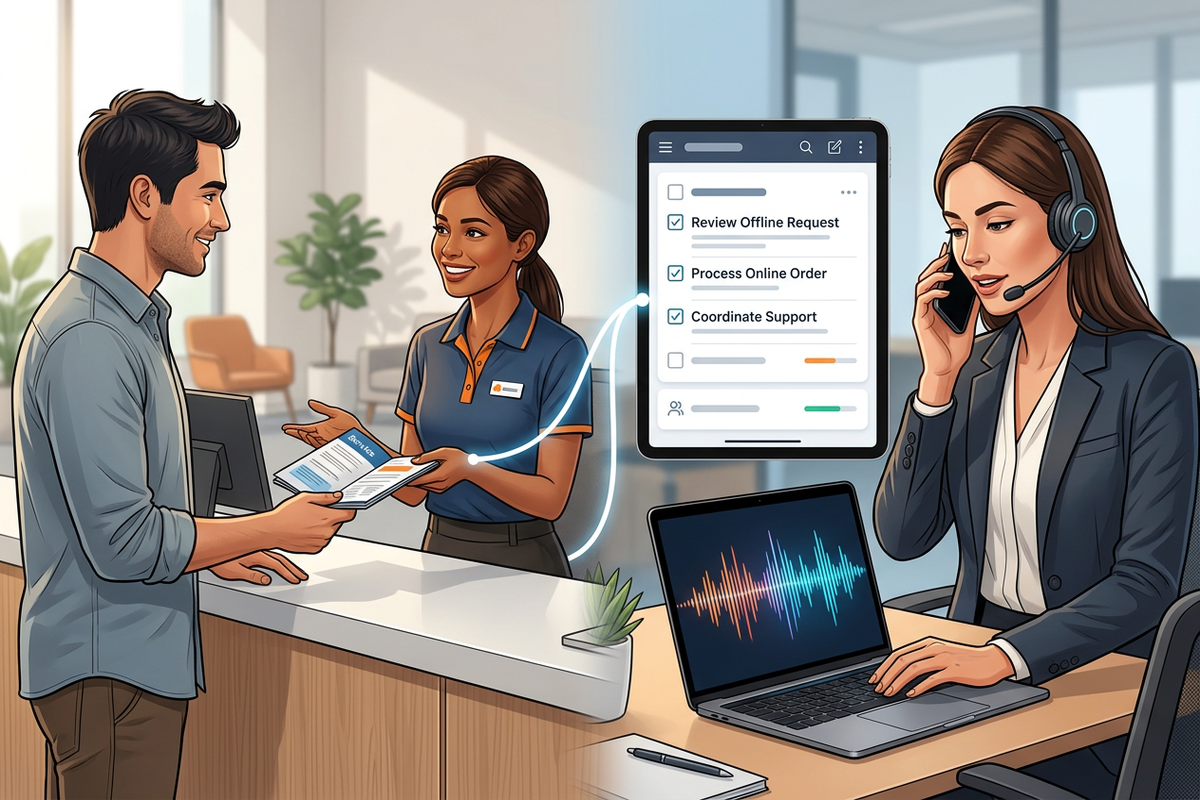
This is where wearable voice capture becomes practical, not sci-fi. With a small in-clinic device like MIC05 capturing key frontline conversations (with appropriate consent and policy), the clinic can turn “we said we’d do it” into trackable follow-up tasks. MIC05 hears the offline, Telalive catches the online, AI turns voice into business actions.
💡 Mid-article self-check: Where does your business lose trust when nobody’s “doing anything wrong”?
Is it the third ring? The forgotten callback? The vague promise at the counter? Write down one “trust leak” you could make visible this week.
3) The “What to Do”: A Practical Framework for Choosing AI You Can Trust
When SMB owners ask me, “Which AI should I buy?” I try to reframe it: you’re not buying intelligence — you’re buying reliability under pressure. Like choosing a refrigerator for a restaurant, you don’t start with the color. You start with: does it hold temperature on the hottest day?
Use this five-step filter. It’s designed for non-technical owners, but it maps to what researchers call human-centered reliability: predictable behavior, legible state, and safe recovery.
- Demand a paper trail: If an AI talks to customers, you need transcripts, summaries, and timestamps—so you can diagnose issues and train your team.
- Design the handoff: Define when AI must escalate to a human (pricing exceptions, angry customers, medical/legal sensitivity) so the customer never feels trapped.
- Turn conversations into tasks: A “nice chat” doesn’t pay rent. The output should be bookings, quotes, follow-ups, and reminders—assigned to a person.
- Measure one trust metric weekly: Pick one: missed calls, response time, no-show rate, quote-to-book rate. Trust becomes manageable when it becomes countable.
- Unify online + offline voice: Calls are only half the story. If your counter or service bay is where promises are made, capture that too (with consent) so follow-through is systematic.
Back to Sam’s auto shop: a setup like Telalive can handle the inbound call surge, generate a quote request task, and send Sam a clean summary after the bay work is safe. Add a wearable like MIC05 for the service advisor’s in-person conversations, and suddenly the shop stops relying on memory as its CRM.
- Analogy #1 (physical world): Think of voice AI like a shop’s “air compressor.” It’s not the craft, but when it’s reliable, every tool works better.
- Analogy #2 (customer experience): Think of trust like tire pressure—small leaks don’t look dramatic, but they reduce performance every mile until something fails.
4) The Zoom-Out: AI Should Reduce Cognitive Debt, Not Create It
Here’s the philosophical anchor I keep coming back to as a founder and as a wearable/AI researcher: small businesses run on human attention. Attention is finite. Every interruption is a tax. Every forgotten detail is a form of “cognitive debt” that compounds into stress, mistakes, and churn.
The best AI doesn’t feel like a new app. It feels like removing sand from a gear. The gear was always strong — it was just grinding itself down.
“A good system makes the right action the default action. Trust is what happens when defaults protect people—especially on busy days.”
This is also why the current public debate about AI “risk” matters to SMBs. When institutions argue about supply chains and designations, they’re really arguing about one thing: who is accountable when systems fail?
In your business, accountability is simpler: it’s you. So choose AI that makes accountability easier—through visibility, logs, and clean handoffs—not harder.
A week later, Sam tries a new routine. He stops treating the phone like a grenade. Calls get answered consistently, quote requests become tasks, and the end-of-day feels less like detective work. The bays are still full—but now the front door doesn’t silently lock itself during rush hour.
Ready to Stop Missing Calls?
If your busiest moments are when customers can’t reach you, Telalive can answer every call, summarize it to your phone, and turn it into follow-up tasks—so trust compounds instead of leaking away.
Starting at $29.9/month. No contracts.